
The European Space Agency’s Rosetta mission conducted an extensive study of the nucleus and chemical composition of Comet 67P/Churyumov-Gerasimenko. Observations from the spacecraft provided researchers with data on the organic materials and gases associated with the comet, which scientists use to investigate the building blocks of the Solar System and the origins of life.
Investigating the Composition of Comet 67P
The Rosetta mission was designed as a comet chaser to unlock the mysteries of the oldest building blocks of our Solar System. According to the European Space Agency, the mission’s primary objectives were to characterize the comet’s nucleus and examine the chemical, mineralogical, and isotopic composition of its volatiles and organic materials. By studying the gas and dust surrounding the nucleus, scientists have been able to gain insights into the environment where the comet was formed.

The Rosetta orbiter, launched in March 2004, reached Comet 67P in August 2014 after a decade-long journey. The spacecraft carried 11 scientific instruments, including the ROSINA (Rosetta Orbiter Spectrometer for Ion and Neutral Analysis) mass spectrometer, led by Kathrin Altwegg of the University of Bern. ROSINA data revealed that the comet’s water vapor possessed a significantly higher deuterium-to-hydrogen ratio—approximately three times that of Earth’s oceans—than what is typically found in terrestrial water. This measurement, published in Science, challenged the long-held hypothesis that comets like 67P were the primary source of Earth’s water supply.
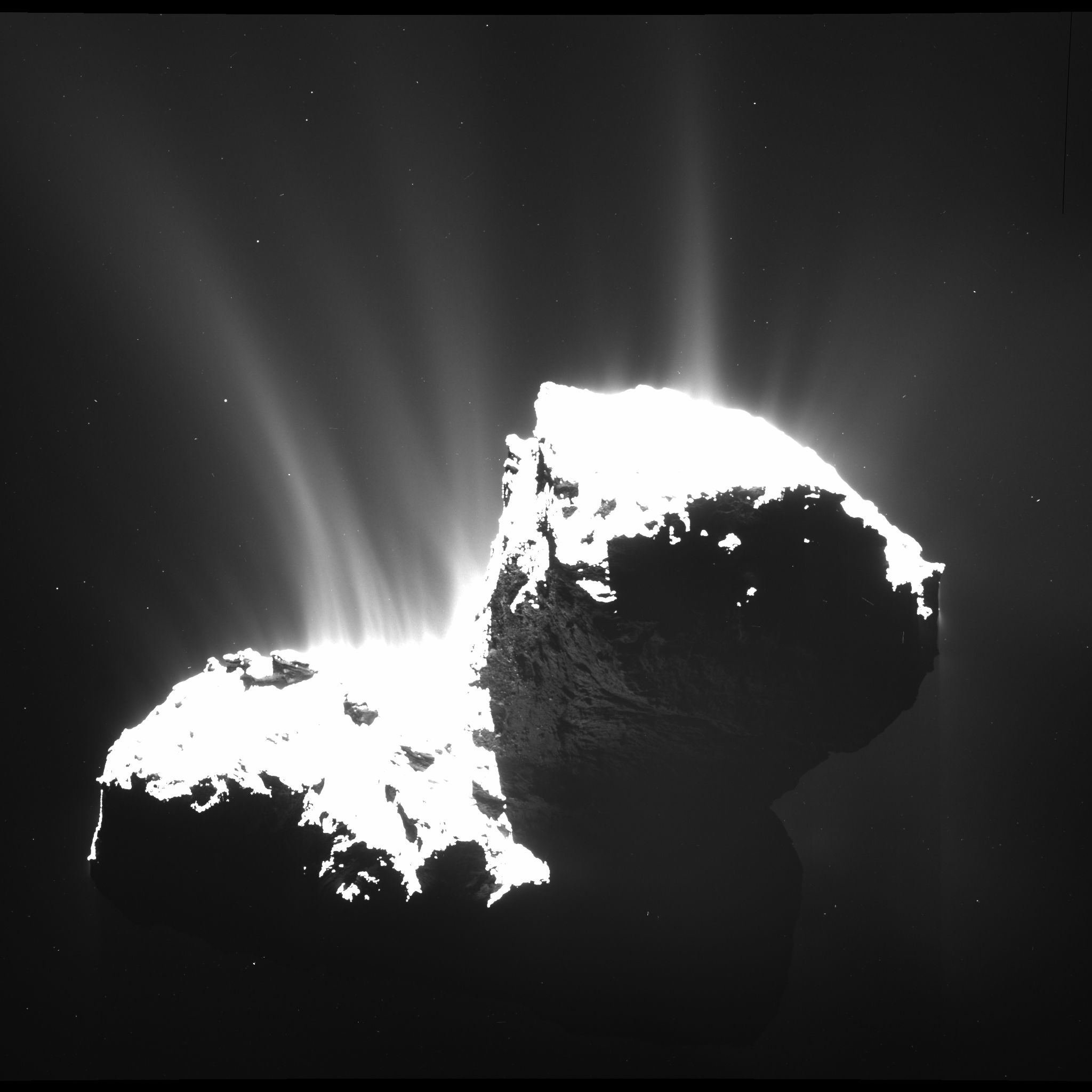
The spacecraft utilized both remote and in situ instruments to analyze the comet. These observations shed light on the complex makeup of Comet 67P/Churyumov-Gerasimenko, revealing a mixture of materials that suggest the composition of its birthplace. Because comets are considered remnants from the early days of the Solar System, analyzing their chemical signatures allows researchers to better understand the conditions present during the formation of planets and the potential delivery of life-supporting compounds to Earth.
Using the COSIMA (Cometary Secondary Ion Mass Analyzer) instrument, researchers identified high-molecular-weight organic matter in dust particles. The data indicated that these organics were not simple molecules but complex, carbon-rich compounds similar to those found in carbonaceous chondrite meteorites. Martin Hilchenbach, the principal investigator for COSIMA at the Max Planck Institute for Solar System Research, reported that these particles were brittle and porous, suggesting they were formed through the aggregation of smaller, interstellar grains rather than through high-temperature processing in the early solar nebula.
Challenges in Sampling and Analysis
The complexity of operating in the environment of a comet presented significant technical challenges for the mission team. As noted in recent reports regarding the mission’s history, scientists were initially reluctant to deploy the drill—an instrument designed to extract samples for chemical analysis—alongside other moving parts. There was a concern that the mechanical actions of these instruments could interfere with the mission or damage the spacecraft, given the delicate nature of the comet’s structure.
The Philae lander, which separated from the orbiter on November 12, 2014, experienced severe landing complications due to the failure of its anchoring harpoons and cold gas thruster. The lander bounced twice before coming to rest in a shadowed, rocky region known as Abydos. Stephan Ulamec, the Philae project manager at the German Aerospace Center (DLR), confirmed that the lander’s Drill, Sample and Distribution (SD2) system struggled to penetrate the surface, which was found to be significantly harder than expected. Measurements from the MUPUS (Multi-Purpose Sensors for Surface and Subsurface Science) instrument showed that the surface hardness reached values equivalent to solid ice, preventing the drill from successfully delivering a sample to the onboard Ptolemy and COSAC gas chromatographs during the initial descent.
Despite these operational hurdles, the data gathered by Rosetta remains a cornerstone of comet exploration. The European Space Agency continues to feature Rosetta in its science and exploration resources, highlighting its role in informing the public and the media on discoveries related to the search for life and the history of the Solar System.
The Broader Context of ESA Science
As of June 2, 2026, the European Space Agency continues to operate a diverse fleet of science missions. While Rosetta provided a deep look into cometary science, the agency’s current focus spans from studying interstellar objects—such as the recent observation of methane on Comet 3I/ATLAS by the Webb telescope—to monitoring black holes and solar phenomena.

The Webb telescope’s NIRSpec instrument detected distinct methane signatures in the coma of 3I/ATLAS, a discovery that researchers at the Space Telescope Science Institute (STScI) contrast with Rosetta’s findings. While 67P showed a high abundance of carbon monoxide and carbon dioxide, the detection of methane in 3I/ATLAS provides a new benchmark for chemical diversity in Oort Cloud objects. These observations are integrated into the ESA’s Planetary Science Archive (PSA), which holds the entirety of the Rosetta mission data, now accessible for comparative studies with current missions.
The agency maintains a unified approach to space exploration through its coordination of financial and intellectual resources among its 20 Member States. This collaborative framework enables the execution of complex, long-duration missions that would be beyond the scope of any single nation. The agency’s ongoing work in space science, which includes missions like Euclid, BepiColombo, and the upcoming Comet Interceptor, continues to build upon the foundational knowledge established by previous explorers like Rosetta.
The Comet Interceptor mission, a collaboration between ESA and the Japan Aerospace Exploration Agency (JAXA), is specifically designed to address limitations encountered by Rosetta. Unlike Rosetta, which targeted a short-period, evolved comet, Comet Interceptor will utilize a multi-spacecraft architecture to perform a high-speed flyby of a long-period comet or an interstellar object entering the inner Solar System for the first time. This approach, coordinated by mission lead Geraint Jones of University College London, aims to characterize pristine, un-processed material that has never been exposed to significant solar radiation, providing a direct test of the chemical models developed from the Rosetta 67P dataset.
As the agency looks toward future missions, including the 2029 launch of the Comet Interceptor, the legacy of the Rosetta mission serves as a primary reference for understanding how humanity can interact with and study these pristine remnants of the early Solar System. The data collected by the orbiter remains available for scientific study, continuing to provide insights into the volatile chemistry that defines these cosmic wanderers.
