Continued Volcanic Activity Signals Persistent Geological Risks Across Multiple Regions
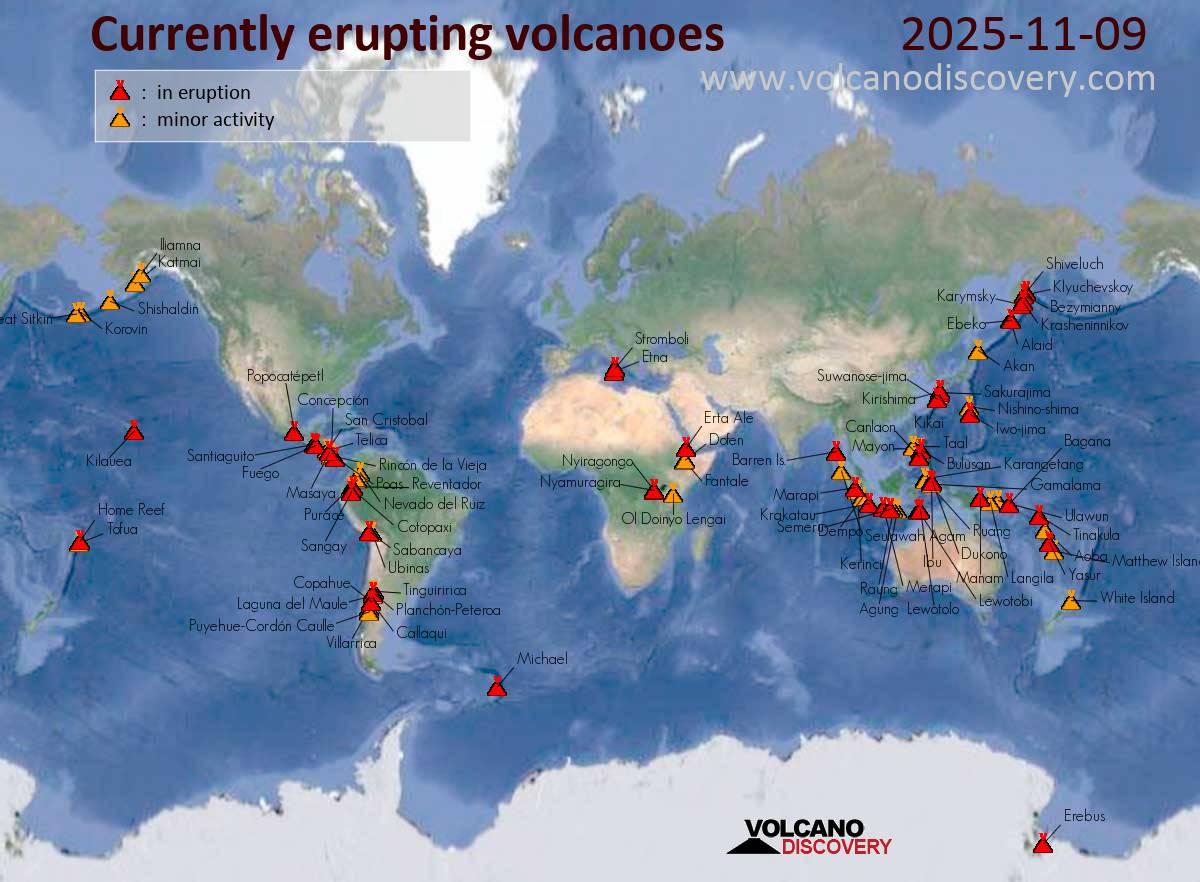
As of November 9, 2025, several volcanoes around the world continue to exhibit significant eruptive and seismic activity, underscoring ongoing geological volatility with pronounced implications for regional safety, aviation, and environmental stability. Verified reports from Volcanic Ash Advisory Centers (VAAC) and scientific monitoring institutions confirm eruptions and ash emissions from key stratovolcanoes in Russia, Indonesia, Central America, and South America.
On Russia’s Kamchatka Peninsula, Krasheninnikov volcano persists in its explosive behavior, emitting ash plumes reaching approximately 9,000 feet altitude traveling southeast. This activity, monitored by the Tokyo VAAC, reflects the region’s volatile tectonics within the Pacific “Ring of Fire,” where shifting subduction zones continually generate volcanic unrest. Continued ash dispersal poses hazards to local air traffic and surrounding communities dependent on accurate monitoring and aviation warnings.
Indonesia’s volcanic landscape remains highly active, with simultaneous eruptions reported at Ibu and Semeru volcanoes on Halmahera and East Java islands, respectively. The Darwin VAAC has issued advisories confirming ash emissions that may disrupt regional air traffic and complicate local disaster preparedness efforts. Indonesia, located at the convergence of several tectonic plates, has the highest frequency of volcanic activity globally, making such alerts critical for international commercial flight safety and domestic risk management.
Central America’s persistent volcanic threats are observable at Guatemala’s Fuego and Santiaguito volcanoes. Both continue explosive activity emitting ash clouds reaching altitudes of 15,000 to 16,000 feet. The Washington VAAC closely monitors these eruptions due to their potential to impact air routes across North and Central America, while also heightening risks to densely populated areas surrounding these volcanoes. Eruptions of this scale historically result in ash fall and pyroclastic flows, exacerbating humanitarian vulnerabilities and requiring sustained local emergency responses.
Further south, Mexico’s Popocatépetl volcano remains active with ongoing explosions ejecting volcanic ash to nearly 19,000 feet height. Given its proximity to Mexico City, one of the world’s largest metropolitan areas, this activity holds significant implications for public health, aviation corridors, and regional infrastructure. Mexican authorities maintain high alert levels, coordinating airspace restrictions and civil protection measures to mitigate ash fallout effects.
South America’s volcanic dynamics are similarly volatile. Notably, Planchón-Peteroa straddling the border of Chile and Argentina continues eruptive episodes with ash plumes rising to around 15,000 feet altitude and drifting southward. This activity is closely tracked by the Buenos Aires VAAC and impacts southern cone airspace. Ecuador’s Sangay and Reventador volcanoes also exhibit intermittent ash emissions, posing recurring risks to local communities and aviation safety in the Andean region.
Broader Implications for Aviation, Climate, and Geopolitical Stability
The collective volcanic activity presents multifaceted challenges beyond immediate local impacts. Volcanic ash clouds disrupt transcontinental and regional air traffic, necessitating rapid responses from international aviation bodies such as the International Civil Aviation Organization (ICAO). Airlines must adapt flight routes to avoid hazardous conditions, elevating operational costs and complicating global air travel schedules. Furthermore, fine volcanic ash has significant environmental consequences, potentially affecting climate patterns by injecting aerosols into the atmosphere, contributing to cooling effects or altered precipitation.
These geological events demand coordinated international monitoring and scientific collaboration. Institutions like the Smithsonian Institution’s Global Volcanism Program and the U.S. Geological Survey provide comprehensive surveillance and timely public updates, while international bodies regularly review protocols to enhance disaster resilience. According to Reuters, such volcanic activities often prompt cross-border exchanges on disaster preparedness, particularly in regions where multiple countries share volcanic belts or airspace.
Regionally, sustained volcanic unrest can impact economic sectors reliant on agriculture, tourism, and infrastructure, especially in developing nations where eruption-induced displacement threatens livelihoods and exacerbates humanitarian needs. Emergency responses are complicated by concurrent hazards such as earthquakes and landslides, common in volcanic regions. Policy frameworks under the United Nations Office for Disaster Risk Reduction (UNDRR) increasingly emphasize integrating volcanic risk into national resilience strategies to minimize socio-economic disruptions.
Current Monitoring and Forewarning Status
Monitoring efforts indicate no immediate escalation to catastrophic volcanic events, but persistent alert levels underscore that risks remain significant. For instance, Kamchatka’s Krasheninnikov and Guatemala’s Fuego volcanoes continue to exhibit eruptive behavior without signs of reduction. Meanwhile, lava flows and ash emissions have been documented at several other volcanoes worldwide, including Papua New Guinea’s Bagana, Italy’s Etna, and Papua’s Dukono. The U.S. Geological Survey’s Hawaiian Volcano Observatory reported stable conditions at Mauna Loa, with only increased seismicity within background norms, indicating recovery phases post-eruption.
Experts note a stable trend in the annual number of erupting volcanoes worldwide, generally averaging 40 to 50 ongoing eruptions—consistent with historical data, as detailed by the Smithsonian Institution’s Global Volcanism Program. While global volcanic activity has not increased significantly over time, the cumulative impact of events demands vigilance, especially amid rising population densities near volcanoes and increasing air travel volume.
Volcanic Activity in Iceland and Other Noteworthy Regions
Iceland remains a focal point for volcanic observation due to its location on the Mid-Atlantic Ridge. The Sundhnúkagígar Crater Row near Grindavík continues eruptive episodes since late 2023, demonstrating persistent fissure activity with implications for European air routes. Icelandic authorities effectively leverage advanced seismic and geophysical monitoring systems to predict hazards, minimizing surprises and enabling timely civil defense initiatives. The broader Reykjanes Peninsula exhibits geothermal unrest consistent with ongoing tectonic processes shaping the region.
Awareness of volcanic threats worldwide is essential for global security, economic stability, and environmental health. Sustained international cooperation on volcanic risk monitoring, alongside improved communication with aviation and local authorities, remains vital to safeguarding lives and mitigating disruptions caused by these natural hazards.
