PM Modi inaugurates SEMICON India 2026 in New Delhi
Prime Minister Narendra Modi launched SEMICON India 2026 at the Yashobhoomi Convention Centre in New Delhi, featuring over 600 exhibitors from 52 countries.
- Headline Dispatch: PM Modi inaugurates SEMICON India 2026 in New Delhi
- Core Takeaway: Prime Minister Narendra Modi launched SEMICON India 2026 at the Yashobhoomi Convention Centre in New Delhi, featuring over 600 exhibitors from 52 countries.
- Source Synthesis: Continuous live monitoring aggregated across major news wires and independent bureaus.
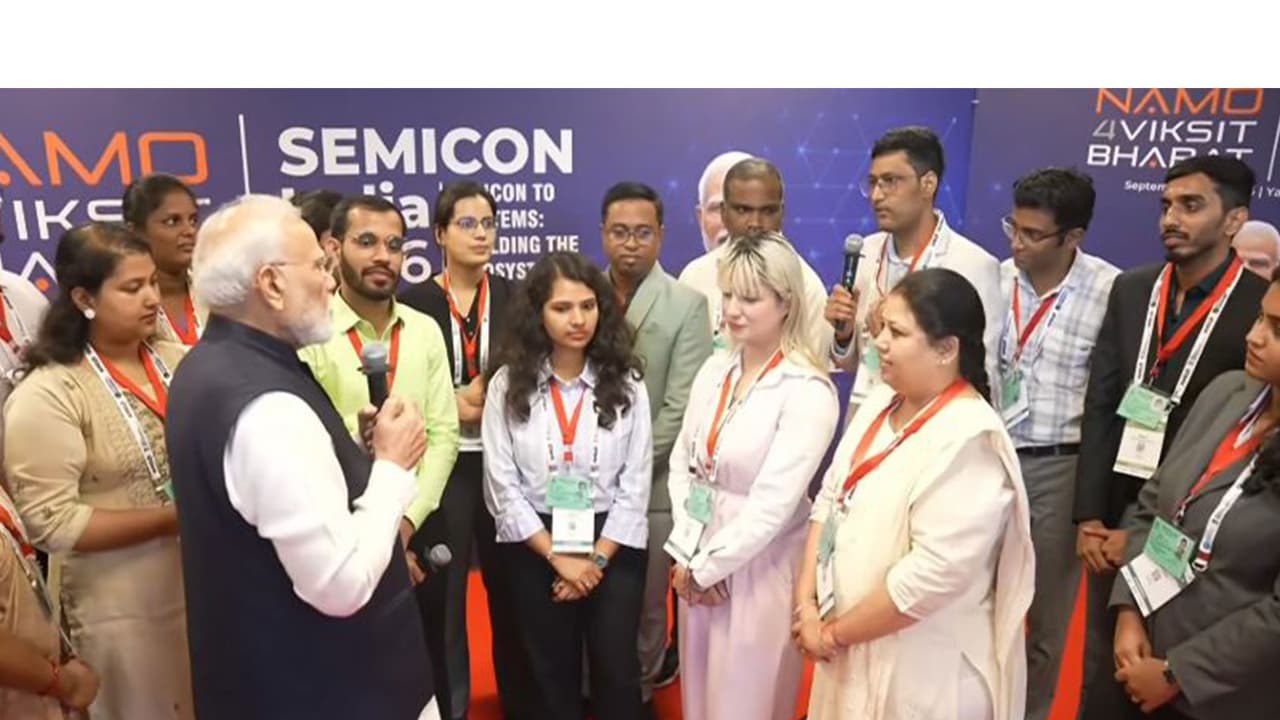
Prime Minister Narendra Modi on Thursday visited the exhibition floor and interacted with participants before officially inaugurating SEMICON India 2026 at the Yashobhoomi Convention Centre in New Delhi. The opening session briefly transitioned into a celebration as attendees and delegates erupted in applause and birthday greetings for Modi, who turned 76 on Thursday. Modi smiled, acknowledged the gathering with folded hands, and thanked participants before delivering his formal address.
Organised jointly by the India Semiconductor Mission (ISM), the Ministry of Electronics and Information Technology (MeitY), and global industry body SEMI, the three-day conference runs from September 17 to 19. The event operates under the central theme "Silicon to Systems: Building the Ecosystem," drawing global and domestic enterprises, policymakers, investors, researchers, startups, academic institutions, and students.
Scale and International Participation
The convention spans an exhibition area of 15,000 square metres, gathering over 600 exhibitors—including approximately 300 international firms—representing 52 countries. More than 150 speakers are participating in panel discussions addressing policy direction, industry engagement, international partnerships, and the complex challenges facing the global semiconductor industry.
The exhibition floor highlights diverse segments through six designated country pavilions and 12 state government pavilions. The six participating country delegations hail from Japan, South Korea, Malaysia, the Netherlands, Singapore, and Sweden. Specialized platforms inside the venue focus on startups, student hackathons, innovation demonstrations, workforce development, and women in the semiconductor industry.
| Exhibition Metric | Detail / Count |
|---|---|
| Exhibition Area | 15,000 square metres |
| Total Exhibitors | Over 600 exhibitors |
| International Firms | Around 300 companies |
| Participating Countries | 52 countries |
| Featured Speakers | More than 150 speakers |
| Country Pavilions | 6 countries (Japan, South Korea, Malaysia, Netherlands, Singapore, Sweden) |
| State Pavilions | 12 state government pavilions |
Policy Milestones and Financial Commitments
During the inaugural proceedings, major financial commitments and strategic roadmaps were unveiled. Prabhu Raja, president of the Semiconductor Products Group at Applied Materials, announced a $5 billion investment plan for India spanning the next decade. Termed Applied Materials India Vision 2035, the initiative is designed to accelerate and integrate India's domestic semiconductor ecosystem into the broader global value chain.
The conference also provided an official review of manufacturing milestones under national support frameworks. According to MeitY, the Union government has approved 12 semiconductor projects under the Semicon India Programme, with three approved units under Semicon 1.0 already having commenced commercial production. Building on this momentum, the Union Cabinet has approved the next phase, designated as Semicon 2.0, which is structured around six core pillars.
Addressing the delegates, Electronics and IT Minister Ashwini Vaishnaw announced that India will target the development of one lakh additional semiconductor engineers under the second phase of the national chip program. Furthermore, electronic design automation tools have been extended to more than 400 academic institutions and 105 startups, while 24 startups have secured official approvals under the Design Linked Incentive scheme.
Industry Collaboration and Value-Chain Integration
SEMICON India 2026 will adopt a comprehensive value-chain approach, showcasing the journey from semiconductor materials and manufacturing to advanced packaging, design, electronics and systems. The newly introduced "Sand to Silicon to Systems" Value Chain Experience offers visitors an integrated view of India's expanding capabilities across every tier of production.
Strategic roundtables and exhibitions feature key global and domestic enterprises, including ASML, Applied Materials, Teradyne, Infineon, Ebara, Jabil, IBM Research, NXP, Tata Electronics, Micron, Merck KGaA, Rapidus, Lam Research, CG Power, Uno Minda, Advantest, and Tokyo Electron.
Wayne Allan, Chief Strategic Sourcing and Procurement Officer at ASML, emphasized the necessity of collective action during the discussions.
"India is home to long-established packaging companies and major global R&D and design centers. Turning this potential into sustainable success will require more than individual investments. It will require supportive and predictable government policies, continued workforce development, world-class infrastructure, and innovation in both technology and manufacturing processes. Above all, it will require long-term strategic partnerships, as many of my colleagues have already mentioned earlier, among companies, government, and academia to develop the semiconductor ecosystem. Government, industry, universities, research institutes, customers, and suppliers each hold part of the answer. Collaboration that brings these strengths together will help accelerate innovation, build technological expertise, and develop a resilient local supply chain. No single company or institution can build a future-proof semiconductor ecosystem alone. India's opportunity also extends beyond chip manufacturing."
Wayne Allan, Chief Strategic Sourcing and Procurement Officer, ASML
Prime Minister Modi pointed to global supply chain vulnerabilities during his address, asserting that the semiconductor industry faces numerous challenges and that the world is in dire need of new and reliable manufacturing hubs. Highlighting broader national metrics, Modi noted that India recently recorded a quarterly GDP growth rate of 7.8% amidst a challenging global economic climate.
Next Steps
SEMICON India 2026 continues through September 19 at the Yashobhoomi Convention Centre. The remainder of the three-day program will feature ongoing stakeholder discussions, startup pitch competitions, student hackathons, and bilateral meetings aimed at solidifying technology collaborations and supply-chain linkages.
How significant is this development?
Participate in our community survey on the trajectory and real-world impact of this news.


