DR Congo battles out-of-control Bundibugyo Ebola outbreak
Public health officials in the Democratic Republic of the Congo are battling an exponential surge of the Bundibugyo Ebola strain amid resource shortages and violence.
- Headline Dispatch: DR Congo battles out-of-control Bundibugyo Ebola outbreak
- Core Takeaway: Public health officials in the Democratic Republic of the Congo are battling an exponential surge of the Bundibugyo Ebola strain amid resource shortages and violence.
- Source Synthesis: Continuous live monitoring aggregated across major news wires and independent bureaus.

DR Congo battles out-of-control Bundibugyo Ebola outbreak
Public health officials in the Democratic Republic of the Congo are struggling to contain an out-of-control outbreak of the Bundibugyo strain of Ebola in the eastern province of Ituri. The virus, which health officials believe circulated undetected for up to three months, is spreading at an exponential speed
according to Dr. Richard Lokudi, director of the main hospital in Mongbwalu.
The World Health Organization (WHO) identified more than 1,000 suspected cases and more than 230 suspected deaths. Seven confirmed cases have also been reported in neighboring Uganda. In May, the WHO declared the situation a Public Health Emergency of International Concern after the virus spread through the mining town of Mongbwalu, Bunia, and Rwampara.
A Silent and Deadly Strain
The Bundibugyo strain presents unique challenges for medical teams. While generally considered less deadly than other strains, it lacks an approved vaccine. John Katabuka, head of Bunia General Hospital, noted that the virus often moves silently
through the body, with symptoms appearing only at the final stage of the illness.
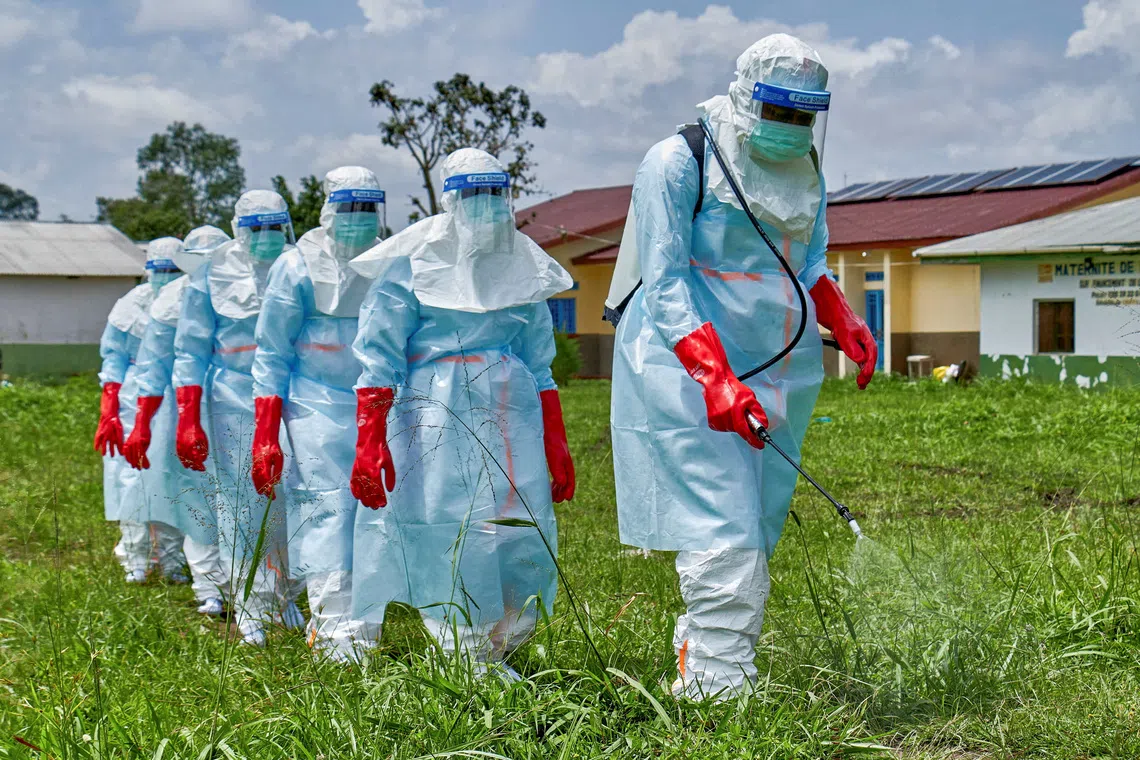
Medical facilities are struggling to keep pace with the surge. The Ebola treatment centre at Bunia General Hospital was full at its 50-patient capacity, prompting the construction of an additional 86 beds. However, clinicians report critical shortages of masks and protective clothing.
Dr. Richard Kojan, president of the Alliance for International Medical Action, warned that a lack of laboratory testing capacity in the region is hindering the response. Because patients must wait days for results, some symptomatic individuals have left isolation prematurely. Dr. Lokudi reported that seven suspected patients recently escaped
from Mongbwalu Hospital, creating multiple chains and chains of contamination
.
Mistrust and Violence
The medical response is being hampered by deep community mistrust and rumors. Some residents deny the existence of the virus, while others claim outsiders brought the disease to profit from the crisis. This skepticism has escalated into violence against health workers and facilities.
In mid-May, angry relatives and friends set fire to isolation tents in Rwampara after being prevented from taking the body of a young man for burial. Because Ebola is transmitted through bodily fluids, safe burials are essential, but these procedures often clash with local traditions. Richard Lifungula, a Red Cross volunteer who has buried more than two dozen people, said responders are often met by hostile crowds at cemeteries.
The safety of volunteers is a critical concern. Alex Lock of the International Federation of Red Cross and Red Crescent Societies reported that two volunteers were injured three weeks ago and required evacuation to Kinshasa.
Complexities of Containment
The outbreak is coinciding with a humanitarian crisis. Diedonne Mwamba, head of the National Institute of Public Health, stated that more than 1.3 million people are currently living in displacement camps due to years of conflict. This makes contact tracing difficult, as officials must negotiate safe access to remote or unstable areas.
Jeremy Konyndyk, president of Refugees International, described the transmission levels as explosive
and suggested the 1,000 suspected cases may be an undercount by a factor of two or three. He attributed part of the delayed response to cuts in U.S. Humanitarian aid, claiming the absence of USAID and a weakened CDC slowed the world's awareness of the crisis.
A White House official dismissed these claims as ridiculous
, arguing that foreign assistance programs are tied to national interests and that the U.S. Continues to save more lives than any other country.
The Path Forward
Efforts to curb the virus now rely heavily on survivors, who are unlikely to be reinfected. Some, such as Gladys Munguromo, have become campaigners visiting villages to warn that staying home while sick leads to death.
Yap Boum of the Africa CDC, working with the Congolese Ministry of Health, said that while laboratory and surveillance capacities have improved, cases and deaths continue to rise. The current strategy focuses on fast-tracking decentralization, deploying more health workers, and expanding treatment capacity to stem the spread.
How significant is this development?
Participate in our community survey on the trajectory and real-world impact of this news.