Scientists Realize Stable "Boron Graphene" and Uncover Quantum Liquid Crystal State
Researchers have developed a stable two-dimensional boron system, revealing a quantum liquid crystal state that could drive energy-efficient electronics.
- Headline Dispatch: Scientists Realize Stable "Boron Graphene" and Uncover Quantum Liquid Crystal State
- Core Takeaway: Researchers have developed a stable two-dimensional boron system, revealing a quantum liquid crystal state that could drive energy-efficient electronics.
- Source Synthesis: Continuous live monitoring aggregated across major news wires and independent bureaus.
Scientists Realize Stable "Boron Graphene" and Uncover Quantum Liquid Crystal State
Researchers at Tohoku University have developed a stable version of "boron graphene," a material long sought after for its potential to drive high-temperature superconductors and energy-efficient electronics. The team achieved this by accessing a naturally occurring boron layer within a three-dimensional crystal, bypassing the instability that has historically prevented the manufacture of free-standing boron sheets.
The findings, published in Science Advances on July 2, 2026, reveal a new quantum state where electrons behave similarly to molecules in a liquid crystal display. This state, known as an "electronic nematic state," emerges from the specific electronic structure of the material.
For years, scientists have focused on borophene, which consists of a two-dimensional sheet of boron atoms. While borophene's strong electron interactions promise exotic quantum phenomena not found in graphene, its ideal honeycomb structure is extremely unstable. To solve this, Takafumi Sato and his colleagues at the Advanced Institute for Materials Research (WPI-AIMR) looked inside a stable three-dimensional crystal called LaRh3B2.
"We demonstrated a fundamentally new way of creating two-dimensional quantum materials,"
Takafumi Sato, WPI-AIMR, via Tohoku University
By exposing the honeycomb boron layers already present within the LaRh3B2 crystal at its surface, the researchers created a stable two-dimensional electronic system. Sato noted that rather than struggling to synthesize a fragile sheet from scratch, the team utilized the existing lattice within the 3D crystal to unlock new quantum phenomena.
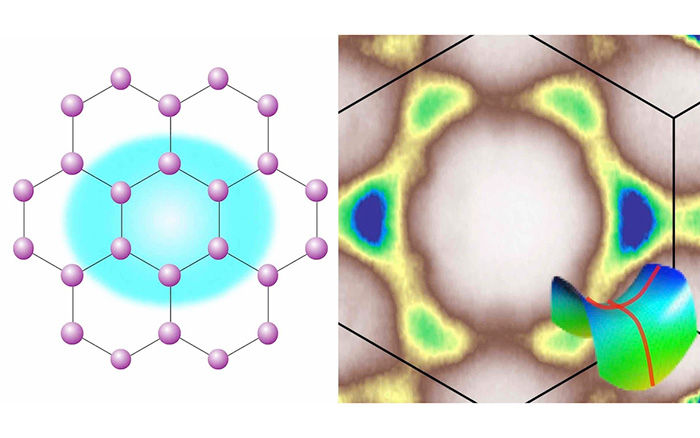
To understand the behavior of the electrons, the researchers employed two distinct imaging techniques. First, they used angle-resolved photoemission spectroscopy (ARPES) at synchrotron radiation facilities. This momentum-space imaging identified a "hot spot" known as a van Hove singularity—an unusually high concentration of electrons near the material's Fermi level. This singularity strengthens interactions between electrons, which can trigger unusual quantum behavior.
The team then used scanning tunneling microscopy and spectroscopy (STM/STS) to observe the electrons in real space. These measurements showed that the electrons spontaneously aligned in one preferred direction. This alignment broke the crystal's original six-fold symmetry, transforming it into a two-fold symmetric state. This is the characteristic of the electronic nematic state, where the spatial distribution of electronic states becomes elongated along a horizontal direction.
"Neither technique alone could have revealed the full picture,"
Kosuke Nakayama, assistant professor at Graduate School of Science, via Tohoku University
According to Nakayama, the synergy between ARPES and STM was essential to connect the electronic instability with the emergence of the nematic state. The ARPES data provided the momentum-space information, while the STM provided the real-space observations of the symmetry-breaking pattern.
The discovery is considered a platform for further innovation because the crystal family used in the study allows for the substitution of many of its chemical elements. This allows researchers to adjust the behavior and number of electrons within the material.
The research was a collaborative effort involving a wide team of authors, including Takemi Kato, Tomonori Nakamura, Takumi Osumi, Seigo Souma, Asuka Honma, Alexandre Antezak, Pedro Rezende Gonçalves, Kiyohisa Tanaka, Miho Kitamura, Kenichi Ozawa, Koji Horiba, Hiroshi Kumigashira, Takashi Takahashi, Franck Fortuna, Andrés Felipe Santander-Syro, Rikio Settai, Yoshichika Onuki, and Yoshinori Okada.
The flexibility provided by the LaRh3B2 crystal family may accelerate the development of energy-saving quantum technologies and next-generation superconductors.
How significant is this development?
Participate in our community survey on the trajectory and real-world impact of this news.