US and China moon base plans could drive Earth-based design breakthroughs
The geopolitical race to establish permanent lunar outposts is accelerating breakthroughs in engineering and psychology that could transform life on Earth.
- Headline Dispatch: US and China moon base plans could drive Earth-based design breakthroughs
- Core Takeaway: The geopolitical race to establish permanent lunar outposts is accelerating breakthroughs in engineering and psychology that could transform life on Earth.
- Source Synthesis: Continuous live monitoring aggregated across major news wires and independent bureaus.
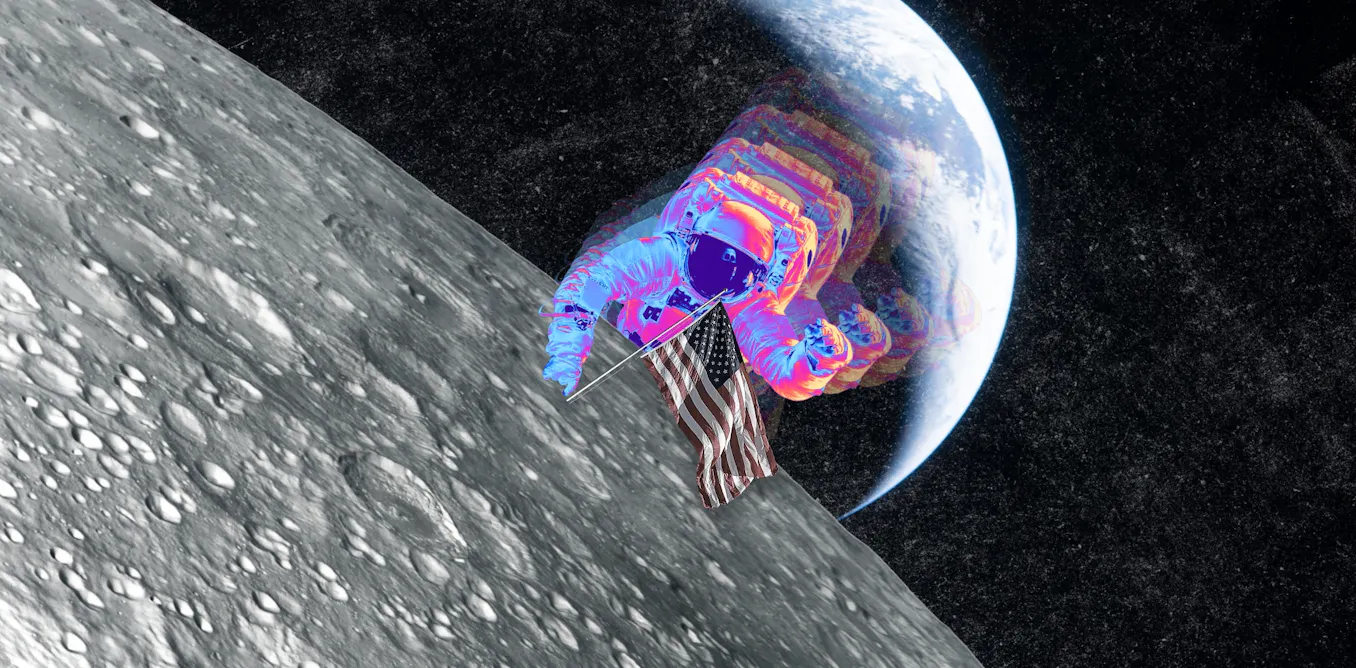
US and China moon base plans could drive Earth-based design breakthroughs
A renewed geopolitical race between the United States and China to establish permanent lunar outposts is accelerating the development of technologies that could transform construction, medicine, and psychology on Earth. While the political competition centers on prestige and technical standards, the engineering requirements for surviving the lunar environment are forcing breakthroughs in circular design and human wellness.
NASA’s Artemis program, supported by 67 countries, aims to return humans to the Moon by 2028. A White House Executive Order has further directed the agency to establish a permanent lunar outpost by 2030. This timeline is driven by a competitive push to beat China, whose lunar program chief designer, Wu Weiren, stated that the Chinese people will definitely be able to set foot on the moon
by 2030.
Engineering for the Lunar Extreme
Designing for the Moon requires overcoming a near-perfect vacuum, unfiltered radiation, and temperature swings ranging from below -200°C to over +120°C. These conditions place severe thermal stress on materials, causing them to expand and contract repeatedly. Furthermore, the lunar surface is covered in regolith — razor-sharp dust capable of destroying machinery and cutting through astronaut suits.
Traditional construction methods are hindered by the cost of transporting materials from Earth and the threat of micrometeorites, which strike at speeds up to 72 kilometres per second. While some current solutions involve 3D printing monolithic shells from local regolith, researchers are developing modular block-based construction. This approach, supported by NASA-funded RETHi facilities at the University of Texas at San Antonio, allows human-robot teams to easily disassemble and repair damaged sections.
This focus on repairability has direct implications for Earth's environmental crisis. The construction industry currently accounts for roughly 30% of carbon dioxide emissions and waste, as well as about half of all global material extraction, largely because buildings are demolished rather than maintained. The principles of human-robot collaboration and repair being developed for the Moon offer a model for circular construction on Earth.
Human Experience at the Edges
Beyond structural engineering, lunar architecture is exploring the psychological and physical toll of extreme isolation. Research into confined spaces — conditions mirrored in submarines, Antarctic stations, and mining outposts, shows that people often experience distorted time, which leads to reduced social satisfaction and higher stress.
To combat this, design psychologists are testing the impact of small environmental details on emotional wellbeing. These include:
- Adjustable lighting tailored to personal rhythms.
- The provision of private retreat spaces.
- Incorporating windows with views.
Such findings could improve living conditions for people in remote communities, polar research bases, or prisons. Similarly, biomechanics research conducted via gravity-offload experiments is studying how the arms, shoulders, and torso stabilize the body as gravity changes. These insights are being used to design safer stairs and handrails for lunar habitats, which could later help older populations on Earth climb stairs more safely and avoid falls.
The Logistics of the Lunar South Pole
Both the U.S. And China are targeting the lunar south pole. This region is highly valued because permanently shadowed craters may contain water ice. This ice can be processed into drinking water, breathable oxygen, and rocket fuel, making it a critical resource for missions extending to Mars.
NASA has planned a $20 billion moon base to be built in three phases. To prepare, the agency is relying heavily on private industry. In 2026, NASA plans three uncrewed missions, including the launch of a Blue Moon lunar lander from Blue Origin to target the Shackleton Connecting Ridge. Other 2026 launches include Astrobotic’s Griffin lander, which will carry a rover, and Intuitive Machines’ third Nova-C lander.
To facilitate surface movement, NASA awarded contracts totaling about $220 million each to Astrolab and Lunar Outpost to build lunar terrain vehicles. These rovers vary in capability: Astrolab's vehicle has a 2,000-pound weight limit and a top speed of 6 mph, while Lunar Outpost's "Pegasus" rover is lighter and travels about 3 mph faster. a $75 million contract was awarded to Firefly Aerospace to transport four drones, part of the "Moonfall" mission, to survey landing sites in 2028.
Strategic and Political Risks
The urgency of the mission is reflected in the leadership of NASA Administrator Jared Isaacman, who stated that the difference between success and failure will be measured in months, not years
. However, some experts, including Casey Dreier of the Planetary Society, question if the 2028 target is realistic, suggesting it is driven by the desire for the achievement to occur during President Trump's second term.
There are also concerns regarding the reliance on private billionaires like Jeff Bezos and Elon Musk. Because NASA is utilizing commercial landers, such as SpaceX's Starship and Blue Origin's Blue Moon Mark 2, the agency is dependent on entities it does not fully control. Analysts also warn that if China establishes a more consistent presence, they may set the global technical standards and data formats for space travel.
The next immediate milestone for the program will occur on June 9, when NASA is scheduled to announce the four astronauts selected for the Artemis III mission.
How significant is this development?
Participate in our community survey on the trajectory and real-world impact of this news.