US and China compete for strategic water ice at lunar south pole
The United States and China are competing to establish permanent lunar bases, targeting water ice deposits that could serve as a critical fuel source.
- Headline Dispatch: US and China compete for strategic water ice at lunar south pole
- Core Takeaway: The United States and China are competing to establish permanent lunar bases, targeting water ice deposits that could serve as a critical fuel source.
- Source Synthesis: Continuous live monitoring aggregated across major news wires and independent bureaus.
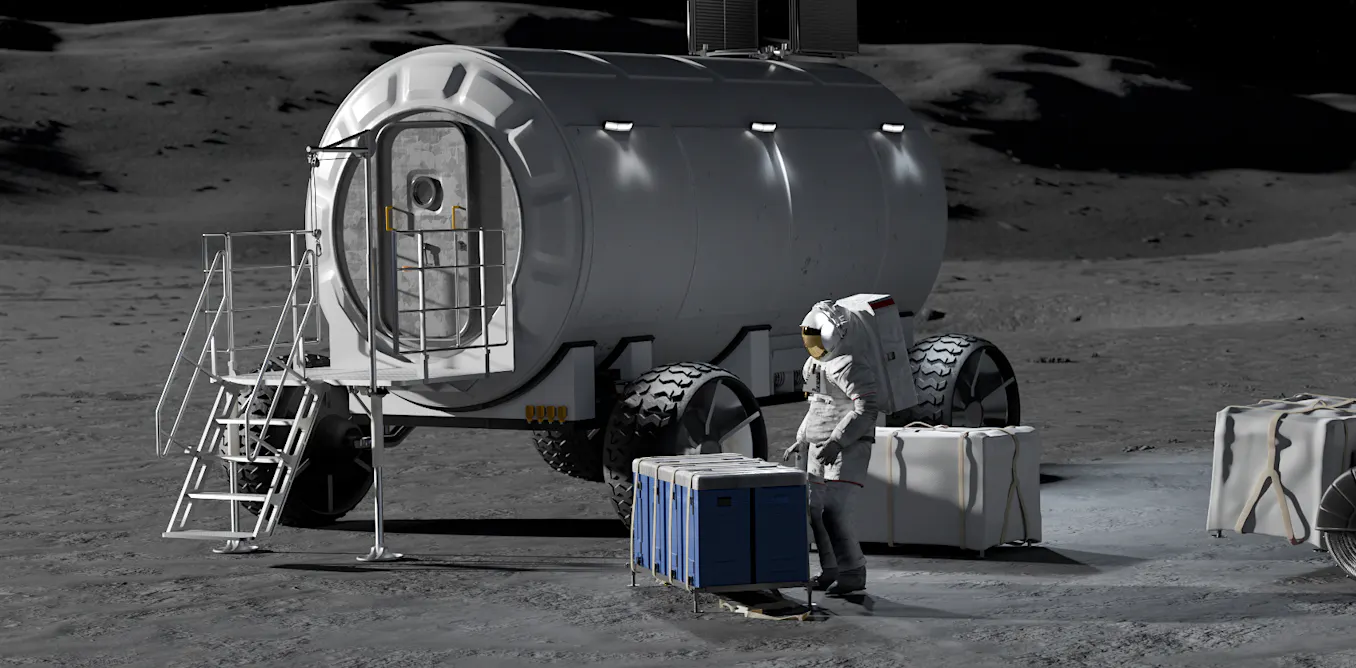
US and China compete for strategic water ice at lunar south pole
The United States and China are engaged in a strategic race to establish a permanent human presence on the Moon, focusing their ambitions on the lunar south pole. Unlike the Apollo missions of the 20th century, which focused on short sorties and symbolic footprints, this 21st-century contest is a "marathon" aimed at sustainable habitation and resource extraction.
The primary driver of this competition is the discovery of water ice within permanently shadowed craters at the south pole. Because these areas are extreme cold and never see sunlight, they have trapped water for billions of years. This ice is viewed as a critical strategic asset: it can provide drinking water and breathable oxygen for crews, and through electrolysis, it can be split into hydrogen and oxygen to create rocket fuel. Establishing such a capability would effectively create a gas station in the sky
, drastically reducing the cost of deep space exploration by eliminating the need to launch all fuel from Earth.
Competing Timelines and Infrastructure
Washington and Beijing are operating on tightening timetables to reach the surface. NASA is currently pursuing an accelerated plan to land Americans on the Moon by early 2028. This goal is driven in part by political urgency, with NASA chief Jared Isaacman stating that the agency intends to return Americans to the surface before the end of President Donald Trump's term. Isaacman noted that the margin between success and failure in this competition will be measured in months, not years
.
China is targeting a crewed landing by 2030. To achieve this, the China Manned Space Agency (CMSA) is accelerating its heavy-lift infrastructure. This includes the Long March 10A rocket, which can lift 14 tons into low Earth orbit (LEO) and is designed to carry astronauts and landing hardware. For the 2030 mission, China plans a dual-launch architecture using the strengthened Long March 10 rocket—capable of lifting 70 tons to LEO and 27 tons to trans-lunar injection—to send the Mengzhou crew capsule and the Lanyue lander.
Both nations are planning long-term bases. China, partnering with Russia and other nations including Nicaragua and Egypt, is planning the International Lunar Research Station (ILRS). Construction of the ILRS is scheduled to begin around 2035.
Private Industry and State Planning
The two superpowers are utilizing fundamentally different operational models:
- United States: NASA relies heavily on public-private partnerships. The agency has outsourced the Human Landing Systems to commercial firms. SpaceX is developing a lunar-optimized Starship for Artemis III and IV, while Blue Origin is building the Blue Moon lander for Artemis V.
- China: Beijing employs a state-directed model with "military-civil fusion," where space activities are deeply integrated with the People’s Liberation Army.
The Risk of a "Land Grab"
Because suitable locations for outposts are finite and ice deposits are unevenly distributed, there are concerns that the race could devolve into a land grab. While the 1967 Outer Space Treaty and the 1979 Moon Agreement prohibit claims of sovereignty, critics argue that vague language creates loopholes.
Next Steps and Pending Milestones
The immediate future contains several critical tests for both programs:
- 2026: China plans to launch the Chang’e-7 probe to the south pole to search for water ice and conduct high-precision surveys. In mid-2026, China also intends to use the Long March 10A to launch navigation satellites.
- Next Year: NASA will conduct a critical test for the Artemis III mission, attempting to dock an Orion capsule with landing craft in low Earth orbit. Blue Origin also plans a test flight for an iteration of its Blue Moon lander later in 2026.
- 2028: The U.S. Targets its first crewed landing of the Artemis program. China plans to launch the Chang’e-8 probe to test in-situ resource utilization.
- 2029-2032: NASA expects to lay down key infrastructure, including power supplies and communications systems, and deploy a Japanese-built pressurized rover.
How significant is this development?
Participate in our community survey on the trajectory and real-world impact of this news.