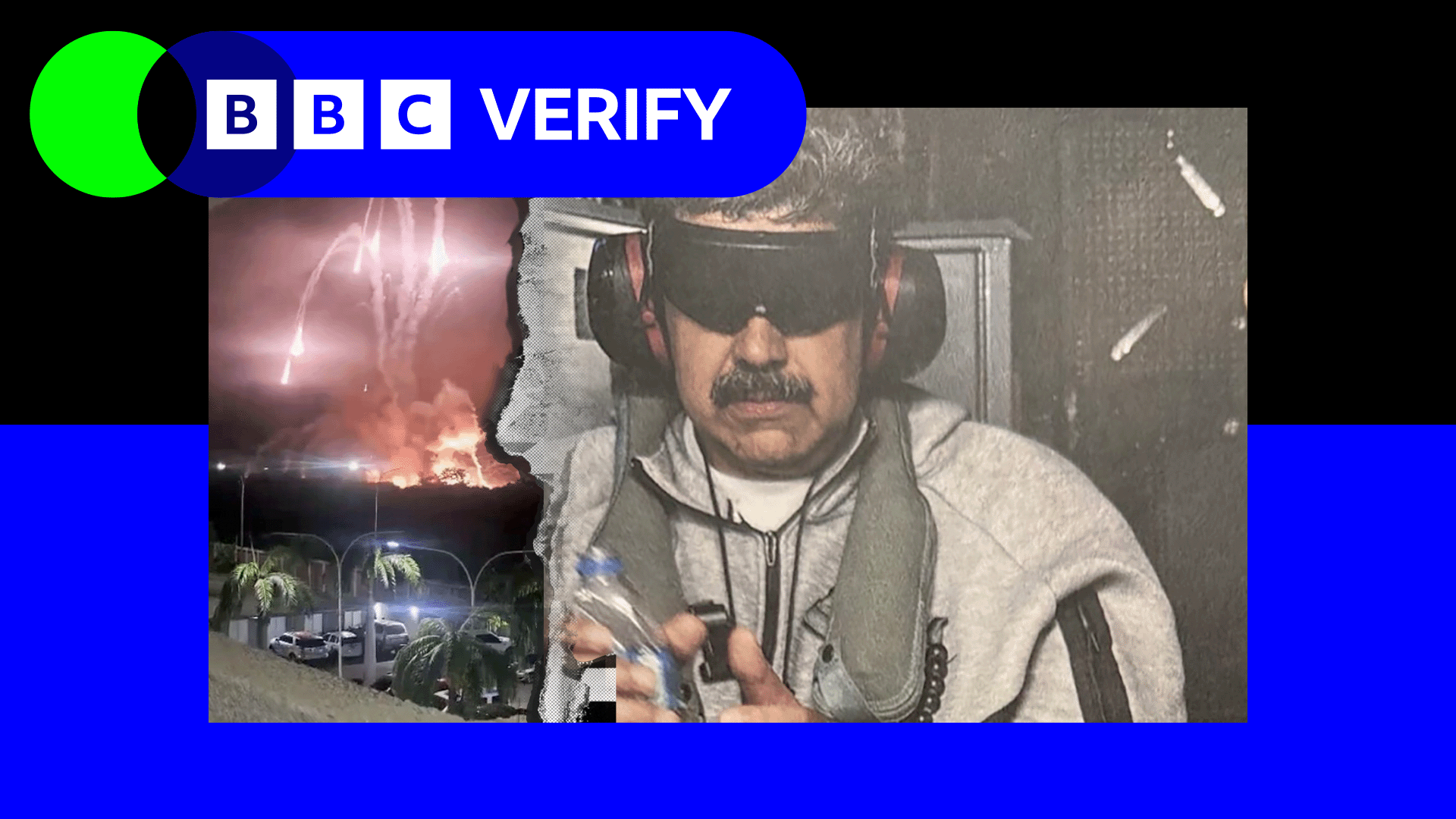
US Bombing Raid Targets Caracas
In the early hours of January 3, 2026, a significant bombing campaign was executed by US forces against multiple targets in Venezuela’s capital, Caracas. The operation commenced around 01:57 local time, with eyewitness accounts describing the scene as harrowing. “The windows on my door shook,” recalled one resident. “I got up to see from my window, thinking something heavy had fallen in my backyard… and immediately I heard the second explosion of what I think was a missile impacting. I could see the reflection of the flames.”
Extent of the Bombardment
Footage verified by BBC shows that strikes occurred at seven locations in and around Caracas, with the bombardment continuing for approximately 30 minutes. Secondary explosions were reported to have persisted until just before 04:00, amplifying local fears. “All of us were scared and distressed,” a young mother shared with the BBC. “We were watching the sky to see if anything was approaching our home.”
US officials confirmed that the operation involved over 150 aircraft, consisting of fighter jets, bombers, and helicopters. Notable hits included military bases in Catia La Mar, La Carlota, and Fuerte Tiuna, along with the coastal Higuerote Airport, which suffered extensive damage.
Casualties and Impacts
Initial reports from Venezuelan officials suggest that at least 100 individuals were killed during the strikes, including military personnel and civilian casualties. Among them was Rosa González, an 80-year-old civilian who died in her apartment when the US strikes blew out the exterior wall of her building near the Caracas airport. Another casualty, a 45-year-old woman, was reported near El Volcán, southeast of Caracas.
US Response to the Operation
In the aftermath, US President Donald Trump appeared alongside military leaders at his Mar-a-Lago resort, describing the military campaign as a significant achievement. He noted that cutting electricity to the city facilitated the assault, underscoring the strategic planning behind the operation.
The strikes took place under a full moon, as US military tactics typically favor operations in complete darkness. NR Jetzen Jones, director of a private intelligence company, emphasized that the timing likely corresponded with operational factors rather than optimal stealth conditions. “It strongly suggests that the timing of the raid was dictated by other factors, most likely access to the target,” he noted.
Political Context and Background
The raid comes amid heightened tensions between the US and the Maduro administration, following months of military posturing and threats. Venezuelan security forces had been under increasing scrutiny, especially regarding their capabilities to counteract US military actions. Analysts indicated that the bombing was aimed, in part, at neutralizing Venezuela’s air defense systems, despite years of investment in Russian military technology.
As the attack unfolded, President Nicolás Maduro was reportedly sheltering with his wife, Cilia Flores, having varied his location for security. A small CIA team had been monitoring Maduro’s movements for months. Following the airstrikes, US troops landed at Fuerte Tiuna around 02:01 and reportedly seized the Venezuelan leader.
International Reactions
The international community’s response has been mixed, with many expressing concern over the ramifications of such aggressive military actions. While some Venezuelans have welcomed the removal of Maduro, they have expressed fear over potential reprisals amid years of governmental repression. “You feel joy because you see the light at the end of the tunnel, that Venezuela will have a change for the better,” one resident remarked. “But not being able to express it or shout it, celebrate… because you can be arrested.”
For updated information on international reactions to the bombing raids in Venezuela, visit Reuters.
