
The Vegas Golden Knights’ Stanley Cup dreams took a brutal hit on Thursday night when defenseman Brayden McNabb was struck in the face by a puck during Game 2 of the Final against the Carolina Hurricanes, leaving him hospitalized and the team scrambling to adjust. The injury came at the 10:52 mark of the first period at the T-Mobile Arena in Las Vegas, where the series remained tied 1-1 after the Golden Knights’ 3-2 overtime loss in Game 1. With the Golden Knights holding a 1-1 series lead, McNabb’s availability for Game 3 on Saturday at 8:00 p.m. ET (10:00 p.m. local time) is now critical, as the team faces elimination with a loss in their home arena.
How It Happened: The Brutal Moment That Changed the Series
The incident occurred when Carolina Hurricanes forward Nikolaj Ehlers unleashed a slap shot from the right circle that struck McNabb square in the face while the defenseman was positioned in front of Golden Knights goaltender Carter Hart. The impact sent McNabb crashing to the ice, prompting an immediate stoppage. According to The New York Times, McNabb was seen covering his nose and mouth with his bare hand as he was helped off the ice. The Golden Knights’ medical staff attended to him on the bench before transporting him to a local hospital for further evaluation, a decision that raised immediate concerns about the severity of his injury.
Footage from the ESPN broadcast showed McNabb wincing in pain as he was escorted off the ice, with his teammates and coaches visibly shaken. The Hurricanes’ bench responded with a mix of reactions—some players appeared concerned, while others maintained composure. The Golden Knights’ bench, however, was visibly upset, with Mark Stone and Noah Hanifin rushing to assist McNabb. The severity of the injury became more apparent when the Golden Knights’ official statement confirmed McNabb would not return to the game and required hospitalization for observation.
In a post-game press conference, Golden Knights head coach John Tortorella declined to provide specific details about McNabb’s condition but emphasized the team’s concern. “We’re obviously very concerned about Brayden,” Tortorella said. “He’s a huge part of this team, not just as a player but as a leader. We’ll take it game by game and see how he recovers.” The coach added that the team’s medical staff was monitoring McNabb closely and would make no decisions about his availability for Game 3 until they had a clearer assessment.
The Impact: A Leadership Void in the Defensemen’s Lineup
McNabb’s absence created an immediate defensive void for the Golden Knights, who entered Game 2 without their most experienced defenseman. McNabb had been a cornerstone of Vegas’ playoff run, recording 33 blocked shots in 17 games this postseason—more than any other Golden Knights defenseman. His physical presence and leadership had been particularly critical in the team’s 3-2 overtime victory in Game 1, where he logged 24:12 of ice time and recorded two assists. Without him, the Golden Knights’ defensive group—comprising Shea Theodore, Rasmus Andersson, Noah Hanifin, Jeremy Lauzon, and Dylan Coghlan—had to adjust quickly.

Shea Theodore, the team’s top defenseman, absorbed the brunt of the workload, logging a team-high 28:30 of ice time in Game 2. Hanifin, who had been limited to 13:32 in Game 1 due to an upper-body injury, stepped up with 24:15 on the ice. Lauzon, who had been sidelined since May 1 with an upper-body injury, played a crucial 21:08 in Game 2, while Andersson and Coghlan also contributed significantly. Despite their efforts, the Golden Knights’ defense struggled to contain Carolina’s offense, particularly in the third period, when the Hurricanes tied the game and eventually won in overtime.
Mark Stone, the Golden Knights’ captain, addressed the impact of McNabb’s injury in a post-game interview. “Brayden is a huge part of this team,” Stone said. “He’s not just a defenseman—he’s a leader. When you lose a guy like that, it changes the dynamic. We’ll do everything we can to step up, but it’s going to be tough without him.” Stone also noted that McNabb’s absence would be felt beyond the ice, as his leadership and experience had been instrumental in the team’s success this season.
Noah Hanifin, who had been McNabb’s frequent defensive partner this postseason, echoed Stone’s sentiment. “Any time you see that happen to a teammate, especially to a guy like ‘Nabber’ who is a huge part of this team, it’s tough,” Hanifin said. “But we’re not going to let it define us. We’ll figure it out, one game at a time.” Hanifin added that the team’s resilience would be tested in the coming days, particularly as they prepared for Game 3.
What Comes Next: The Race Against Time for Game 3
The Golden Knights now face a critical 48-hour window to determine McNabb’s availability for Game 3, which will be played at the T-Mobile Arena in Las Vegas. The team’s medical staff will assess McNabb’s facial injury, which may include potential concussion protocols or other restrictions. If McNabb is cleared to play, the Golden Knights will have a fighting chance to regain their momentum. If not, they will need to rely on their remaining defensemen to hold off the Hurricanes, who are playing with confidence after their Game 2 victory.
For the Hurricanes, the series remains winnable, and their offense—led by players like Ehlers and Sebastian Aho—has been relentless. Carolina’s goaltending, particularly from Frederik Andersen, has also been stellar, allowing just two goals in the first two games of the series. The Golden Knights’ ability to sustain their defensive structure without McNabb will be the key factor in determining whether they can close out the series in their home arena.
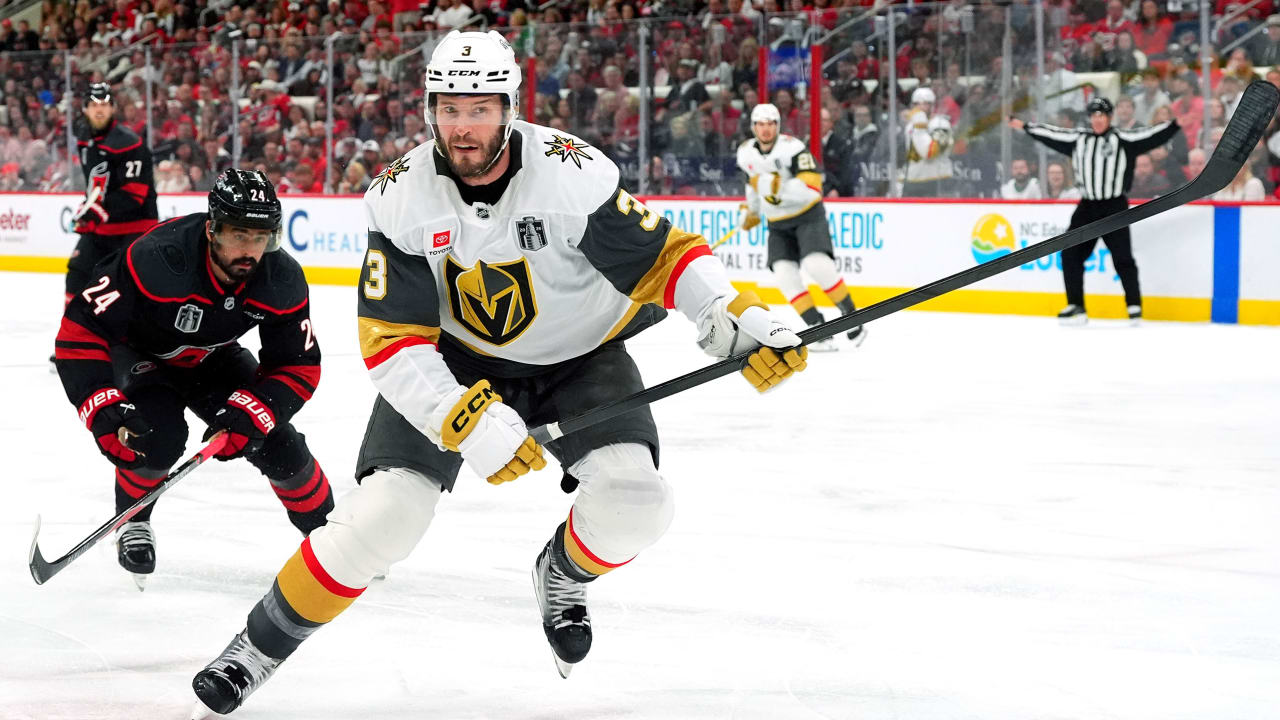
The stakes could not be higher for the Golden Knights. A win in Game 3 would put them one step closer to repeating as Stanley Cup champions, a feat that would cement their place in NHL history. However, without McNabb, their path to victory becomes significantly more difficult. The team’s ability to adapt, both on and off the ice, will be tested in ways that extend beyond the scoreboard.
Golden Knights general manager Kelly McCrimmon addressed the situation in a post-game press conference, emphasizing the team’s commitment to McNabb’s recovery. “Our focus right now is on Brayden,” McCrimmon said. “We’ll make no decisions until we have a full understanding of his condition. But we’re also preparing for Game 3 as if he’s available, because that’s what our team does—they fight.” McCrimmon added that the team’s medical staff was working closely with specialists to ensure McNabb’s safety and recovery.
The Bigger Picture: McNabb’s Legacy and the Golden Knights’ Future
McNabb’s injury is not just a blow to the Golden Knights’ playoff hopes—it also raises questions about his long-term future in the NHL. At 35, McNabb has already established himself as one of the league’s most decorated defensemen, with 1,417 blocked shots and 1,469 hits in his career with Vegas—both franchise records. His ability to stay healthy and effective at this stage of his career has been a testament to his durability. However, facial injuries of this nature often require careful monitoring, and the team will need to weigh the risks of returning him to the lineup too soon.
For the Golden Knights, the stakes could not be higher. A win in Game 3 would put them one step closer to repeating as Stanley Cup champions, a feat that would cement their place in NHL history. But without McNabb, their path to victory becomes significantly more difficult. The team’s ability to adapt, both on and off the ice, will be tested in ways that extend beyond the scoreboard.
As the series enters its most critical juncture, one thing is clear: the Golden Knights’ resilience will be put to the test like never before. Whether McNabb returns for Game 3 or not, the team’s ability to overcome adversity will define their legacy in this postseason—and perhaps in the annals of NHL history.
For now, all eyes are on Las Vegas, where the fate of the Stanley Cup hangs in the balance. The Golden Knights will look to bounce back in Game 3, where they will require more than just determination to overcome the Hurricanes’ momentum. The team’s next move—whether it’s a defensive adjustment, a leadership shift, or a strategic change—will determine whether they can reclaim their advantage and advance toward their second consecutive Stanley Cup.
