A ‘direct wave’ from colliding black holes reveals signature of a whirlpool in spacetime
Researchers have identified a previously hidden component of a gravitational wave signal that provides a direct probe of a black hole's event horizon.
- Headline Dispatch: A ‘direct wave’ from colliding black holes reveals signature of a whirlpool in spacetime
- Core Takeaway: Researchers have identified a previously hidden component of a gravitational wave signal that provides a direct probe of a black hole's event horizon.
- Source Synthesis: Continuous live monitoring aggregated across major news wires and independent bureaus.
A ‘direct wave’ from colliding black holes reveals signature of a whirlpool in spacetime
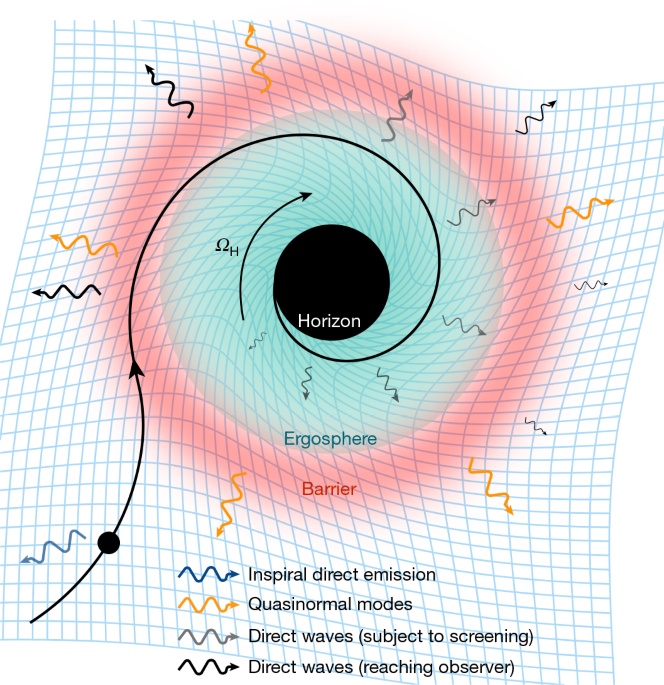
Researchers have identified a previously hidden component of a gravitational wave signal that provides a direct probe of a black hole's event horizon. The discovery, based on the analysis of a massive collision known as GW250114, reveals a direct wave
that carries the signature of spacetime being whirled around a rotating black hole.
Detected on January 14, 2025, by the Laser Interferometer Gravitational-Wave Observatory (LIGO), GW250114 is the clearest gravitational wave signal received to date. The event occurred near the end of the O4b subrun, with nearly identical signals registered just after 08:22:03 UTC by LIGO's Hanford and Livingston detectors. While partner observatories Virgo and KAGRA were not operating at the time, the signal was exceptionally loud, achieving a combined signal-to-noise ratio (SNR) of 80.
The Physics of the Direct Wave
According to theoretical physicist Sizheng Ma of the Perimeter Institute in Canada, the event horizon is a boundary from which nothing, including light, can escape, making it impossible to observe directly via traditional means. However, gravitational waves offer a different pathway.
As two black holes merge and form a single object, the orbital motion becomes dominated by the new remnant. General relativity predicts that a rotating black hole produces frame dragging
, an effect where spacetime itself is dragged around the hole like a whirlpool. This process creates the direct wave: gravitational radiation originating from just outside the event horizon.
This specific wave oscillates at nearly twice the horizon's rotation frequency and decays at a rate determined by surface gravity.
"As everything gets closer to the horizon of a rotating black hole, they are dragged into extremely rapid motion around it. But at the same time, the signal they send to us fades away very quickly because of the black hole's strong gravity,"Sizheng Ma, theoretical physicist, via ScienceAlert.
"So what we see is a final, fast, rapidly dimming swirl near the horizon."Sizheng Ma, theoretical physicist, via ScienceAlert
The evidence for this wave in GW250114 was found with a 90% credible matched-filter signal-to-noise ratio of 15.8 in the Hanford detector and 17.1 in the Livingston detector. These measurements align with theoretical predictions for a Kerr black hole.
Confirming General Relativity
The extreme clarity of GW250114 allowed scientists to test fundamental laws of physics. The signal provided empirical confirmation of Stephen Hawking's 1971 area theorem, which posits that the total surface area of merged black holes must increase or remain the same. In this instance, the two original black holes had a total surface area of about 240,000 square kilometers, while the resulting black hole measured about 400,000 square kilometers.
The collision involved two low-spin black holes with masses of 33.6+1.2−0.8 M☉ and 32.2+0.8−1.3 M☉. The final merged mass was 62.7+1.0−1.1 M☉, with an energy release of 3.1±2.2 M☉c2 and a merged spin of 0.68+0.01−0.01 of the maximum possible spin.
Analysis of the ringdown
—the stage where the new black hole vibrates like a bell—allowed researchers to identify the first overtone of the Kerr solution with a 4.1σ level of significance.
Future Implications
The ability to measure multiple tones in a ringdown allows for independent checks of a black hole's mass and spin. If these measurements agree, general relativity is verified; if they deviate, it could signal new physics.
The discovery of the direct wave establishes a new observational channel to explore the strong-gravity regimes near the horizon, potentially revealing the signatures of quantum gravity.
The findings were corroborated in a September 2025 scientific article. The results will now undergo further testing against other gravitational-wave signals to validate the breakthrough.
How significant is this development?
Participate in our community survey on the trajectory and real-world impact of this news.