Curiosity rover captures close-up images of elemental sulfur crystals on Mars
High-resolution images from the Curiosity rover reveal elemental sulfur crystals found after a rock was accidentally crushed. The discovery adds to a history of chemical analysis in Gale Crater.
- Headline Dispatch: Curiosity rover captures close-up images of elemental sulfur crystals on Mars
- Core Takeaway: High-resolution images from the Curiosity rover reveal elemental sulfur crystals found after a rock was accidentally crushed. The discovery adds to a history of chemical analysis in Gale Crater.
- Source Synthesis: Continuous live monitoring aggregated across major news wires and independent bureaus.
Curiosity rover captures close-up images of elemental sulfur crystals on Mars
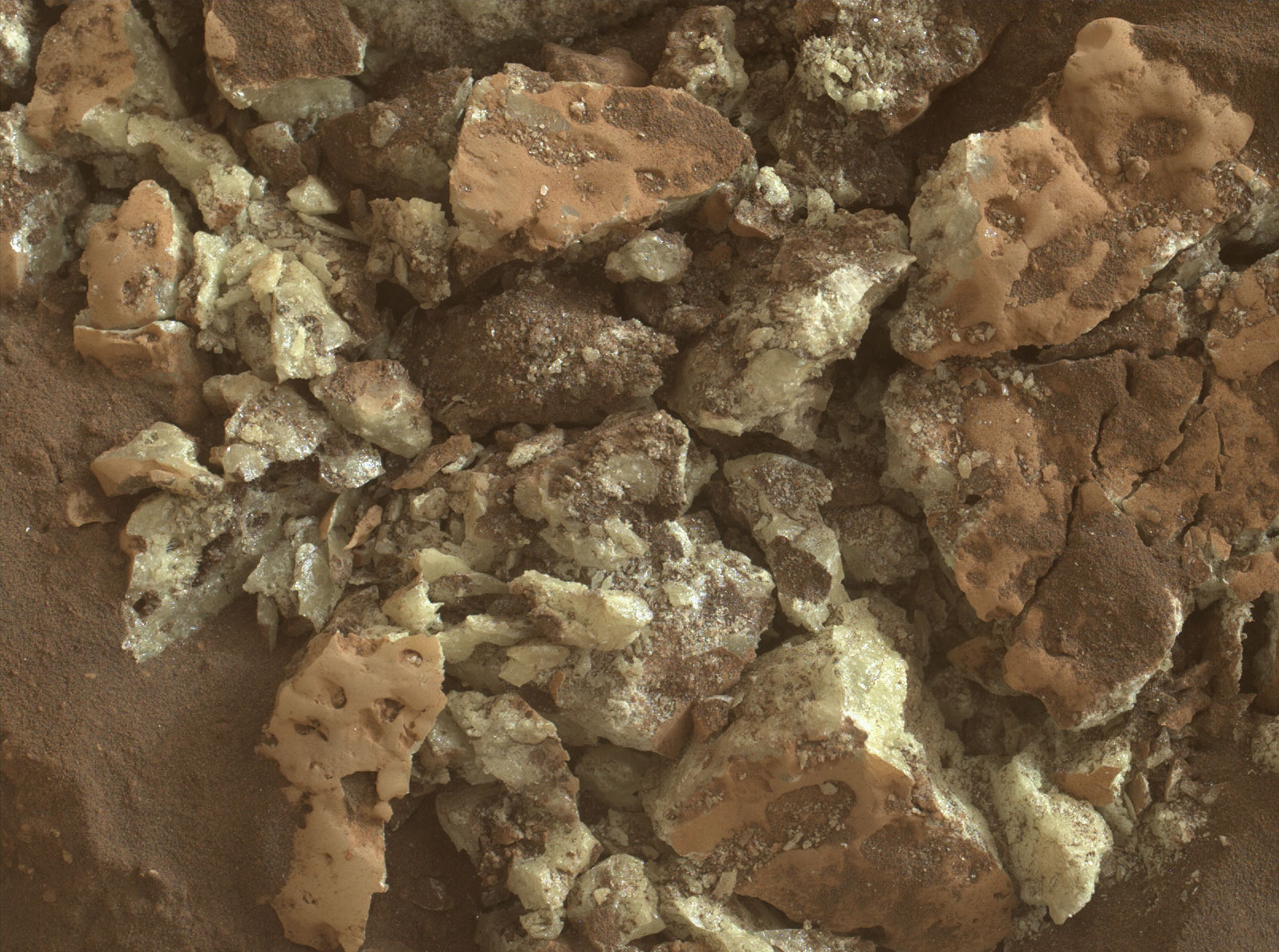
NASA’s Curiosity rover has captured high-resolution images of elemental sulfur crystals discovered inside a Martian rock. The discovery occurred after the rover accidentally crushed the rock on May 30, 2024, which was the 4,200th Martian day, or sol, of the mission.
The rock, which researchers nicknamed Convict Lake
after a site in California’s Sierra Nevada, was imaged on June 4, 2024 (Sol 4,205). The photos were taken by the Mars Hand Lens Imager (MAHLI), a camera located on the end of the rover's robotic arm. Analysis performed by Curiosity’s Alpha Particle X-Ray Spectrometer (APXS) confirmed that the crystalline material is elemental sulfur.
The rover was built by NASA’s Jet Propulsion Laboratory (JPL), managed by Caltech in Pasadena, California. While JPL leads the mission for NASA’s Science Mission Directorate in Washington, the MAHLI camera was constructed by Malin Space Science Systems in San Diego.
A legacy of chemical exploration
This recent find adds to a long history of chemical analysis conducted by the 1-ton rover since it landed in Gale Crater on August 5, 2012. The mission, officially known as the Mars Science Laboratory (MSL), was designed to determine if the Red Planet ever supported microbial life.
During its early operations, Curiosity conducted initial test drives on August 22, 2012 (Sol 16), moving approximately 10 feet forward and turning 90 degrees to the right. Early mission goals included traveling to a site called Glenelg and eventually reaching the base of Mount Sharp, a mountain rising 3.4 miles high from the center of Gale Crater. Scientists targeted Mount Sharp's foothills because orbiting spacecraft had identified evidence of sulfates and clays, suggesting the presence of liquid water in the distant past.
Complex organics and the search for life
The detection of sulfur crystals follows other significant chemical discoveries made by the rover. In a 2020 experiment using a drilled target called Mary Anning 3 in the clay-rich Glen Torridon area, Curiosity used a chemical reagent called tetramethylammonium hydroxide (TMAH) to break down larger organic materials.
This process allowed the Sample Analysis at Mars (SAM) instrument suite to identify a broad mix of organic molecules. Researchers confirmed seven molecules, including naphthalene, methyl benzoate, tetramethylbenzene, trimethylbenzene, dihydronaphthalene, methylnaphthalene, and benzothiophene. The latter is a sulfur-containing molecule that had not been firmly confirmed on Mars previously.
The analysis also revealed a signal, designated as peak 22, that matched a nitrogen-bearing molecule similar to dimethyl-indole. While the team did not make a firm identification because the retention time did not perfectly align with lab comparisons, such nitrogen-containing ring structures are central to nucleic acids.
"We think we're looking at organic matter that's been preserved on Mars for 3.5 billion years,"
Amy Williams, geological sciences professor at the University of Florida, via The Brighter Side of News
Williams noted that while this does not prove life once existed, it demonstrates that ancient organic matter can be preserved, which helps scientists assess the habitability of the environment.
Technical challenges and future missions
The search for organics has not been without difficulty. During its initial checkout in 2012, Curiosity's weather station suffered damage to wind sensors on one of its two booms, likely caused by rocks deposited on the deck during landing. More recently, the TMAH experiment faced "messy" results; some internal standards were lost due to sampling design, and several chemical peaks remain unidentified.
Despite these hurdles, the diversity of one- and two-ring aromatic compounds, oxygen-bearing organics, and sulfur-bearing molecules suggests that Mars has preserved a rich chemical archive in its shallow subsurface.
These findings are now informing the design of future missions. The Rosalind Franklin rover and the Dragonfly mission, destined for Saturn's moon Titan, are both expected to utilize TMAH-based tests to search for organics. However, scientists maintain that a final verdict on whether these chemicals originated from biology, abiotic water-rock reactions, or meteorites will likely require returning rock samples to Earth for analysis with larger instruments.
How significant is this development?
Participate in our community survey on the trajectory and real-world impact of this news.