ESA's Euclid telescope captures most detailed image of Milky Way center
The Euclid space telescope has produced the most detailed visible light photograph of the galactic bulge to date, providing a critical historical reference for future exoplanet research.
- Headline Dispatch: ESA's Euclid telescope captures most detailed image of Milky Way center
- Core Takeaway: The Euclid space telescope has produced the most detailed visible light photograph of the galactic bulge to date, providing a critical historical reference for future exoplanet research.
- Source Synthesis: Continuous live monitoring aggregated across major news wires and independent bureaus.
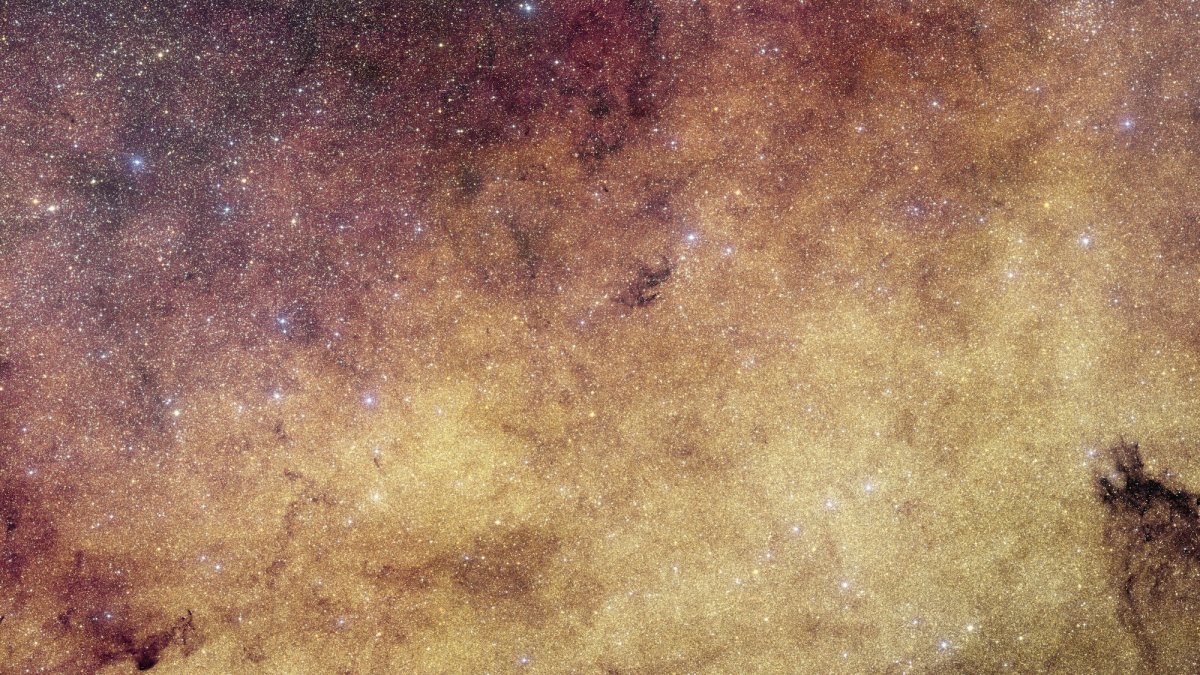
ESA's Euclid telescope captures most detailed image of Milky Way center
The European Space Agency’s Euclid space telescope has produced the largest and most detailed visible light photograph ever made of the Milky Way galaxy’s center. The image focuses on the galactic bulge, a luminous region described by astronomer Jean-Charles Cuillandre as a large bubble containing billions of stars
.
Captured over 26 hours on 23 March 2025, the image contains more than 60 million stars, along with star clusters and nebulas. The final product is a mosaic comprising nine separate pointings from Euclid’s visible light camera, with each individual pointing covering an area of the sky larger than the full Moon. While the original data was captured in black and white, the public release image includes colors added from observations by the ground-based Canada-France-Hawai'i Telescope.
The telescope, which launched in July 2023 and is positioned 1.5 million km from Earth, was primarily designed to study dark matter and dark energy. However, its visible light camera is sensitive enough to distinguish individual stars in the super-crowded bulge without being blinded. According to ESA, Euclid’s sharpness and sensitivity are similar to the wide field camera of the Hubble Space Telescope, but Euclid can image an area 270 times larger than Hubble's field of view in just a few hours. To capture the same mosaic, the Keck Observatory would require approximately 2000 hours.
A tool for exoplanet discovery
Astronomers requested this specific observation to aid the study of exoplanets through a technique called microlensing. This form of gravitational lensing occurs when two stars align from the perspective of an observer; the closer star acts as a magnifying glass, bending and brightening the light of the star behind it. If a planet orbits the nearer star, its gravity creates a tiny, uneven change in that brightness, revealing the planet's presence.
Jean-Philippe Beaulieu of the University of Tasmania and Institut d’Astrophysique de Paris noted that nearly 300 exoplanets have been found using this method over the last 20 years, all via ground-based telescopes. The Euclid image includes 51 known planetary systems. Unlike other hunting methods that favor large, hot planets, microlensing is unbiased and uniquely suited to discover cold exoplanets, such as ice giants similar to Neptune or Uranus.
Because a microlensing event requires more than 20 days of observation to detect the unevenness of light, Euclid’s 24-hour session cannot identify new events. Instead, the data serves as a critical historical reference. Natalia Rektsini of the Institut d’Astrophysique de Paris explained that Euclid has captured the stars involved in all future microlensing events that the Roman space telescope will eventually detect, but before those stars and planets have aligned.
By providing a "time reference in the past," scientists can compare the stars' appearance before they overlapped. This allows them to measure the speed of the stars and determine the precise mass of both known and future planets.
Scientific targets and future missions
Researchers are already applying this data to specific systems. Jean-Philippe Beaulieu, who discovered the icy planet OGLE-2005-BLG-390Lb 20 years ago, stated that Euclid may now allow for the measurement of its precise mass. Similarly, Rektsini noted that combining Euclid data with earlier observations from Hubble and Keck could confirm the mass of the planet in the OGLE-2013-BLG-341Lb system, which consists of two stars and one planet.
Beyond exoplanets, Valeria Pettorino, Euclid Project Scientist at ESA, stated the data will be used to study binary stars, brown dwarfs, stellar motions, and galactic dust. She described the achievement as a result of what a relatively small, dedicated team
could accomplish within the larger international mission.
The mosaic encompasses the entire region that the upcoming Roman space telescope will monitor for planet hunting. NASA is currently preparing for the launch of the Roman Space Telescope in August 2026.
How significant is this development?
Participate in our community survey on the trajectory and real-world impact of this news.