Interstellar comet 3I/ATLAS may be twice as old as the Sun
Analysis of the interstellar comet 3I/ATLAS reveals isotopic ratios suggesting it formed long before the Sun. Scientists used the JWST and VLT to probe its alien chemistry.
- Headline Dispatch: Interstellar comet 3I/ATLAS may be twice as old as the Sun
- Core Takeaway: Analysis of the interstellar comet 3I/ATLAS reveals isotopic ratios suggesting it formed long before the Sun. Scientists used the JWST and VLT to probe its alien chemistry.
- Source Synthesis: Continuous live monitoring aggregated across major news wires and independent bureaus.
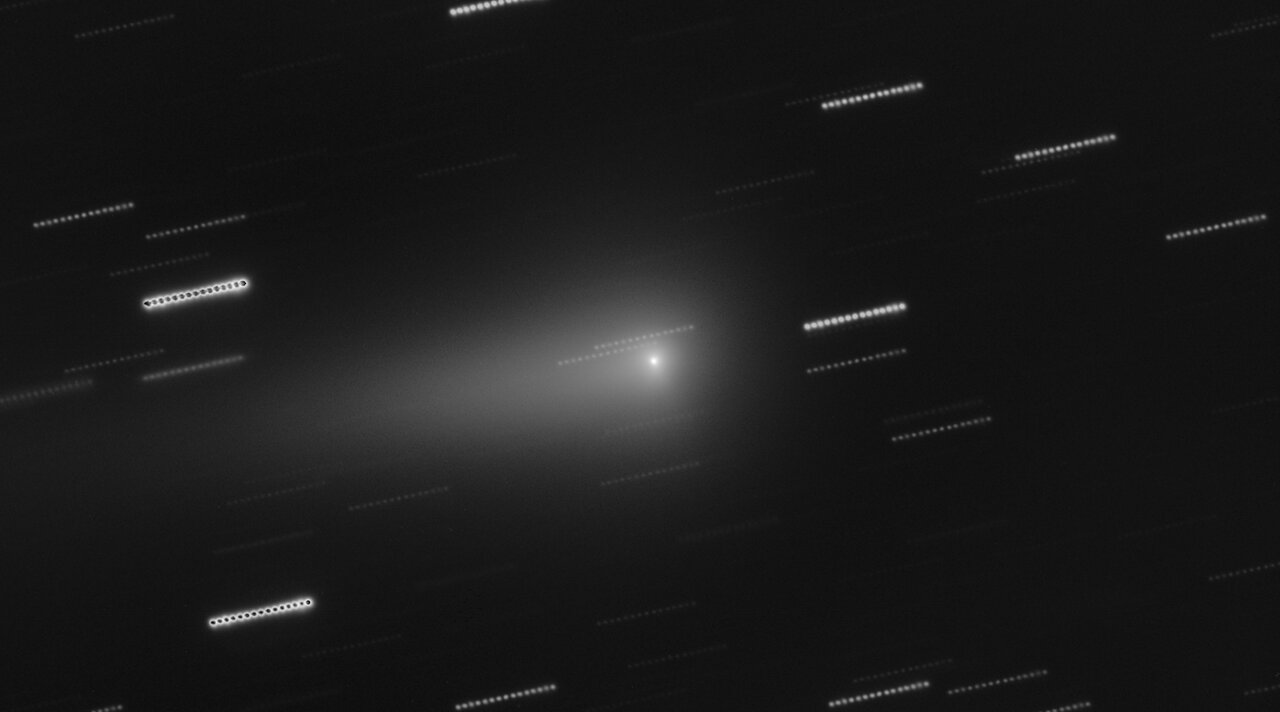
Interstellar comet 3I/ATLAS may be twice as old as the Sun
Astronomers have identified chemical fingerprints on the interstellar comet 3I/ATLAS suggesting it may be more than twice as old as the Sun. The object, the third interstellar visitor ever discovered after 1I/ʻOumuamua and 2I/Borisov, likely originated in the outskirts of an ancient, low-metallicity star system.
The findings result from coordinated observations using NASA’s James Webb Space Telescope (JWST) and the European Southern Observatory’s (ESO) Very Large Telescope (VLT). While previous interstellar objects were too faint or lacked detectable gas to allow for detailed composition analysis, the unprecedented brightness of 3I/ATLAS provided a rare opportunity to measure isotopic ratios—the relative amounts of different forms of the same element.
Ancient Chemical Fingerprints
A study led by Martin Cordiner at the NASA Goddard Space Flight Center, published June 22 in Nature
, used the JWST’s Near-Infrared Spectrograph (NIRSpec) to analyze the comet's gases in December 2025. The instrument detected levels of deuterium, or heavy hydrogen, approximately 30 times higher than those seen in comets from our own solar system. This high concentration implies the comet formed in a very cold system and remained in a deeply frozen state, exposed to radiation but lacking the long-term warmth that would have processed its heavy water ice into standard H2O.
The JWST data also revealed only traces of carbon-13 relative to carbon-12. Because the galaxy accumulates more carbon-13 over time as generations of stars are born and die, the low levels suggest 3I/ATLAS was born long before carbon-13 became abundant. Based on these ratios, researchers estimate the comet could be between 10 and 12 billion years old, placing its origin during the universe’s cosmic noon
, a period when star formation was at its peak.
A complementary study published July 6 in Nature Astronomy
, led by astronomer Cyrielle Opitom of the University of Edinburgh and co-led by Jean Manfroid and Damien Hutsemékers of the University of Liège, used the VLT's UVES instrument to examine carbon and nitrogen isotopes in cyanide molecules. The team found carbon and nitrogen isotopic ratios that were unusually high compared to solar system comets.
The ratio of nitrogen-14 to nitrogen-15 in 3I/ATLAS was found to be more than twice as large as values measured in native solar system comets. According to the researchers, this specific ratio is typical of the outer edges of planet-forming discs around young stars, suggesting the comet formed far from its parent star, possibly in a region equivalent to a Kuiper belt.
Origins and Galactic Context
The combination of these findings points to a parent star with low metallicity, meaning it possessed few elements heavier than helium. Such stars are thought to have formed when the universe was much younger and less chemically rich.
"3I/ATLAS is a really exciting opportunity to probe the composition of another planetary system, one that formed long before our Sun and Solar System even existed,"
Rosemary Dorsey, researcher at the University of Helsinki, via ESO
Additional data from JWST indicated the comet is rich in carbon dioxide and carbon monoxide relative to water, and contains unexpectedly high abundances of iron, nickel, and methanol relative to hydrogen cyanide. These markers suggest a chemistry notably alien to the solar system.
Regarding how the object entered interstellar space, researchers note that while migrating giant planets can eject small bodies, the birth of 3I/ATLAS far from such planetary action suggests it may have been snatched from its parent star by the gravity of a passing star and hurled into deep space.
Scientific Implications
The study of these fossils
of distant planetary formation may provide insight into the conditions necessary for life. Stefanie Milam, a planetary scientist at NASA and co-author of the Cordiner study, stated that analyzing these objects is a major step toward learning how common or uncommon the conditions for the evolution of life are in the universe, noting that Earth is the only known place where chemical ingredients led to life.
As 3I/ATLAS moves away from the Sun and grows fainter, VLT observations are nearing their end. However, astronomers expect the upcoming Extremely Large Telescope (ELT) to enable similar measurements for future interstellar objects, even those that lack the extreme brightness of 3I/ATLAS.
How significant is this development?
Participate in our community survey on the trajectory and real-world impact of this news.