Astronomers find biggest super-puff planets yet that are lighter than cotton candy
Two giant exoplanets with densities lower than cotton candy have been identified. The pair exhibits a rare orbital resonance and the longest ground-observed transits.
- Headline Dispatch: Astronomers find biggest super-puff planets yet that are lighter than cotton candy
- Core Takeaway: Two giant exoplanets with densities lower than cotton candy have been identified. The pair exhibits a rare orbital resonance and the longest ground-observed transits.
- Source Synthesis: Continuous live monitoring aggregated across major news wires and independent bureaus.
Astronomers find biggest super-puff planets yet that are lighter than cotton candy
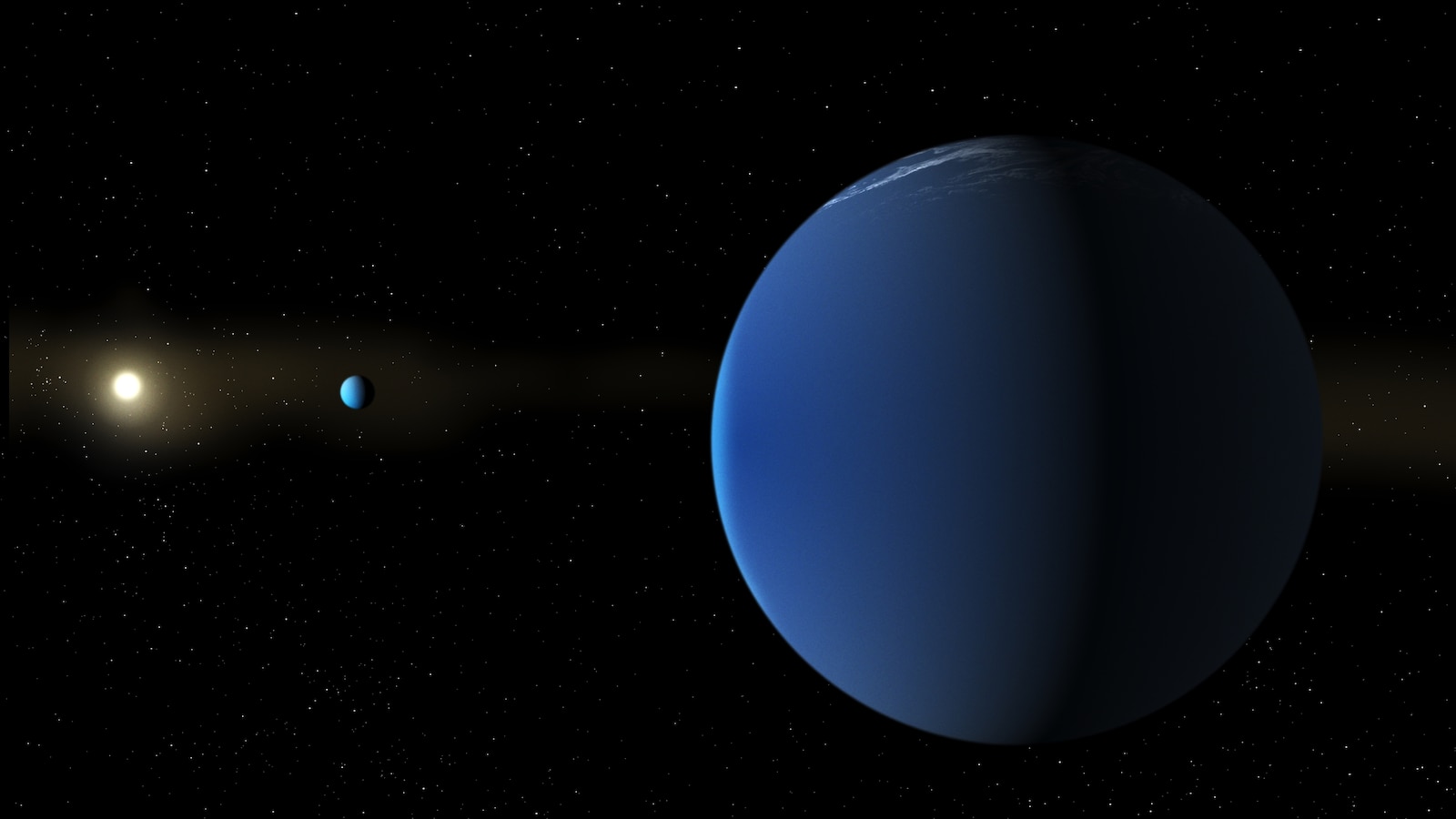
Astronomers have identified two giant exoplanets with densities lower than cotton candy, making them the lightest known planets of their size. The "super-puff" siblings, named TOI-791 b and TOI-791 c, are approximately the size of Jupiter but possess a wispy, featherweight composition.
Orbiting an F7-type dwarf star in the southern constellation Volans, known as the flying fish, the pair is located 1,110 light-years from Earth. According to researchers, a light-year is nearly 6 trillion miles, or 9.7 trillion kilometers.
The discovery was led by George Dransfield of the University of Oxford and an international team including the University of Birmingham and Université Côte d'Azur/Observatoire de la Côte d'Azur. The findings were published June 25, 2026, in Monthly Notices of the Royal Astronomical Society.
Density and Composition
The two planets are remarkably lightweight. TOI-791 b has a density of 0.038 grams per cubic centimeter, while TOI-791 c measures 0.047 grams per cubic centimeter. For comparison, candy floss typically has a density of about 0.05 grams per cubic centimeter, and Earth averages 5.5 grams per cubic centimeter.
Jupiter is significantly denser, averaging 1.33 grams per cubic centimeter. This makes the solar system's largest planet up to 35 times denser than these two lightweights—specifically 35 times denser than TOI-791 b and 28 times denser than TOI-791 c.
"These two planets have densities comparable to a nice blob of shaving foam, fresh from the can,"
George Dransfield, University of Oxford, via email
Dransfield suspects the worlds are likely white or blue, depending on cloud cover, rather than pink. They are believed to be composed primarily of hydrogen and helium.
A Rare Orbital Dance
The planets are locked in a 5:3 mean-motion resonance, a rare orbital arrangement where the inner planet completes five orbits for every three completed by the outer planet. This gravitational relationship causes the planets to pull on one another, creating measurable changes in the timing of their transits across the host star.
The orbits are unusually long, with one planet taking 139 days and the other 232 days to circle the star. Their transits are also exceptionally long, each lasting more than 11 hours. Researchers noted these are the longest continuous planetary transits ever fully observed from the ground.
The Path to Discovery
The identification of the planets began with citizen science. Volunteers with the Planet Hunters TESS project first flagged TOI-791 b in 2019 and TOI-791 c in 2023 using data from NASA's Transiting Exoplanet Survey Satellite (TESS). TESS detects planets by observing the tiny dip in a star's brightness when a planet passes in front of it.
Confirming the nature of these worlds required eight years of observations. This included data from the ASTEP (Antarctic Search for Transiting ExoPlanets) telescope at Concordia Station in Antarctica. The region's long winter nights provided months of uninterrupted darkness, allowing astronomers to capture the full 11-hour transits.
The Super-Puff Puzzle
Super-puffs are rare in the cosmos. Out of nearly 6,300 confirmed worlds outside our solar system, Dransfield states that fewer than 40 are super-puffs. Finding two in a single system is even rarer; only four other such systems are known.
The origin of these planets remains a subject of study. One theory suggests they form in cold, distant regions of the gas and dust disks surrounding newborn stars, where gas can rapidly accumulate around a solid core. Over time, these planets may shed much of their material.
"The main reason these planets are interesting to study is that we didn't expect to see them at all,"
Jon Jenkins, science lead for the Science Processing Operations Center at NASA's Ames Research Center, via NASA news release
Researchers view the TOI-791 system as a unique laboratory. Next, the team proposes using NASA's James Webb Space Telescope to conduct follow-up observations. These will be used to confirm the chemical makeup of the atmospheres and determine if they contain oxygen-, nitrogen-, and carbon-bearing species.
How significant is this development?
Participate in our community survey on the trajectory and real-world impact of this news.