ML workflow identifies Raman signals to detect fast ion conduction
A new machine learning pipeline identifies 'liquid-like' ion motion in solid crystals, providing a high-throughput method to screen for superionic conductors.
- Headline Dispatch: ML workflow identifies Raman signals to detect fast ion conduction
- Core Takeaway: A new machine learning pipeline identifies 'liquid-like' ion motion in solid crystals, providing a high-throughput method to screen for superionic conductors.
- Source Synthesis: Continuous live monitoring aggregated across major news wires and independent bureaus.
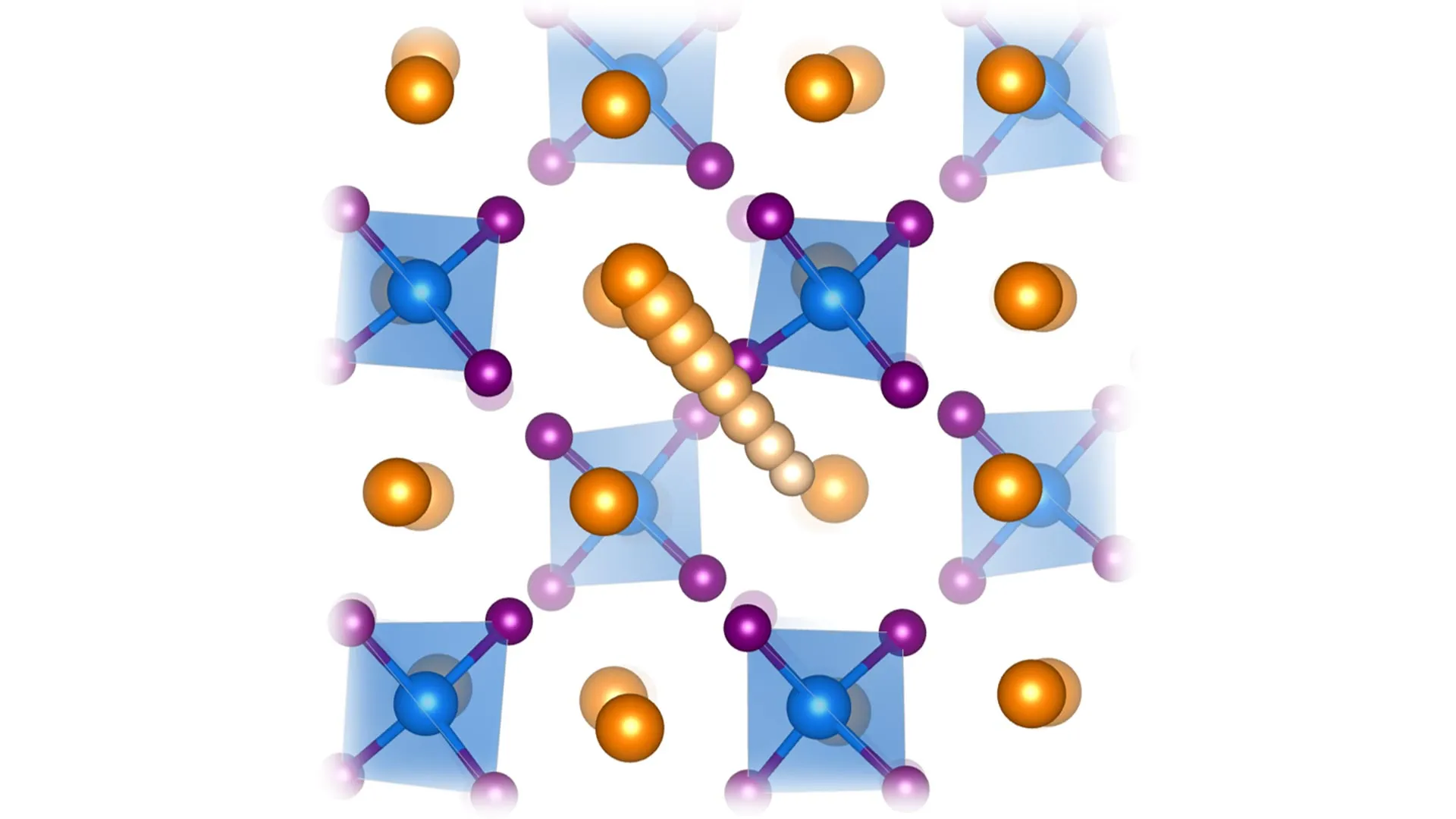
ML workflow identifies Raman signals to detect fast ion conduction
Researchers have developed a machine learning (ML) accelerated workflow capable of detecting "liquid-like" ion motion within solid crystals. The method combines tensorial ML models with ML force fields to simulate Raman spectra, providing a spectroscopic indicator for high ionic mobility. This discovery addresses a primary bottleneck in the development of all-solid-state batteries (ASSB), which are viewed as safer, more energy-dense alternatives to traditional lithium-ion batteries.
The performance of ASSB relies on how quickly ions travel through solid electrolytes. Traditionally, identifying materials with rapid ion movement required time-consuming experimental characterization and synthesis. While computer simulations are used, standard computational techniques often struggle to model the disordered behavior of ions at high temperatures and demand immense computing power, making large-scale studies impractical.
The new ML pipeline allows scientists to simulate vibrational spectra of disordered materials at realistic temperatures with near-ab initio accuracy while reducing computational costs. When applied to sodium-ion conducting materials such as Na3SbS4, the workflow revealed pronounced low-frequency Raman features. These signals occur because ions moving in a fluid-like manner temporarily disturb the lattice symmetry, relaxing standard Raman selection rules.
The research highlights a critical distinction in transport mechanisms: materials where ions move through hopping between fixed positions do not produce these Raman signatures. By contrast, those with strong low-frequency Raman intensity show high ionic diffusivity and dynamic relaxation of the host lattice. This provides a broader framework for interpreting diffusive Raman scattering across various material classes and enables high-throughput screening for new superionic materials.
The Physics of Superionic Conduction
The phenomenon of superionic conduction involves ions moving rapidly through a solid while the crystalline framework remains intact. A research team led by the University of Osaka, collaborating with RIKEN, the Institute of Science Tokyo, and The National Institute of Advanced Industrial Science and Technology (AIST), has worked to unify the understanding of this mechanism through a simple physical model.
The team identified a process called sublattice melting
, where carrier particles lose their ordered arrangement and move like a liquid as temperature increases, while the host lattice remains crystalline. Their model suggests that carriers do not hop independently but move cooperatively in spatially heterogeneous, string-like patterns. Senior author Takeshi Kawasaki stated:
"Superionic conduction has long been difficult to understand because of the complexity of real materials. By deliberately starting from a simple model, we identified broadly applicable physics that could guide the design of new ion-conducting materials."
Takeshi Kawasaki, senior author, via miragenews.com
Other research into superionic conductors has identified specific materials with extraordinary conductivity. For example, silver iodide (AgI) transitions into a high-conductivity phase at temperatures above 147 °C. Currently, the record holder for ionic conductivity is the related material Ag2[HgI4].
Organic and Quantum Material Innovations
Parallel advancements in organic chemistry have led to the creation of state-independent electrolytes (SIEs). Researchers at the University of Oxford developed a family of materials that maintain conductivity across liquid, liquid crystal, and solid states. This challenges the electrochemistry rule that ions move more slowly when a liquid solidifies, a phenomenon known as freezing out
.
The Oxford team, including Professor Paul McGonigal and PhD student Juliet Barclay, designed disc-shaped molecules with flexible hydrocarbon sidechains, described as a wheel with soft bristles
. This architecture spreads the positive charge across a flat center, preventing the trapping of negative ion partners through tight electrical bonds. As the material solidifies, the discs stack into columns, but the flexible bristles maintain a permeable environment for ions to flow freely.
Separate research from Argonne National Laboratory, Purdue University, and Rutgers University has explored quantum materials. They found that samarium nickelate, a solid perovskite, can quickly transport lithium ions at room temperature. When lithium ions are inserted into the material, its ability to pass free electrons is reduced by eight orders of magnitude. Subramanian Sankaranarayanan, a scientist at Argonne’s Center for Nanoscale Materials, noted that the material possesses insulating properties better than liquid electrolytes, such as alkyl carbonates, while maintaining rare solid-state ion conductivity.
Future Applications and Integration
These diverse approaches—from ML-driven Raman detection and simplified physical models to organic SIEs and quantum perovskites—converge on the goal of replacing liquid electrolytes. Because solids do not leak, they eliminate fire risks associated with lithium-ion batteries.
Potential real-world applications include:
- Manufacturing: SIEs can be applied as a liquid to ensure homogeneous coating and then cooled into a stable solid.
- Electronics: Organic solids may be used in flexible electronics and memory devices.
- Energy: High-performance solid-state batteries for electric vehicles and wearable sensors.
The Oxford team is currently working with a group in Japan to implement their materials in memory devices and is focused on expanding the family of cationic cores and anions beyond chloride and bromide. Meanwhile, researchers at Argonne plan to study other materials to identify additional ions that samarium nickelate can conduct.
How significant is this development?
Participate in our community survey on the trajectory and real-world impact of this news.