NASA to Launch Robotic Mission to Save Falling Space Telescope
NASA has partnered with Katalyst Space Technologies to deploy a specialized robotic vehicle designed to intercept and tow the aging Swift telescope to a stable orbit.
- Headline Dispatch: NASA to Launch Robotic Mission to Save Falling Space Telescope
- Core Takeaway: NASA has partnered with Katalyst Space Technologies to deploy a specialized robotic vehicle designed to intercept and tow the aging Swift telescope to a stable orbit.
- Source Synthesis: Continuous live monitoring aggregated across major news wires and independent bureaus.
NASA to Launch Robotic Mission to Save Falling Space Telescope
NASA is attempting a high-stakes salvage operation to prevent the Neil Gehrels Swift Observatory from plummeting into Earth's atmosphere. After a delay due to unfavorable weather, the mission is now scheduled to launch no earlier than 5:43 a.m. EDT on Wednesday, July 1.
The $30 million operation involves a robotic spacecraft designed to intercept the aging telescope and tow it to a higher, more stable altitude. Launched in November 2004, Swift was originally projected to last only two years in orbit. It has since operated for nearly 22 years, documenting more than 2,000 gamma-ray bursts—the most powerful explosions in the universe—some from the fringes of the observable universe.
The Descent of Swift
Swift is currently in low-Earth orbit, where it is subject to atmospheric drag. Since fall 2024, intense solar activity and eruptions of solar flares have caused the atmosphere to expand, increasing drag and causing the telescope to sink faster than NASA anticipated. Its altitude has dropped from 363 miles to approximately 224 or 225 miles.
The telescope must remain above 185 or 186 miles for a rescue to be viable. Latest estimates suggest Swift will reach this point of no return in October. To slow the descent, NASA turned off all scientific instruments in February.
The urgency of the mission is highlighted by probability estimates from Katalyst Space Technologies: the satellite has a 50% chance of an uncontrolled reentry by mid-2026, rising to 90% by the end of 2026.
The Robotic Rescuer: LINK
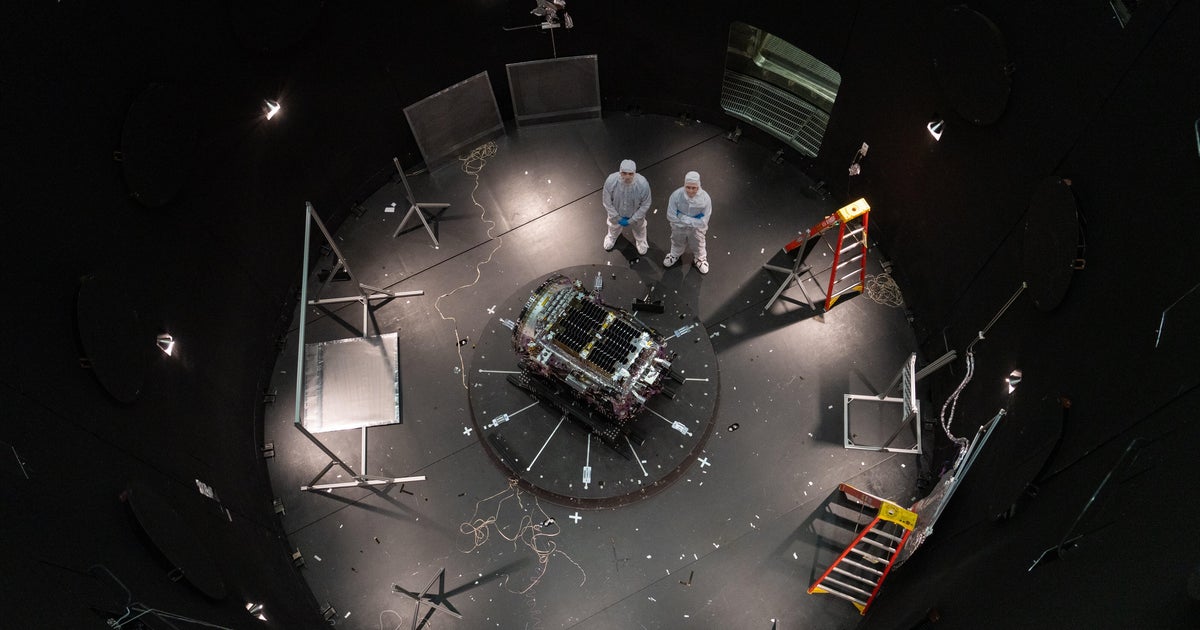
NASA contracted Arizona-based startup Katalyst Space Technologies in September 2025 to build the LINK robotic servicing spacecraft. The company had less than a year to design, manufacture, and test the vehicle.
LINK is roughly the size of a small kitchen refrigerator, weighing 937 pounds and standing about 4.9 feet tall with a 40-foot solar wingspan. Because Swift was never designed to be serviced and lacks docking ports or grappling fixtures, LINK features a custom capture mechanism. This consists of three robotic arms with a reach of just over 3 feet, each ending in two finger-like pinching grippers described as resembling the hands of a Lego mini figure.
Once launched, LINK will spend two to three weeks performing observations to determine the optimal grapple points on the 1.6-ton observatory. After catching Swift, LINK will use ion thrusters to raise the pair's orbit from its current position to the desired 373 miles over several months. If successful, Swift could resume scientific operations as early as September.
Launch Logistics
The mission utilizes a Northrop Grumman Pegasus XL rocket, a 55-foot small-lift vehicle. The launch will take place from Bucholz Army Airfield at Kwajalein Atoll in the Marshall Islands. Using an air-launch strategy, a Stargazer L-1011 aircraft will carry the rocket to approximately 39,000 or 40,000 feet while traveling at Mach 0.82 before releasing the Pegasus.
The Pegasus rocket was selected because it can reach Swift's specific orbital inclination of 20.6 degrees and offered a fast timeline. This flight is scheduled to be the final time the Pegasus XL rocket ever flies.
A New Playbook for Space
This mission marks the first time a commercial robotic spacecraft will attempt to capture a U.S. Government satellite not designed for servicing. While China successfully boosted a satellite into a graveyard orbit four years ago, this is the first American attempt of its kind.
"This is the first American space robot to go up and do anything like this,"
Ghonhee Lee, CEO of Katalyst Space, via The Associated Press
NASA officials emphasize that replacing the $500 million observatory is not currently a budgeted option. Beyond saving Swift, the mission serves as a proof-of-concept for future robotic servicing.
The 36-year-old Hubble Space Telescope is also losing altitude due to solar activity. While Hubble was previously serviced by astronauts during the shuttle era, Katalyst Space is developing a next-generation robot to provide a life-extending boost for Hubble in 2028. This future robot, scheduled to fly next year, will be capable of tackling satellites as high as 22,300 miles.
Shawn Domagal-Goldman, NASA's astrophysics director, noted that the progress made in just nine months was unexpected.
"I have to be honest. No one thought it was going to be possible. No one thought we would get as far as we've already gotten today,"
Shawn Domagal-Goldman, NASA astrophysics director, via The Associated Press
If saved, Swift will act as "NASA's first responder," quickly pivoting to capture astronomical events to complement discoveries from the Webb Space Telescope and the upcoming Roman Space Telescope.
How significant is this development?
Participate in our community survey on the trajectory and real-world impact of this news.