Hamas conditions Trump peace deal implementation on Israeli compliance
Hamas has agreed to a peace framework involving disarmament but insists Israel must first fulfill obligations from the Sharm el-Sheikh agreement.
Hamas conditions Trump peace deal implementation on Israeli compliance
U.S. President Donald Trump announced a great breakthrough
on Friday, July 31, regarding a peace deal designed to bring an end to the war in Gaza. The proposal, developed by his Board of Peace
, envisions the complete disarmament of Hamas and other armed groups. However, the announcement has been met with significant hurdles as both Hamas and Israel maintain conflicting demands on who must move first.
Hamas has agreed to a written agreement for the second phase of a Gaza ceasefire, but the group has tied its implementation to Israel's full compliance with the first phase of a previous agreement reached in Sharm el-Sheikh. Ghazi Hamad, a senior Hamas official and member of the group's political bureau and negotiating delegation, told Reuters that the agreement is a comprehensive framework
and a single, integrated package
.
According to Hamad, Hamas will only agree to hand over weapons for storage by the National Committee for the Administration of Gaza (NCAG) — a Palestinian technocratic body — after Israel meets its obligations. These obligations include stopping attacks in Gaza, increasing the flow of aid and goods, and withdrawing forces to where they stood in October.
The 15-point roadmap published by the Board of Peace calls for both Israel and Hamas, along with other Palestinian factions, to fully implement the Sharm el-Sheikh agreement. Specifically, the roadmap outlines a process to decommission and store heavy weapons, military production sites, depots of weapons, and tunnels. The document specifies that no weapons would be handed over to Israel or non-Palestinian parties.
Hamad described the agreement as difficult and painful
for Hamas, stating the group accepted it to spare Gaza further destruction and to stop what he termed a genocide
and satanic
plans to displace Palestinians. He noted that the deal followed national consultations with other Palestinian factions to ensure a consensus position.
Israel's response has been divided. An Israeli official stated that the IDF will not withdraw from the Yellow Line
, a military demarcation line agreed upon in the ceasefire, unless Hamas undergoes genuine disarmament
. Furthermore, Police Minister Itamar Ben-Gvir, head of the far-right Jewish Power party, declared the draft agreement unacceptable
on his Telegram channel, insisting that Israel must continue assassinating Hamas leaders.
President Trump, who met with Prime Minister Benjamin Netanyahu in Washington on Tuesday, claimed that Israel was very happy
about the deal and helped us
. But an Israeli political source reported that the issue of Gaza did not actually come up during that meeting. Netanyahu has not yet issued an official comment and faces an election in October.
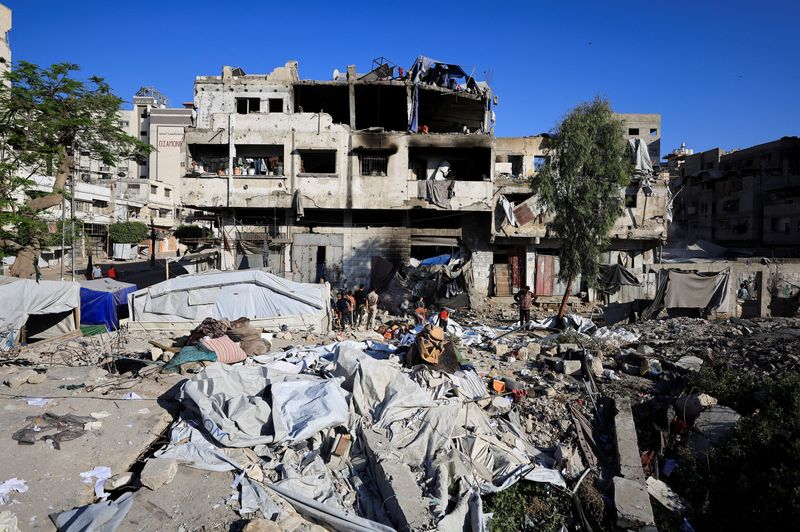
Violence continued in the enclave shortly after the announcement. Gazan medical authorities reported that one Palestinian was killed and several others wounded in at least two Israeli airstrikes and gunfire on Friday. The Israeli military said it was reviewing one strike that was diverted after uninvolved individuals were identified, though it stated it was unaware of any shooting.
Displaced Palestinians in Gaza City expressed skepticism. Samir Ayad, 60, urged Trump to compel Israel to abide by the agreement, stating, We are not seeing any agreement at all, nothing from what he is saying
.
International reactions have been generally supportive. U.N. Secretary-General Antonio Guterres urged all sides to follow the roadmap without any questions, scepticism, or determination to undermine it
. EU foreign policy chief Kaja Kallas called it a constructive step towards peace
, though she noted that verifying Hamas' compliance would be a significant challenge
. Belgium's Foreign Minister Maxime Prevot and France also welcomed the diplomatic efforts led by the U.S., Egypt, Qatar, and Türkiye.
The agreement also provides for an international oversight committee to monitor implementation and the deployment of international forces. Hamas is expected to participate in a new round of talks in the coming days to finalize timelines and mechanisms. This will involve meetings with U.S. Representatives, mediators, and Nikolay Mladenov, the high representative of the Board of Peace.