7.1 magnitude earthquake hits southern Japan causing mall collapse
Emergency services are searching for survivors after a 7.1 magnitude earthquake hit Kumamoto prefecture, triggering a mall collapse and power outages.
- Headline Dispatch: 7.1 magnitude earthquake hits southern Japan causing mall collapse
- Core Takeaway: Emergency services are searching for survivors after a 7.1 magnitude earthquake hit Kumamoto prefecture, triggering a mall collapse and power outages.
- Source Synthesis: Continuous live monitoring aggregated across major news wires and independent bureaus.
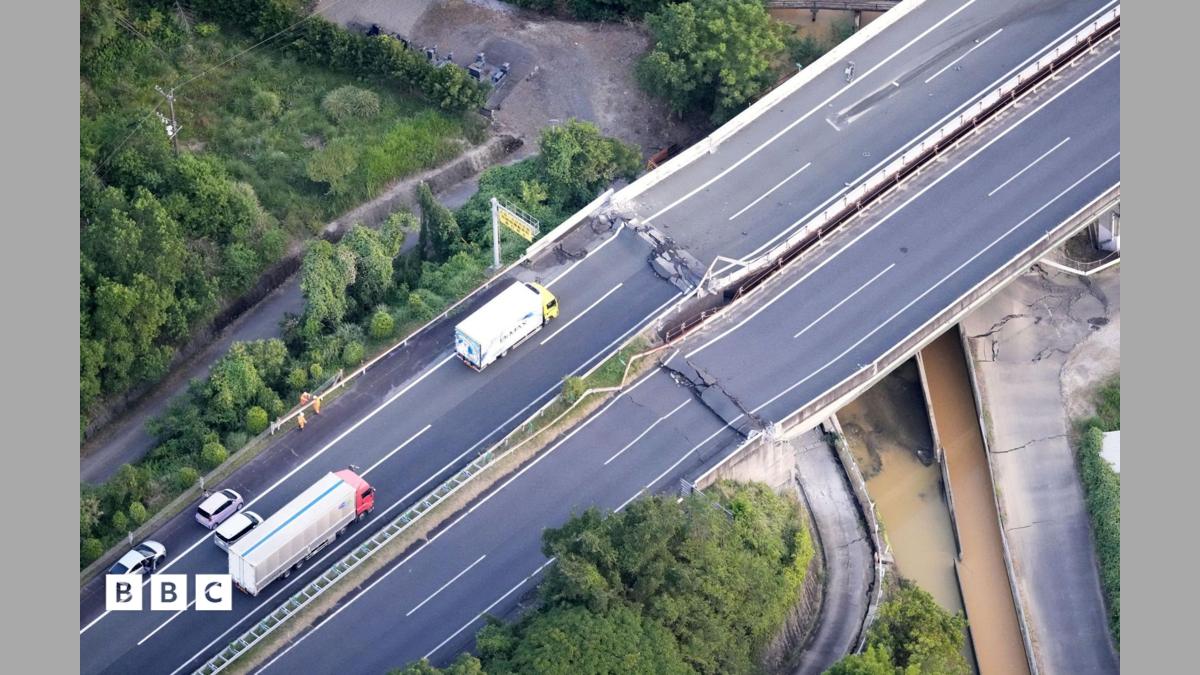
7.1 magnitude earthquake hits southern Japan causing mall collapse
A magnitude 7.1 earthquake struck Japan's south-western Kyushu island on Tuesday, July 28, 2026, causing building collapses, fires, and a major emergency at a shopping center. The initial quake hit the Kumamoto prefecture at 16:27 local time, with the epicentre located approximately 20km to the south of Kumamoto city at a depth of 10 kilometres below the sea's surface.
The disaster escalated when the Aeon Mall shopping centre, which houses about 200 shops and businesses, suffered a partial collapse of its second floor. Emergency services reported that "many people" became trapped inside following an explosion that occurred after the first earthquake. Police indicated to broadcaster TBS that "quite a few" people are presumed dead in the incident. NHK reported that between 20 and 30 workers trapped at the mall could not be reached.
An Aeon spokesperson stated that employees and customers were evacuated immediately after the initial quake, though the cause of the subsequent explosion remains unclear. Kazuya Tsurunaga, who was at a pub about 300 metres from the mall, told TBS he heard the blast while cleaning up broken dishes and saw a large cloud of smoke billow up, describing the area as appearing as if "volcanic ash was falling."
The mall had recently reopened after suffering bad damage during a magnitude 7.3 earthquake in Kumamoto in April 2016.
The region faced a series of violent tremors. Following the initial 7.1 magnitude quake, the area was hit by 26 aftershocks ranging between 3.3 and 4.5 magnitude, before a second strong tremor of magnitude 6.1 recorded at 5:12pm (6:12pm AEST). Japan’s Meteorological Agency (JMA) has since recorded at least 75 additional quakes in Kumamoto prefecture.
Casualties and infrastructure damage are widespread. Prime Minister Sanae Takaichi confirmed "human casualties, building collapses, road damage, fires" and announced that a major rescue operation would continue through the night. NHK reported that at least two hospitals are treating more than 50 injured people each, some of whom are in serious condition. Police are also searching for nine missing people.
Further industrial damage occurred at a Nippon Paper Industries factory in Yatsushiro, where a chimney collapsed. NHK reported that multiple people are unaccounted for following that collapse.
The earthquake disrupted critical infrastructure across the region:
- Power: Outages affected at least 48,000 households in Kumamoto prefecture.
- Transport: JR Kyushu suspended services, including high-speed Shinkansen trains, and one train derailed.
- Aviation: Kumamoto airport shut its runway, diverting and cancelling flights.
- Roads: Aerial views showed damage to the Kyushu Expressway, and NHK footage showed cracked roads and bridges.
The Japanese government issued emergency earthquake warnings for the prefectures of Kumamoto, Nagasaki, Kagoshima, Fukuoka, Saga, Oita, and Miyazaki. Officials ordered approximately 300,000 people to evacuate their homes. Japan's Chief Cabinet Secretary, Minoru Kihara, urged residents to remain calm and follow evacuation information via the internet, television, and radio.
Nuclear authorities reported no immediate danger. Kyushu Electric Power and Japan's Nuclear Regulation Authority found no abnormalities at the Genkai and Sendai nuclear power stations. The IAEA confirmed via X that the Nuclear Regulation Authority reported no damage or safety issues at the Sendai plant.
Visitors to the region were also affected. Leon Chan, an 18-year-old from Hong Kong, described being "quite scared" when the quake hit while she was with her boyfriend in Kumamoto city. She reported that the shaking lasted about 30 seconds and that her accommodation subsequently lost water and electricity. Hong Kong’s travel authority confirmed that about 200 members of tour groups in the region are safe.
Japan's location on the Pacific Ring of Fire makes it one of the world's most earthquake-prone countries, accounting for about 20 per cent of global earthquakes of magnitude-6 or more. A previous quake in Kumamoto in 2016 killed more than 50 people and injured 1,800.
Kumamoto airport plans to resume normal operations on Wednesday, while JMA warns that aftershocks could remain a concern for about a week.
How significant is this development?
Participate in our community survey on the trajectory and real-world impact of this news.