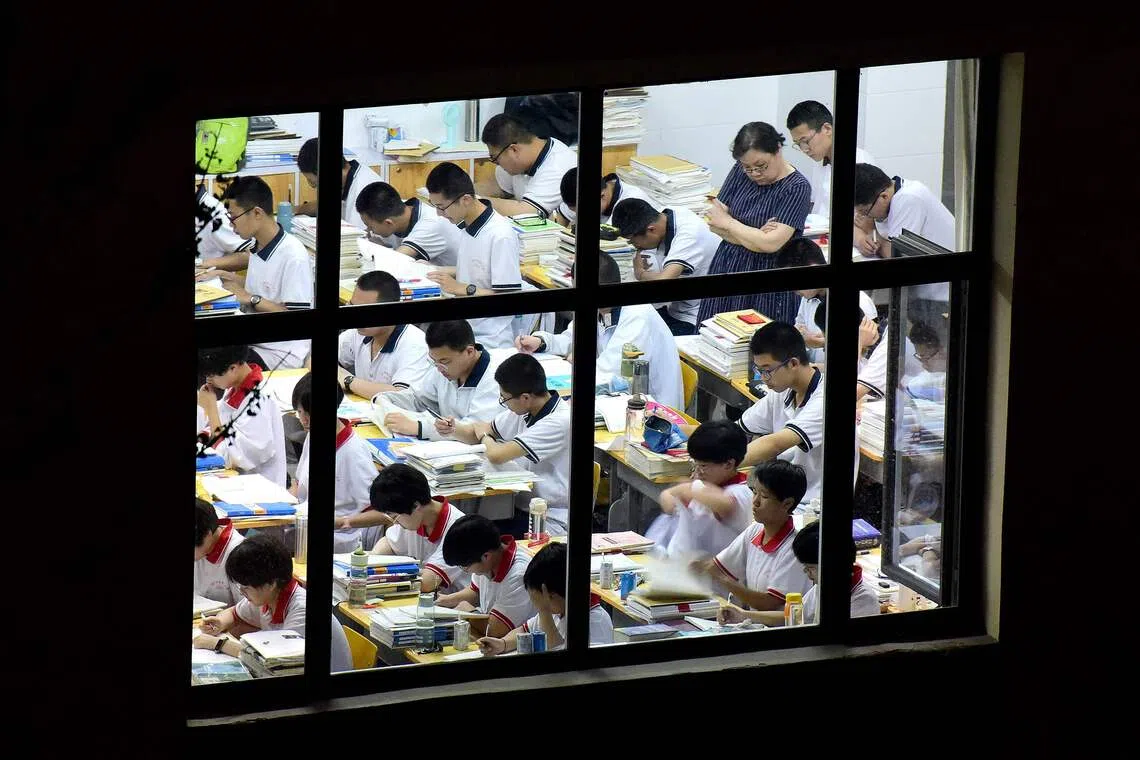
Rigorous Regimen Facing Chinese Students: The Decline of the Hengshui Model
BEIJING – In a stark reflection of China’s demanding education system, students at Hengshui No. 2 High School in Hebei province endure an arduous daily routine. The schedule begins at 5:30 AM, with students allotted just eight minutes to rise, make their beds, and assemble for a 1.6 km morning run by 5:38 AM. This is followed by a relentless 16-hour study day that typically concludes well past 10 PM, leaving little room for relaxation or leisure.
For Alan Wang, who graduated in 2020, this rigidity represented the “Hengshui model” that has drawn both international attention and scrutiny. “The quilts had to be folded into a perfect rectangle, and the sheets couldn’t have a single wrinkle. We had 15 minutes to eat breakfast and dinner, and 20 minutes for lunch. All the other hours were spent studying,” Wang recounted to local media.
The Challenge of the Gaokao
The underlying purpose of such a rigorous approach is to perform well on the gaokao, China’s national university entrance examination, crucial for admission to prestigious institutions like Tsinghua University and Peking University. However, recent trends indicate a notable drop in success rates. In 2025, only 45 Hengshui students earned spots in these top-tier universities, a sharp decline from 275 in 2019, sparking conversations about the efficacy and sustainability of the educational model.
Critics argue that the Hengshui model epitomizes the stress embedded in China’s education system, which is notorious for its high-stakes academic environment. Analysts attribute the declining university admission rates to several factors, including demographic changes, such as the legacy of the one-child policy, which has heightened parental expectations on single offspring.
Debate Over the Model’s Viability
Public discourse around the Hengshui model has bifurcated, with some viewing it as an effective, albeit extreme, educational approach while others criticize it for crushing student enthusiasm and mental health. “After going through the Hengshui model, you will lose your enthusiasm for further studies,” one commenter stated, reflecting a sentiment of disillusionment among former students.
Conversely, others defend the model, asserting it prepares students for the pressures of future academic and professional environments. The model’s rise has inspired dozens of schools nationwide to adopt similarly stringent methodologies, amplifying concerns regarding student well-being.
Growing Pressures and Policy Responses
The gaokao remains essential for upward mobility in China. Approximately 13 million students sat for the exam in 2025, with about 80% progressing to some form of higher education. Yet, only a fraction successfully secure places in elite universities. The educational landscape’s competitive nature often results in exorbitant pressure on students, schools, and families alike, prompting Chinese authorities to address burgeoning mental health concerns.
In December 2022, China’s Ministry of Education implemented reforms aimed at alleviating academic burdens, including restrictions on routine exam frequencies and a push to moderate the excessive amount of homework. These measures are part of broader efforts to mitigate stress in an education system that has increasing scrutiny for fostering anxiety and burnout.
Future Directions for Educational Reform
While innovations in policy could lead to improvements, experts like Professor Sang Guoyuan of Beijing Normal University argue that meaningful change will require higher-level adjustments in how educational success is measured. “If provincial education authorities stopped imposing ranking and performance pressure on schools based on exam results, China’s education ecosystem would improve significantly,” he said.
Furthermore, educational reform is increasingly vital as China grapples with the implications of its competitive and often harsh educational policies, which not only impact student mental health but also reflect broader issues of social inequality. There is a growing consensus among educators advocating for reforms that respect diverse talents beyond mere test scores.
As discussions about systemic reform continue, the Hengshui model serves as a vital case study for understanding the complexities and pressures intrinsic to China’s educational framework—a framework that holds profound implications for future generations and societal development.
