Global Defense Spending Reaches $2.7 Trillion Amidst Escalating Geopolitical Tensions
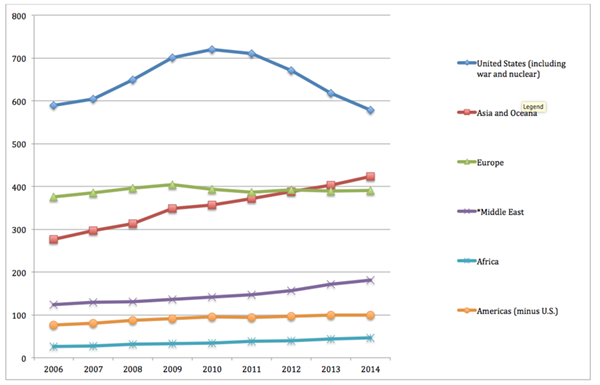
Global military expenditure surged to a record $2.72 trillion in 2024, marking the steepest increase since 1987, according to data released by the Stockholm International Peace Research Institute (SIPRI) and corroborated by recent analyses from FlightGlobal. This unprecedented level of spending underscores a fundamental shift towards a “security supercycle,” driven by intensifying conflicts in Eastern Europe, the Indo-Pacific, and the Middle East, as highlighted by Wedbush MarketMinute. The escalating expenditures have significant implications for global stability and the future of the international arms industry.
European and North American Investment Lead the Surge
The United States remains the largest defense spender globally, with an estimated $838 billion allocated in 2025, representing 60% of total NATO expenditure, according to the alliance’s latest annual report. However, a significant trend is the dramatic increase in spending by European nations. NATO members in Europe and Canada collectively invested $574 billion in defense in 2025, a 20% real increase compared to 2024. Several European countries are now exceeding the NATO target of 2% of GDP dedicated to defense, with Poland leading the way at 4.3% of its GDP, followed by Lithuania (4%) and Latvia (3.74%). Germany, spurred by its ‘Zeitenwende’ policy following the 2022 invasion of Ukraine, is undertaking a multi-decade procurement program, significantly boosting its defense budget.

Asia-Pacific Region Accelerates Military Modernization
Alongside Europe, the Asia-Pacific region is witnessing a rapid acceleration in military spending. Concerns over China’s growing military assertiveness and regional tensions, particularly in the South China Sea, are driving increased investment in defense capabilities. Japan, for instance, has embarked on its largest military expansion since 1952, reflecting a shift away from its traditionally pacifist stance. India, facing border disputes with China and Pakistan, has also substantially increased its defense budget, focusing on modernizing its armed forces and enhancing its indigenous defense industry. This regional arms race is fueled by a desire for self-reliance and a response to perceived security threats. The Forces News reports that rising tensions are the primary driver of the increased spending.
The Impact of Conflict and Geopolitical Instability
The primary catalyst for this global defense spending boom is the confluence of ongoing and emerging geopolitical crises. The war in Ukraine, which began in 2022, initially led to a reactive replenishment of Western stockpiles, but has now transitioned into a long-term rearmament strategy. The escalating maritime friction in the Indo-Pacific, coupled with renewed instability in the Middle East following regional operations in late 2025, has further exacerbated these trends. These conflicts are not isolated incidents; they represent a broader breakdown of the post-Cold War security architecture, resulting in a more volatile and unpredictable international landscape. The United States has proposed a massive $1.5 trillion defense budget for the 2027 fiscal cycle, signaling its commitment to maintaining global security leadership.
Defense Industry Beneficiaries and Technological Focus
The surge in defense spending is directly benefiting major aerospace and defense contractors. Top U.S. firms alone have reported record-breaking order backlogs exceeding $750 billion, indicating a long-term shift toward high-rate production and the integration of next-generation technologies. The focus is increasingly on autonomous systems, artificial intelligence, and cyber warfare capabilities. Defense News US highlights the growing importance of cybersecurity and defense innovation, driven by the rising threat of cyberattacks and the proliferation of advanced technologies. This technological arms race is reshaping the nature of warfare and raising concerns about the potential for escalation.
Future Outlook and Diplomatic Implications
The trend of increasing global defense spending is expected to continue in the coming years. NATO allies are now targeting a baseline of 3% to 5% of GDP for defense spending, with a new benchmark target of 5% by 2035. This sustained increase in military expenditure will have profound diplomatic implications, potentially leading to a further escalation of tensions and a more polarized international order. The United Nations has repeatedly called for de-escalation and a renewed commitment to multilateralism, but these calls have largely gone unheeded amidst the current geopolitical climate. The long-term consequences of this “security supercycle” remain to be seen, but it is clear that the world is entering a new era of heightened military competition and strategic uncertainty. The increased defense spending also diverts resources from crucial areas like climate change mitigation and sustainable development, potentially exacerbating existing global challenges.
