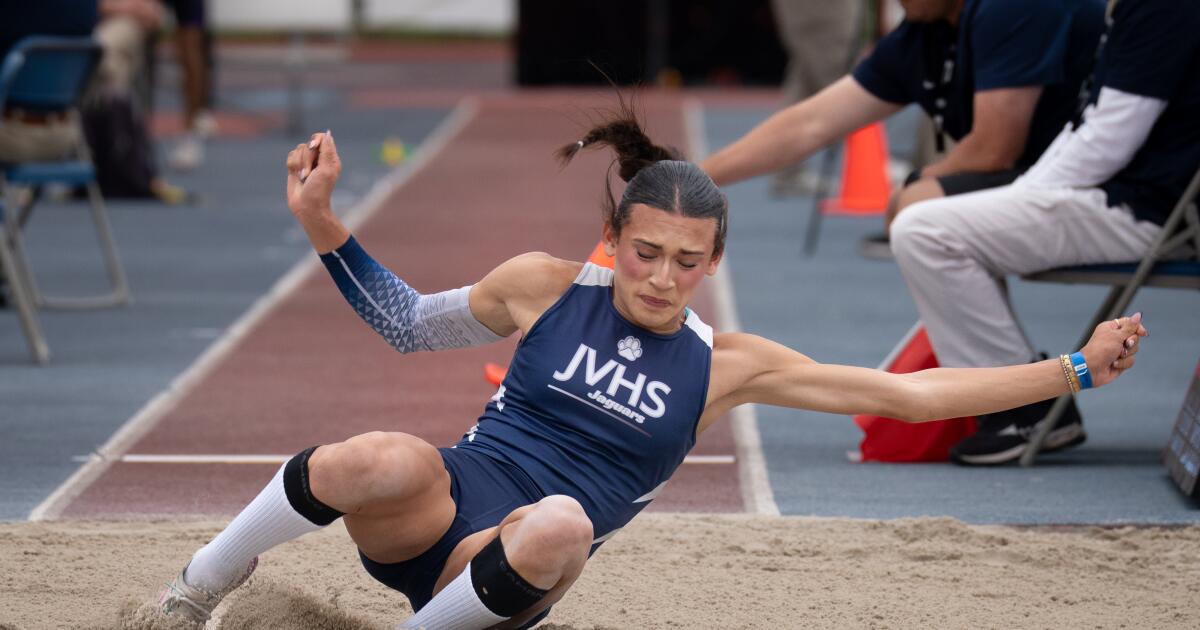
AB Hernandez, a 17-year-old transgender senior from Jurupa Valley High School, won the girls’ high jump and triple jump at the 2026 California Interscholastic Federation (CIF) state track championships on May 30 in Clovis, marking her second consecutive year dominating the events. The victory came amid a notable shift in protest intensity—this year’s demonstrations were muted compared to last year’s heated clashes, but the debate over transgender athletes in girls’ sports remains as contentious as ever.
AB Hernandez’s Dominance: A Record-Breaking Weekend
Hernandez’s performance was nothing short of commanding. She cleared 5 feet, 10 inches in the high jump—the only competitor to do so—and secured the triple jump with a mark of 48 feet, 8 3/4 inches, more than an inch ahead of the second-place finisher. In the long jump, she placed third, adding to her two-year streak of medals in all three events. The Los Angeles Times reported that Hernandez’s high jump victory was particularly notable, as she was the sole competitor to clear the 5-10 bar.

Under CIF’s current policy, transgender athletes who qualify for state championships receive medals but do not displace cisgender competitors in the final standings. This rule, introduced last year, applies specifically to the long jump, triple jump, and high jump—the same events Hernandez excelled in this weekend. The policy was designed to balance inclusion with fairness, though it has done little to quiet critics on both sides.
Hernandez’s mother, Nereyda Hernandez, told ABC30 Fresno that the atmosphere this year felt markedly different from last year’s championships, where protests and counter-protests escalated into violence. “It’s a different feeling this year. Everything is more calm. We don’t see many of the agitators yet,” she said. The shift may reflect a broader exhaustion with the issue—or perhaps a strategic retreat by opponents ahead of California’s gubernatorial primary, just four days away.
The Protests That Never Quite Faded
While the protests outside Veterans Memorial Stadium were less confrontational this year, they were far from absent. Republican gubernatorial candidate Steve Hilton returned to Clovis for a second year, holding a news conference outside the stadium where he criticized CIF’s policies on transgender athletes. Standing before signs reading “Hey, CIF: Girls’ Sports Girls Only,” Hilton framed the issue as a matter of fairness, though his presence also underscored the political stakes. The LA Times noted that Hilton’s rally was the most visible protest activity of the weekend.

Inside the stadium, however, the focus remained on the athletes. Hernandez’s qualifying round on May 29 was dominated by her performances—she led the field in every event she competed in, securing her spot in the finals. The KMPH reported that some coaches and parents, like Mark Hicks, a track coach, argued that while transgender athletes should be allowed to compete, their participation should not automatically displace cisgender competitors. “Even though you have hormones and everything that are changed, you still have a male and a female body and the bone structure and muscle structure is still a male structure,” Hicks said, reflecting a common counterargument to inclusion policies.
Meanwhile, outside the stadium, tensions flared during a press conference organized by LGBTQ advocacy groups Pride at the Pier and Rainbow Families Action. When a group of “Save Girls Sports” activists arrived, a heated verbal confrontation erupted. Footage from Fox News showed the clash, which eventually dissipated without police intervention. Beth Bourne, a prominent “Save Girls Sports” activist, told reporters, “I just wanted to share my signs… and just talk about how not only is this unfair to the girls competing in sports, but it’s also unfair to the athlete, to AB Hernandez, to lie to him about his biological reality.”
The response from pro-LGBTQ activists was swift. Daisy Gardner, speaking to Fox News, said of Bourne, “I hope that she is able to learn and educate and open up her heart and heal with her family.” The exchange highlighted the deep emotional and ideological divides at the heart of the debate.
CIF’s Policy: A Compromise Under Fire
The CIF’s decision to allow transgender athletes to compete in girls’ events—while excluding them from final standings in certain events—was a deliberate attempt to address the controversy without outright banning participation. The policy, known as the Pilot Entry Program, ensures that any student-athlete assigned female at birth who would have qualified for automatic entry but was displaced by a transgender competitor can still compete in the state championships. As ABC30 Fresno reported, Hernandez’s mother expressed relief that the policy remained in place: “Yes, at least they didn’t take that away.”
Yet the policy has not satisfied everyone. Clovis Mayor Pro Tem Diane Pierce criticized CIF’s approach, telling ABC30, “CIF continues to allow boys to compete against our girls.” Her statement reflects a broader conservative argument that the policy does not go far enough to protect cisgender athletes. Meanwhile, Hernandez’s mother countered by shifting the focus to political leadership: “That’s not leadership. We’re going to focus on people like Tom Steyer who are supportive of AB and all trans athletes,” she said, referencing the Democratic gubernatorial candidate.
What Comes Next: The Debate Isn’t Over
The 2026 CIF championships may have seen a quieter protest scene, but the underlying questions remain unresolved. Should transgender athletes be allowed to compete in girls’ sports? If so, under what conditions? And how do policymakers balance inclusion with fairness?

For Hernandez, the immediate focus is on her final year of high school competition. She has already secured her place in track history, but her future—both in sports and beyond—will likely be shaped by the ongoing debate. As her mother noted, she is simply there to support her daughter, not to engage in the political fray. “That’s all I’m doing is being supportive, being my baby’s cheerleader and just making sure she knows I’m here and she’s safe,” Nereyda Hernandez said.
For the CIF, the policy will face continued scrutiny, particularly if legal challenges or legislative changes emerge in the coming months. The organization’s approach—allowing participation while attempting to mitigate displacement—may not satisfy either side, but it represents a middle ground in an increasingly polarized landscape.
One thing is clear: AB Hernandez’s story is far from over. Whether she continues to compete at the collegiate level or transitions to another arena, her journey has already become a defining moment in the conversation about transgender athletes in sports. And for now, at least, the medals—however contentious their backdrop—speak for themselves.
