
NASA has directed International Space Station astronauts to prepare for potential evacuation after disagreements with Roscosmos regarding the repair of a persistent air leak in the Zvezda service module. Following a standoff over a proposed structural repair, the agencies are now moving toward decommissioning the module’s transfer tunnel, known as the PrK, to isolate the leak.
The Standoff Over Zvezda’s Leaky Transfer Tunnel
The situation aboard the International Space Station reached a critical point earlier this month when NASA instructed five crew members to shelter in the SpaceX Crew Dragon spacecraft. This emergency procedure followed a sharp increase in air leakage from the station’s aging Zvezda service module, specifically within the PrK, a vestibule connecting the module to a rear docking port. According to The Register, the tension peaked when Russian cosmonauts proposed using tools, including a saw, to cut into a load-bearing bracket to reach a suspected leak site.

NASA officials strongly objected to this approach, arguing it could compromise the structural integrity of the module. As reported by Ars Technica, one NASA official stated, “We threatened we would put astronauts in suits, in Dragon, to send a message to the world that we disagreed.” The decision to move the crew into a “safe haven” ultimately compelled Roscosmos to halt the drilling plans.
“This revised approach involved cutting a bracket to access better an area identified as a possible leak source for further inspection, using a method that could have resulted in elevated risk to the structure in the area.”
NASA, via The Register
Escalating Risks and Decades of Wear
The cracks in the Zvezda module are not a recent development. The module, which serves as a core component of the station, has been in orbit since 2000, with some of its underlying technology dating back to the 1980s. As CBC notes, a 2024 report from NASA’s Office of the Inspector General identified these ongoing leaks as a top safety risk, noting that the leakage rate had doubled over several years to more than two pounds of air per day.
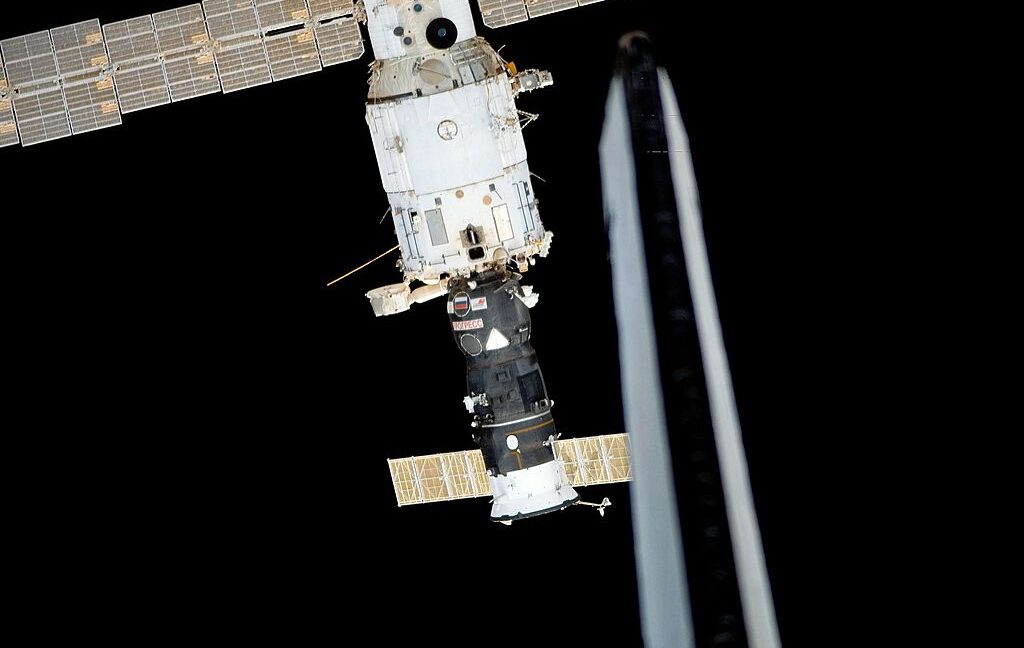
The technical challenge involves the Zvezda module’s specific design as the primary Russian life-support node. The PrK vestibule acts as a critical interface for docking supply ships. Because the station operates in a vacuum, any structural compromise—such as the microscopic, fatigue-induced cracks that have appeared over time—threatens the atmospheric pressure required for human life. NASA’s concern stems from the fact that the Zvezda module is a pressurized vessel; any unauthorized mechanical alteration, such as cutting into structural brackets, risks propagating existing cracks or creating new stress concentrations, which could lead to a catastrophic failure of the seal.
For years, the two space agencies have attempted various patches and mitigation strategies. While Gizmodo reports that NASA detected a brief, promising change in pressure in June 2025—suggesting a temporary success—the discovery of a pressure drop on May 1 confirmed that the leak remained active.
The Path Toward Decommissioning the PrK
Following the June 5 emergency shelter procedure, negotiations between NASA and Roscosmos have shifted toward a more permanent solution: permanently sealing off the PrK chamber. According to Hackaday, this involves abandoning the module’s rear docking port to ensure the rest of the station remains pressurized.
This approach mirrors suggestions made by experts in previous years. In 2024, ESA astronaut Andreas Mogensen suggested that sealing the chamber was a viable, if imperfect, path forward. “The lucky point is that the cracks are confined to that chamber at the very end,” Mogensen said. “So, as long as Russia is willing to forego that docking port, that wouldn’t impact operations too badly.”
Operational Implications for the Station’s Final Years
Closing the PrK hatch will effectively isolate the leak, but it imposes new operational constraints on the Russian segment. Roscosmos will no longer be able to use the rear docking port for cargo transfers via Progress vehicles, forcing the agency to rely on other available ports. While this limits logistics, it resolves the immediate threat of a rapid, uncontrolled depressurization.
The International Space Station is currently in its final years of planned operation, with an end-of-life date projected for 2030. The station relies on a complex network of modules contributed by international partners. Because the Zvezda module is essential for station propulsion and orientation control, its structural health is a matter of station-wide concern. When a leak occurs in one segment, it necessitates a coordinated response, as all modules share a common atmosphere. This requires precise monitoring of air pressure sensors across the entire orbital complex to isolate which specific volume is losing pressure.
The decision to decommission the PrK represents a calculated trade-off between the desire for continued scientific research and the practical realities of managing hardware that has exceeded its original 15-year lifespan. As the agencies prepare to seal the module, the focus now shifts to whether the station can maintain stability without further structural surprises. The long-term plan for the station involves a gradual transition to commercial orbital platforms, but until the 2030 decommissioning, the maintenance of the Zvezda module remains a critical prerequisite for the safety of all crew members currently serving on board.
Find more reporting in our Technology section.
