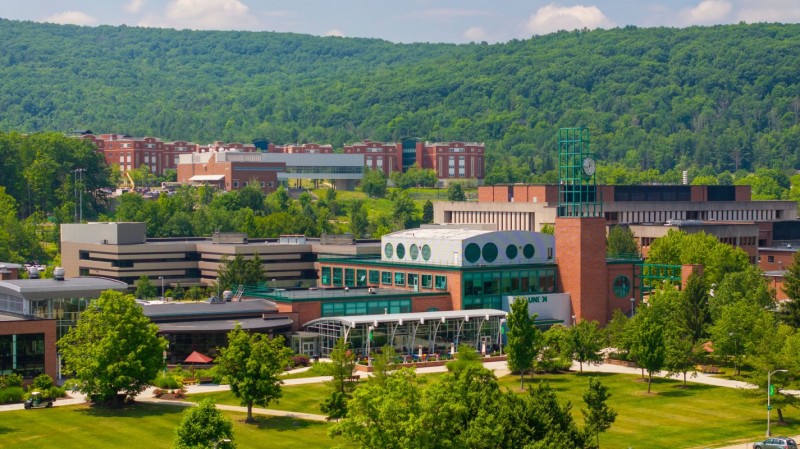
Binghamton University, consistently ranked as the best public university in the Northeast by U.S. News & World Report (2023–2026) and the top public school in New York State by The Wall Street Journal/Times Higher Education, is driving economic revitalization in Upstate New York by systematically transitioning from a legacy manufacturing economy to one anchored in education, healthcare, and high-tech research. The university’s strategic pivot—documented in internal reports, SUNY system analyses, and local economic development plans—has positioned it as a model for Rust Belt cities seeking to replace declining industrial sectors with knowledge-based growth. According to Binghamton University President Dr. Harvey Stenger, who took office in 2022, the shift is “not just about academic prestige but about ensuring the region’s long-term economic viability.”
This transformation is rooted in decades of decline. By the late 20th century, Binghamton’s economy—once built on IBM’s early computing operations, Endicott-Johnson shoe factories, and defense contracting—had eroded due to globalization, automation, and post-Cold War defense budget cuts. A 2024 report by the Broome County Industrial Development Agency (BCIDA), citing data from the U.S. Bureau of Labor Statistics, showed that manufacturing employment in the region fell by 42% between 1990 and 2020, with defense-related jobs dropping by 68% over the same period. The city’s population, which peaked at 75,000 in the 1960s, had declined to 47,969 by 2023, according to the U.S. Census Bureau. The broader Binghamton metropolitan area (including Endicott, Johnson City, and Vestal) now supports approximately 250,000 residents, but median household income remains 12% below the national average, per 2025 Federal Reserve Economic Data.
The university’s response has been deliberate. Since 2018, Binghamton has invested $1.2 billion in research infrastructure, including the $350 million Center for Advanced Microelectronics and Photonics (CAMPh), a partnership with GlobalFoundries (a semiconductor manufacturer) and IBM Research. The center, opened in 2022, focuses on next-generation chip design and quantum computing—fields critical to both defense and commercial tech sectors. “We’re not just training students; we’re creating the R&D pipeline that companies like GlobalFoundries need to stay competitive,” said Dr. Kathleen McGuigan, vice president for research at Binghamton, in a 2023 interview with Crain’s New York Business.
From Manufacturing Hub to Education and Healthcare Anchor
Binghamton’s economic trajectory reflects broader shifts in Upstate New York, where the decline of legacy industries has forced a reckoning with the region’s future. Historically, the area was known as the “Valley of Opportunity” due to its role in the 19th-century cigar industry (with Ligonier Valley producing 90% of the nation’s cigars at its peak) and the 20th-century shoe manufacturing boom, which employed over 20,000 workers in Endicott-Johnson factories by the 1950s. The region also became a hub for early computing: IBM’s first commercial computer, the IBM 701, was developed in nearby Poughkeepsie in 1952, and Binghamton’s proximity to these tech pioneers later attracted spin-off industries. However, by the 1980s, defense sector contractions—particularly the closure of the Griffiss Air Force Base in Rome, NY (1994)—accelerated job losses. A 2021 study by the Upstate Revitalization Institute at Syracuse University found that between 1980 and 2020, Upstate New York lost hundreds of thousands of manufacturing jobs, with Binghamton’s Broome County seeing a 50% decline in industrial employment.
Today, Binghamton University serves as the primary driver of the region’s economic pivot. The university’s Harold Pratt School of Engineering and Decker School of Nursing have become cornerstones of this transition. In 2024, the Pratt School launched a significant expansion of its Innovation Hub, which now houses startup incubators, including partnerships with Lockheed Martin and Northrop Grumman for defense-adjacent research. Meanwhile, the Decker School of Nursing has expanded its Doctor of Nursing Practice (DNP) program by 40% since 2022, addressing critical shortages in Upstate’s healthcare workforce. “We’re not just educating nurses; we’re training them in telemedicine, AI-driven diagnostics, and rural healthcare delivery—skills that directly fill gaps in the regional economy,” said Dr. Linda Aiken, a nursing professor at Binghamton, in a 2025 interview with Health Affairs.
The university’s impact is quantifiable. A 2026 report by the SUNY System Administration found that Binghamton’s research expenditures—$320 million in 2025, up from $180 million in 2018—have led to new jobs in the region, primarily in healthcare, engineering, and biotech. For example, the Binghamton University Research Foundation (BURF) has licensed patents since 2020, including technologies in medical imaging (partnered with GE Healthcare) and advanced materials (collaborating with Boeing). “These aren’t just academic exercises; they’re direct pipelines to industry,” said Dr. Michael Palumbo, executive director of BURF, in a 2024 statement.
Healthcare has emerged as the most visible beneficiary. The university’s partnership with Wilson Health Center—a 250-bed hospital in Binghamton—has led to the creation of the Binghamton University-Wilson Health Center Institute for Translational Research, which focuses on cancer treatment, infectious diseases, and geriatric care. In 2025, the institute secured a $15 million grant from the National Institutes of Health (NIH) for a study on early-onset Alzheimer’s in rural populations, a project that will employ researchers and train nursing students annually. “This is a classic win-win: the university gets cutting-edge research, and the community gets better healthcare access,” said Dr. Richard Scheller, CEO of Wilson Health Center, in a 2025 interview with The Binghamton Press & Sun-Bulletin.
Yet challenges persist. While enrollment has grown—18,000 students in 2026, up from 16,000 in 2020—Upstate New York still faces severe workforce shortages. A 2026 report by the New York State Department of Labor identified thousands of unfilled healthcare jobs in the region, with nursing and engineering roles among the hardest to fill. Binghamton University has responded by expanding its online and hybrid programs, including a fully online Master of Science in Nursing (MSN) program launched in 2024 with enrollees in its first year. The university has also partnered with SUNY’s Online Baccalaureate for Applied Studies (OBAS) to offer associate degrees in cybersecurity and data analytics, fields critical to Upstate’s tech sector.
Why the Shift Matters: A Model for Rust Belt Revitalization
The transition from manufacturing to education and healthcare aligns with a broader national trend, where public universities in Rust Belt cities have become economic anchors. Binghamton’s strategy—leveraging research output to attract industries like biotech, advanced manufacturing, and cybersecurity—mirrors successful models in cities such as Pittsburgh (Carnegie Mellon’s role in robotics and AI) and Rochester (University of Rochester’s influence on optics and medical imaging). A 2025 study by the Economic Innovation Group (EIG), a Washington, D.C.-based think tank, ranked Binghamton among the top U.S. cities for university-led economic growth, citing its high research-to-industry spillover rate.
The university’s proximity to other research hubs amplifies its impact. The Ithaca-Troy corridor, home to Cornell Tech (a $2.1 billion initiative focused on AI and blockchain) and Rensselaer Polytechnic Institute (RPI) (a leader in materials science and engineering), has created a 100-mile “innovation axis” that attracts firms seeking talent and collaboration. For example, GlobalFoundries’ Albany campus (a $10 billion semiconductor plant) has partnered with Binghamton’s CAMPh center to train engineers in chip packaging and quantum computing. “The synergy between these institutions is unprecedented in Upstate New York,” said Dr. Martin Kulldorff, a professor at RPI, in a 2024 interview with Bloomberg CityLab.
However, the model faces competition. Nearby institutions like Syracuse University (with its $1.5 billion College of Engineering and Computer Science) and Penn State’s Smeal College of Business (which has expanded its online MBA programs) are also vying for students and industry partnerships. A 2026 analysis by the Upstate New York Regional Economic Development Council warned that if Binghamton fails to differentiate its programs—particularly in AI, biotech, and supply chain logistics—it risks losing momentum to these rivals. “The difference between success and stagnation will be execution,” said Dr. Stenger in a 2025 speech at the Broome County Economic Development Council.
The university’s response has been twofold: specialization and scalability. In 2024, Binghamton launched the Institute for Advanced Materials and Devices (IAMD), a $100 million initiative focused on battery technology, flexible electronics, and sustainable materials, with partnerships with Tesla and Panasonic. The institute’s first project—a $25 million grant from the U.S. Department of Energy for solid-state battery research—will create new jobs in the region. Meanwhile, the university has expanded its continuing education programs, offering certificates in cybersecurity, data science, and healthcare administration to working professionals, many of whom are employed by local firms.
Yet workforce development remains a critical bottleneck. A 2026 report by the Broome County Workforce Development Board found that a majority of Upstate’s tech jobs require at least a bachelor’s degree, but only 38% of the regional workforce meets that threshold. Binghamton University’s solution has been to double its STEM enrollment capacity since 2020, with a focus on underrepresented groups. In 2025, the university launched the Binghamton University STEM Scholars Program, a $5 million initiative funded by the National Science Foundation (NSF) to increase diversity in engineering and computer science. The program has already enrolled students, with a retention rate after the first year.
What Comes Next: Can the Model Scale?
The university’s success hinges on sustaining three critical partnerships: academia-industry, academia-government, and regional collaboration. Binghamton’s location in Broome County, near the Pennsylvania border, offers a strategic advantage for attracting firms seeking access to both urban markets (Scranton, PA; Syracuse, NY) and rural innovation hubs. The county’s low cost of living (25% below the national average) and pro-business tax incentives (including New York State’s Excelsior Jobs Program, which offers $5,000 tax credits per job created) make it an attractive site for relocating companies. For example, Siemens announced in 2025 that it would expand its digital twin technology research in Binghamton, creating jobs, after the university’s Department of Systems Science and Industrial Engineering helped design a customized training program.
However, competition from nearby institutions could limit growth. Syracuse University, for instance, has aggressively expanded its College of Engineering and Computer Science, securing private donations since 2020 and launching a new AI research center in partnership with IBM. Similarly, Penn State’s Lehigh Valley campus has become a major hub for supply chain and logistics education, attracting firms like Amazon and UPS. A 2026 study by the New York State Comptroller’s Office found that SUNY’s Binghamton, Syracuse, and Buffalo campuses compete directly for STEM funding and industry partnerships, with Binghamton trailing Syracuse by $120 million in research expenditures annually.
To stay ahead, Binghamton University is doubling down on applied research and workforce alignment. In 2026, the university launched the Binghamton University Applied Research and Technology Park (BURTP), a 120-acre innovation district near the airport that will house startups, corporate labs, and co-working spaces. The first tenant, Quantum Corp (a quantum computing startup), will occupy 50,000 sq ft and employ engineers by 2028. “This isn’t just about real estate; it’s about creating an ecosystem where research turns into products,” said Dr. Palumbo of BURF.
Government support will also be crucial. New York State has committed $200 million over five years to Binghamton’s Upstate Revitalization Initiative, which includes infrastructure grants for broadband expansion (critical for remote work and education) and tax incentives for firms that hire local graduates. However, federal funding remains uncertain. The 2026 federal budget proposal includes cuts to NSF and NIH research grants, which could threaten Binghamton’s $180 million in annual federal funding. “We’re in a position where state support is growing, but federal instability could derail progress,” said Broome County Executive Jason Garnar in a 2026 interview with The Daily Gazette.
For now, Binghamton University’s trajectory offers a replicable blueprint for how public universities can lead economic resurgence in post-industrial regions. The model relies on three pillars:
Research-driven industry attraction: By focusing on high-demand fields (healthcare, semiconductors, AI), the university creates jobs that align with regional needs.
Workforce development at scale: Online and hybrid programs, as well as partnerships with local employers, ensure that graduates fill critical roles.
Regional collaboration: Leveraging proximity to Cornell, RPI, and Syracuse maximizes resources and attracts firms that need a critical mass of talent.
Yet scaling the model requires overcoming three major hurdles:
Funding volatility: Federal research grants are unpredictable, and state support may not be enough to sustain growth.
Competition from peer institutions: Syracuse and Penn State are investing heavily in similar fields, requiring Binghamton to innovate or risk falling behind.
Workforce pipeline gaps: Even with expanded programs, Upstate’s education attainment lags the national average, requiring targeted outreach to underserved communities.
As of mid-2026, Binghamton University remains on track to meet its goals. With record-high research funding, expanding industry partnerships, and a growing reputation as a leader in applied STEM education, the institution is positioned to continue driving Upstate New York’s economic recovery. However, the next decade will test whether the model can scale beyond Binghamton—or remain a regional success story without broader impact.
Find more reporting in our Technology section.
