The U.S. stock market saw futures rise after the Federal Reserve indicated a potential rate hike in 2026, while oil prices fell below $80 per barrel, according to reports from CNBC and Greenwich Time. The Fed left interest rates unchanged but signaled a more hawkish stance in its “dot plot,” with the median forecast for the year-end rate at 3.8%, up from 3.4% in March. Meanwhile, Japan’s Nikkei 225 hit a record high above 71,000 for the first time, driven by a Bank of Japan rate increase.
Federal Reserve’s Dot Plot Signals Possible 2026 Rate Hike
The Federal Reserve’s decision to keep the federal funds rate between 3.5% and 3.75% on June 17, 2026, was overshadowed by its “dot plot,” which revealed that several officials now expect a rate hike in 2026. The median projection for the year-end rate rose to 3.8%, up from 3.4% in March. This shift reflected growing concerns about elevated inflation, though the committee remains divided, with only about half of policymakers penciling in hikes later this year, according to Sonu Varghese, chief macro strategist at Carson Group.
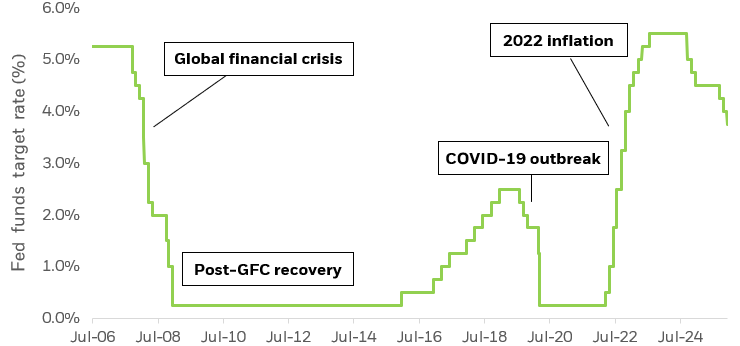
“The Fed held rates steady but spoiled the mood with a much more hawkish dot plot. Elevated inflation makes that understandable, but the committee is far from united, with only about half still penciling in rate hikes later this year,” Varghese said, as reported by CNBC.
The decision came amid mixed market reactions. While stock futures climbed, the S&P 500 and Nasdaq Composite fell on the day, with the Dow Jones Industrial Average dropping 0.98% after hitting an intraday high. Bond yields, however, surged, with the two-year Treasury yield reaching 4.22%.
Asia-Pacific Markets Show Mixed Performance
Asia-Pacific markets opened with mixed results, driven by divergent economic policies and geopolitical factors. South Korea’s Kospi rose 0.89%, fueled by gains in tech giants SK Hynix and Samsung Electronics, while Japan’s Nikkei 225 surged 1.79% to surpass 71,000 for the first time. The Bank of Japan raised its benchmark interest rate to 1%, its highest level in three decades, following a similar move by the European Central Bank.
In contrast, Australia’s S&P/ASX 200 fell 0.29%, and Hong Kong’s Hang Seng index declined 0.76%. The Nikkei’s record high came after the Bank of Japan’s rate hike, which aimed to counterbalance inflationary pressures and stabilize the yen. Meanwhile, the Nikkei’s surge was tempered by concerns over global demand, particularly in China, where the CSI 300 remained flat.
For more on this story, see Trump Signals Iran War, Stocks Plummet 1.3% Overnight.
Oil Prices Drop Below $80 Amid U.S.-Iran Tensions
Oil prices fell below $80 per barrel for the first time since early March, with Brent crude settling at $78.96, a 5.1% drop, according to Greenwich Time. The decline followed renewed optimism about a potential U.S.-Iran deal to reopen the Strait of Hormuz, which could ease global supply constraints. However, significant hurdles remain, including Iran’s nuclear program, which complicates long-term energy market stability.
The drop in oil prices contrasted with the Fed’s hawkish signals, as lower energy costs could ease inflationary pressures. However, analysts warned that the energy sector’s recovery would take months, with the price of Brent crude still far from its $100-plus level from weeks prior.
“The market doesn’t like regime change,” said David Zervos, chief market strategist at Jefferies, on CNBC’s “Closing Bell: Overtime.” His comment highlighted investor unease over the Fed’s shift toward tighter policy, even as inflation remains a persistent challenge.
U.S. Tech Stocks Weigh on Market Performance
U.S. tech stocks dragged the Nasdaq Composite lower, with Nvidia, Broadcom, and Micron Technology posting declines of 2.4%, 4.4%, and 6.2%, respectively. These losses reflected concerns over valuations and the sector’s recent volatility, as AI-driven growth stocks faced profit-taking after a prolonged rally. The S&P 500 slipped 0.6%, while the Dow Jones Industrial Average edged higher, buoyed by gains in industrials and financials.

Despite the downturn, some companies saw strong performance. SpaceX rose 4.8% after announcing a $60 billion acquisition of Cursor, an AI coding assistant, while Yum Brands climbed 1.9% following its $2.7 billion sale of Pizza Hut to LongRange Capital. However, Dave & Buster’s Entertainment fell 6.2% after missing earnings expectations, and Robinhood Markets declined 1.4% amid layoffs of 10% of its workforce.
What’s Next for Markets and Policy?
The Fed’s decision has left investors navigating a complex landscape. While the central bank’s rate hike outlook remains uncertain, the “dot plot” suggests a gradual tightening path. Analysts are closely watching the outcome of the U.S.
Find more reporting in our Business section.
