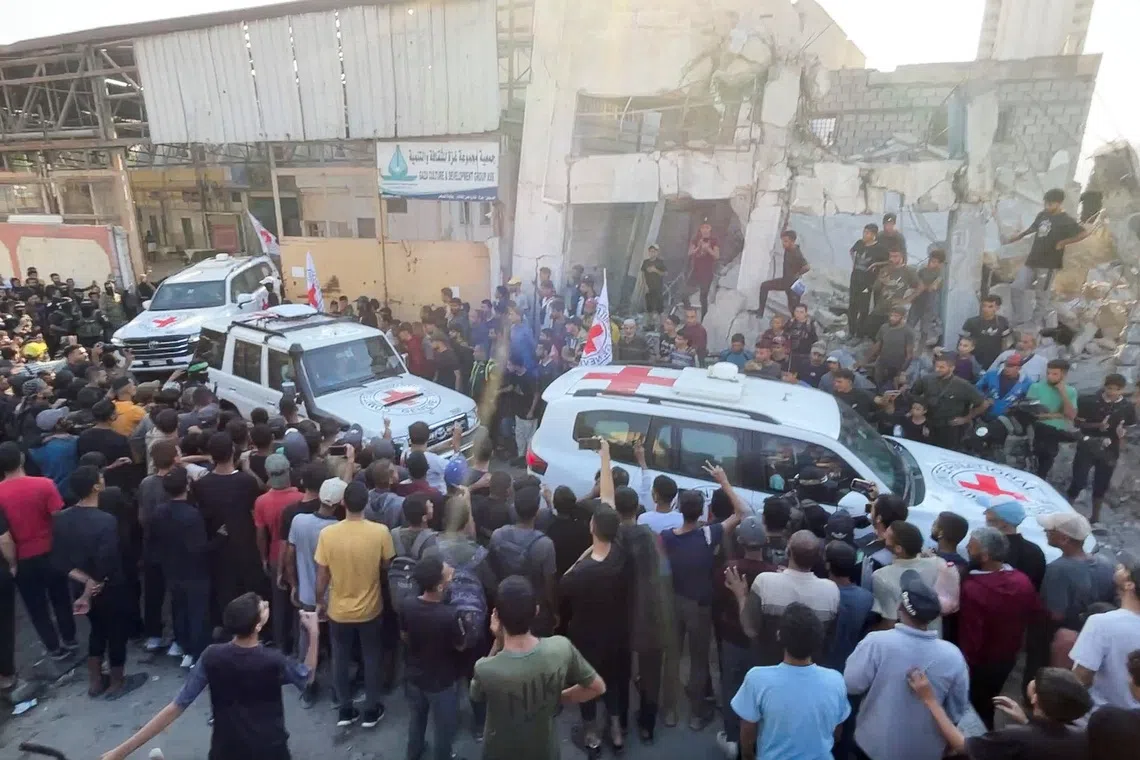
JERUSALEM/CAIRO — Hamas released seven Israeli hostages to the International Committee of the Red Cross on Monday, Oct. 13, the first handover under a U.S.-brokered ceasefire intended to end two years of war in Gaza, according to Israeli authorities and aid officials. The group is the first of 20 surviving captives slated for release under the deal; another 13 living hostages and the bodies of 26 others, with two cases still unaccounted for, are expected to follow later in the day, Israeli and Egyptian officials said.
The transfers began as crowds gathered at Israel’s Reim military base near the Gaza border, where the freed hostages are to be received for medical checks and reunions before moving to hospitals. In Tel Aviv, thousands converged on Hostages Square, cheering updates as news of the first releases spread. The International Committee of the Red Cross said it is coordinating multi-leg convoys between Gaza and Israel to move hostages and remains as safely as conditions allow.
Ceasefire implementation starts with staggered exchanges
As the hostage handovers got underway, Israel prepared to free nearly 2,000 Palestinian detainees and convicted prisoners in parallel, in line with lists approved by officials over the weekend. Many are expected to be processed in southern Gaza, where security was stepped up around Nasser Hospital in Khan Younis ahead of planned receptions and health screenings, according to on-the-ground footage and official briefings. Israeli outlets said additional releases would proceed in stages through the day to match the hostage timetable.
Initial schedules circulated by Israeli and Egyptian media indicated operations would begin at designated corridors in central Gaza and continue in the south. Israeli authorities said forensic teams are on standby to identify the remains of deceased hostages and to manage repatriations. Phased exchanges are a common feature of such deals, allowing mediators to verify compliance in real time and respond quickly to any breach.
Trump declares ‘the war is over’ as leaders head to Sharm el-Sheikh
U.S. President Donald Trump, en route to Israel ahead of a regional summit in Egypt, told reporters aboard Air Force One on Sunday, “The war is over,” and predicted the ceasefire would hold. He is scheduled to address Israel’s parliament in Jerusalem on Monday before co-chairing a peace summit in Sharm el-Sheikh with Egypt’s President Abdel Fattah el-Sisi, where more than 20 world leaders are expected to discuss post-war arrangements and reconstruction. Israel’s presidency said it plans to award Trump the country’s highest civilian decoration in the coming months for his role in the talks, according to AFP reports.
The summit will center on the first phase of what the White House has framed as a 20-point plan: a ceasefire, full hostage returns (living and deceased), and a large release of Palestinian prisoners, followed by a handover of Gaza’s civilian administration to a technocratic Palestinian committee under international oversight. Full text versions circulated by major outlets outline benchmarks for aid flows, security guarantees, and a pathway to broader political talks. According to a Reuters dispatch, the deal grew out of intensive mediation in Sharm el-Sheikh by Egypt, Qatar, Turkey, and U.S. envoys.
Why it matters: If the ceasefire endures and the exchanges proceed, it would mark the first comprehensive halt to fighting since October 2023 and set terms for Gaza’s transition from war to relief and recovery.
Casualties, displacement and the road to this moment
The conflict began with Hamas’ Oct. 7, 2023, cross-border assault that killed about 1,200 people in Israel and saw roughly 250 others taken hostage. Israel’s subsequent air and ground campaign shattered much of Gaza’s infrastructure. Palestinian health authorities estimate that more than 67,000 people have been killed in the enclave since the war began, a figure cited by multiple international reports. The fighting also widened into a regional confrontation involving Iran-aligned groups in Lebanon and Yemen, compounding the risks of escalation and maritime disruption in the Red Sea.
Those dynamics informed Washington’s push for a ceasefire that couples security assurances with humanitarian imperatives. The current arrangement foresees heavy international involvement in aid logistics, border management, and security deconfliction to accelerate relief and rubble removal while preventing weapons smuggling. Analysts note that past truces in the conflict often faltered when political questions about who governs Gaza and how security is enforced went unresolved.
Unsettled questions could test the truce
Key points remain contentious. Israel says any lasting calm requires Hamas to disarm and for a vetted authority to assume control in Gaza; Hamas rejects disarmament and insists that prisoner releases and full Israeli withdrawal are preconditions for longer-term arrangements. The U.S. plan envisions a temporary technocratic administration, with an international “board” guiding reconstruction until Palestinian institutions complete reforms and can take over. European and Arab states will be pressed in Sharm el-Sheikh to finance early recovery and infrastructure rebuilds, contingent on access guarantees and security benchmarks.
Implementation risks are substantial. Humanitarian agencies warn that unexploded ordnance, damaged roads, and limited fuel could slow aid deliveries. Israeli officials have indicated they will monitor compliance closely and reserve the right to resume operations if attacks or rocket fire resume. Mediators are preparing verification mechanisms to confirm each tranche of releases, a method that helped previous swaps withstand political shocks.
In Israel, the initial returns are being treated as a national priority, with hospitals standing up multidisciplinary teams for physical and psychological care. In the West Bank and Gaza, families have prepared to receive detainees whose legal and medical status varies widely after two years of mass arrests and emergency detentions. Rights groups say clear timelines and transparent procedures will be essential to prevent disputes that could imperil the broader deal.
Leaders in Jerusalem, Cairo, and Washington argue that sustaining the ceasefire requires rapid, visible improvements on the ground: expanding daily aid truck entries, restoring water and electricity, reopening schools and clinics, and jump-starting livelihoods. The alternative, they warn, is a slide back into violence as displaced families face a second winter amid ruins.
According to Reuters, Monday’s releases are the most sensitive test yet of the ceasefire’s credibility, marrying complex logistics with intense political stakes for all sides. For continuing coverage and analysis of the diplomacy behind the deal, read more on Globally Pulse News.
