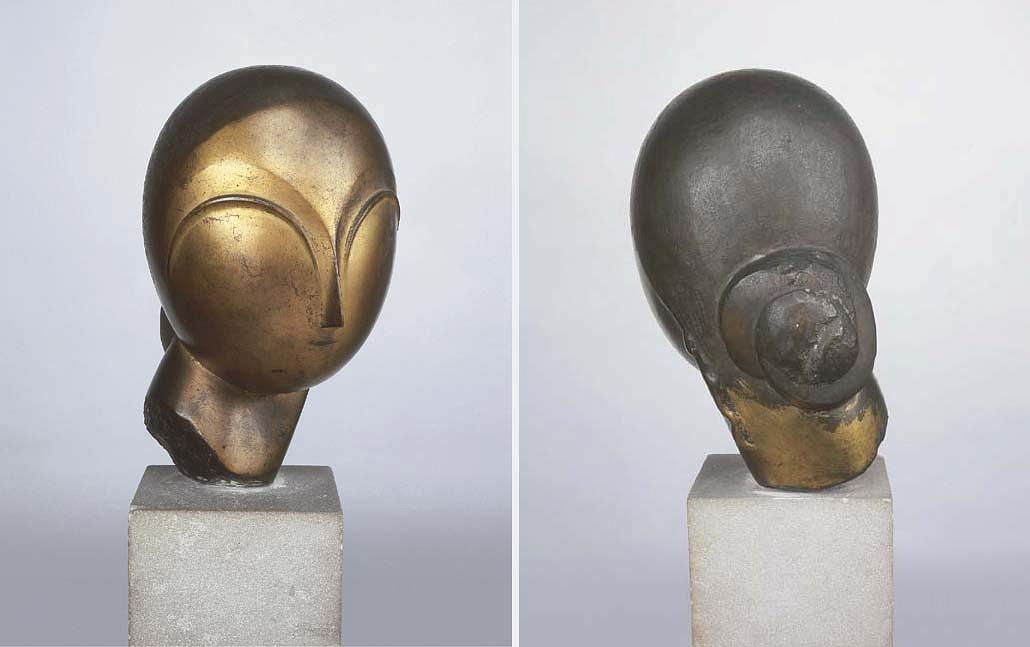
A Jackson Pollock drip painting from 1948, *Number 7A*, shattered auction records Tuesday by selling for $181.2 million with fees at Christie’s, joining Constantin Brancusi’s bronze sculpture—also estimated at $100 million—as the latest works to breach the $100 million threshold in this month’s spring sales.
The $100 Million Club Expands as Pollock and Brancusi Dominate Auctions
The art market’s resilience in 2026 reached new heights this week as two works—one by the Abstract Expressionist Jackson Pollock, the other by modernist sculptor Constantin Brancusi—became the latest entries in the exclusive $100 million auction club. Pollock’s *Number 7A, 1948*, a swirling canvas from his drip-painting era, fetched $181.2 million with buyer’s premium, while Brancusi’s bronze *Head of a Young Man* (circa 1913) sold for $107.6 million, both at Christie’s in New York. The sales, announced Tuesday, mark the first time Pollock has crossed the $100 million barrier, cementing his status alongside Picasso, Warhol, and Basquiat in the stratosphere of auction prices.
Pollock’s record-breaking sale was the centerpiece of Christie’s spring auctions, which drew nearly $2 billion in estimated sales across three major auction houses. The event underscored the market’s defiance of geopolitical unease, including the Iran war’s impact on Middle Eastern buyers, as collectors from Asia and the U.S. drove demand. “Buyers are engaged and looking for opportunity right now,” said Philip Hoffman, chairman of Fine Art Group, reflecting the liquidity of ultra-high-net-worth individuals who view art as a long-term store of value.
Pollock’s Price: A Reflection of Abstract Expressionism’s Enduring Value
Pollock’s *Number 7A, 1948* is part of a small cohort of his works that have fetched seven figures in recent years, though none had previously reached the $100 million mark. The painting’s provenance—tracing back to the collection of the late art dealer Larry Gagosian—added to its allure, as did its technical mastery of the drip technique, which Pollock perfected in the late 1940s. The sale also highlighted the shifting dynamics of the auction market, where Abstract Expressionist works, once the domain of American collectors, now attract global interest, particularly from Asia.

Brancusi’s *Head of a Young Man*, a defining piece of his minimalist style, had been expected to sell for between $80 million and $120 million. Its $107.6 million price tag exceeded estimates, reinforcing Brancusi’s standing as one of the 20th century’s most sought-after sculptors. The work’s sale followed a trend of modernist sculptures commanding record prices, with other Brancusi pieces, including *Bird in Space*, previously fetching over $20 million.
The Broader Context: Art as a Hedge Against Economic Uncertainty
The May auctions reflect a broader rebound in the art market, which has seen rapid growth since late 2025 despite economic volatility. Analysts attribute the surge to a combination of factors: the post-pandemic wealth of tech billionaires, the diversification of collecting bases into Asia, and the perception of art as a hedge against inflation and currency fluctuations. Christie’s, Sotheby’s, and Phillips have all reported record sales in 2026, with over 20 works estimated at $20 million or more.
However, the market’s future remains clouded by geopolitical risks. The Iran war has dampened enthusiasm among Middle Eastern buyers, a demographic that has become increasingly influential in the art world. Hoffman noted that while Asian collectors—particularly from China and South Korea—are driving current demand, the absence of traditional high rollers from the Gulf could temper future sales. “The wild card is the Middle East,” Hoffman said, acknowledging the uncertainty.
What Comes Next for the $100 Million Market
The Pollock and Brancusi sales are not just records—they signal a broader shift in how value is assigned to art. Pollock’s entry into the $100 million club is particularly notable, as his works have historically lagged behind those of his contemporaries like Rothko or de Kooning in auction prices. The sale suggests that the market is increasingly valuing Pollock’s technical innovation and cultural impact, positioning him as a titan of modern art.

Looking ahead, the next major test for the market will be the summer sales in July, when additional works by Rothko, Basquiat, and other heavyweights are expected to hit the block. The question remains whether the current momentum can sustain itself amid persistent economic and political headwinds. For now, Pollock and Brancusi have set the bar high—literally and financially.
One certainty is that the art world’s elite will continue to chase these records, proving that in an era of uncertainty, some assets remain priceless.
