Ancient human DNA recovered from cave walls in Spain and Portugal
A study published in Nature Communications reveals that cave walls can preserve genetic traces of prehistoric humans even when bones or teeth are missing.
- Headline Dispatch: Ancient human DNA recovered from cave walls in Spain and Portugal
- Core Takeaway: A study published in Nature Communications reveals that cave walls can preserve genetic traces of prehistoric humans even when bones or teeth are missing.
- Source Synthesis: Continuous live monitoring aggregated across major news wires and independent bureaus.
Ancient human DNA recovered from cave walls in Spain and Portugal
Researchers have recovered ancient human DNA directly from cave walls in Spain and Portugal, marking the first time genetic traces have been preserved on rock surfaces for thousands of years. The findings, published in Nature Communications, suggest that cave walls can act as archives of prehistoric human presence even when traditional archaeological deposits like bones or teeth are missing.
The study was conducted as part of the First Art project, an interdisciplinary effort led by researchers from Spain and Portugal in collaboration with institutions in Germany, China, and the UK. The project primarily aims to characterize the chemical composition and date the earliest known cave art. Specialists from the Max Planck Institute for Evolutionary Anthropology (MPI-EVA) joined the effort to determine if the rock itself could hold genetic traces of the artists.
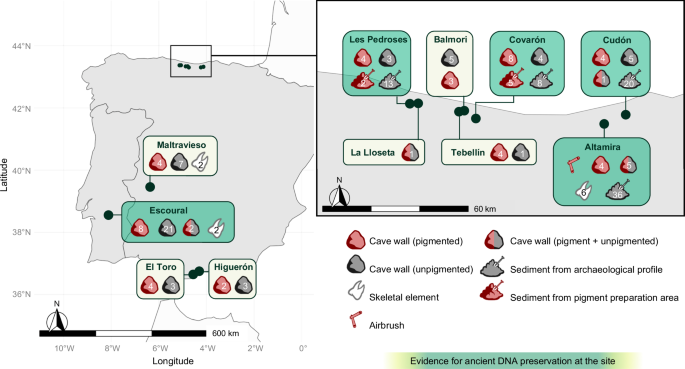
The team analyzed 24 rock art panels across 11 caves, examining a variety of materials including hand stencils, simple marks, figurative paintings from the Cave of Altamira in Spain, and unpigmented wall surfaces. They also sampled sediments, bones, and a prehistoric bird-bone airbrush tool used to spray red ochre.
While the team collected between 54 and 120 samples depending on the metric, only five yielded authentic ancient human mitochondrial DNA. One successful sample came from a pigmented calcite crust on Panel 11 at Escoural Cave in Portugal. Notably, this sample contained no faunal DNA. According to the researchers, the absence of animal DNA — which is typically found in cave sediments — strongly suggests direct human contact through the deposition of bodily fluids such as saliva or sweat.
Other discoveries appeared on plain rock. Several unpigmented wall samples from Escoural and Covarón Cave in northern Spain also held ancient human DNA. Some of these samples contained a mixture of human and faunal DNA, which the team attributes to indirect deposition via water movement or sediment carried by hands.
"Although we cannot directly connect the traces of ancient human DNA we have found to the creation of rock art, this is the first evidence for human DNA preservation on cave walls for thousands of years,"
Alba Bossoms Mesa, doctoral researcher at MPI-EVA, via Nature Communications
The recovered DNA provided specific biological insights. Nuclear DNA from two samples at Covarón identified the individuals as Western hunter-gatherers, a genetic cluster consistent with other ancient Iberian populations. The researchers also determined biological sex from some samples: three were mostly female, and one was mostly male.
Determining the exact age of the DNA proved challenging as no direct dates exist. The team estimated the age based on molecular damage and site history. The DNA is at least 2,000 years old. At Escoural Cave, which remained sealed from the Chalcolithic period until 1963, the minimum age is estimated at roughly 4,000 or 5,000 years.
Not all tests were successful. The bird-bone airbrush from Altamira Cave yielded no ancient human DNA. Researchers believe decades of handling the tool buried any original genetic material under modern human DNA.
The rarity of the findings, with authentic DNA appearing on only one of the 24 painted panels, indicates that pigment surfaces seldom retain DNA unless they are protected by sealed environments or mineral crusts. The preservation of human DNA on cave walls is highly variable, according to Bossoms Mesa.
"This study fundamentally changes how we think about where ancient DNA can be found. We were surprised to see that ancient DNA can be recovered not only from pigmented samples, but also from cave walls that show no visible evidence of past human activity,"
Matthias Meyer, palaeogeneticist at MPI-EVA, via press release
Hipólito Collado Giraldo, an archaeologist with the Extremadura Government in Spain, stated that the work is about understanding how prehistoric people used caves and where they left their marks. He noted that because art was often applied by rubbing or blowing pigment, the sensitivity of modern analysis could potentially allow researchers to obtain genetic profiles of the artists themselves.
The research team now intends to refine their methods to determine the specific conditions that lead to higher success rates of DNA preservation. Future steps include testing more sites, art styles, and techniques, with a specific focus on figurative art and hand stencils in caves with strong molecular preservation, utilizing minimally invasive sampling.
How significant is this development?
Participate in our community survey on the trajectory and real-world impact of this news.