Astronomers find nearby planets to be small, strange, and utterly uninhabitable
A team of researchers has presented a detailed portrait of four small, uninhabitable planets orbiting Barnard’s Star. These worlds are rich in periclase and likely lack atmospheres.
- Headline Dispatch: Astronomers find nearby planets to be small, strange, and utterly uninhabitable
- Core Takeaway: A team of researchers has presented a detailed portrait of four small, uninhabitable planets orbiting Barnard’s Star. These worlds are rich in periclase and likely lack atmospheres.
- Source Synthesis: Continuous live monitoring aggregated across major news wires and independent bureaus.
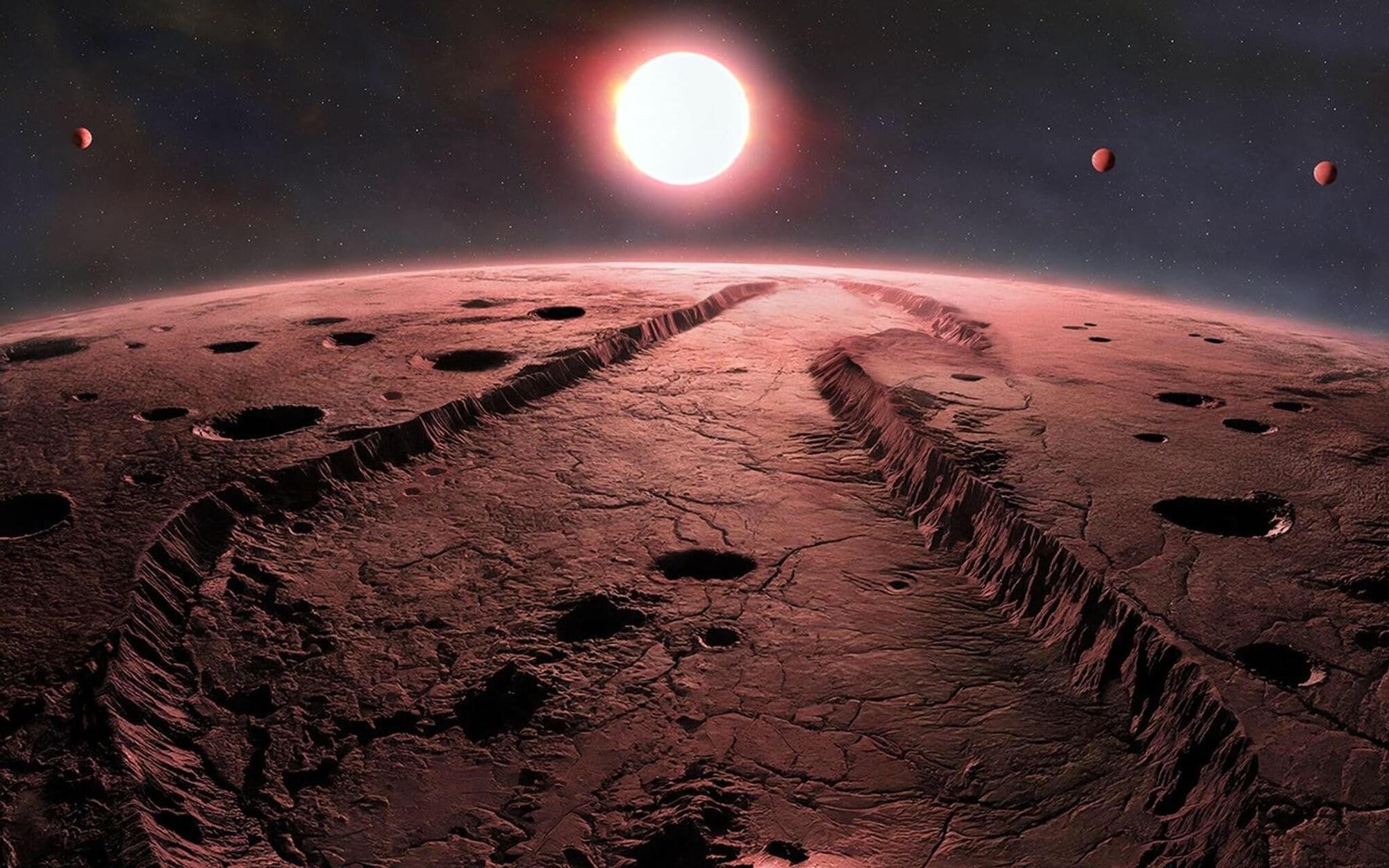
Astronomers find nearby planets to be small, strange, and utterly uninhabitable
A team of researchers has presented the most detailed portrait yet of the planetary system orbiting Barnard’s Star, the Sun’s closest neighbor after Alpha Centauri. The four planets, discovered in 2025, are all smaller than Earth and Venus but larger than Mars, making them a type of planet not found anywhere in our own Solar System.
By analyzing the chemical makeup of the star, the researchers found that its planets are rich in a rare mineral called periclase, which on Earth is only found hundreds of kilometers below the surface. According to lead author Xander Byrne from Cambridge’s Institute of Astronomy, "Barnard’s Star has an enormous amount of the element magnesium compared to other stars, so its planets are likely to be rich in magnesium too." However, the abundance of magnesium creates huge quantities of periclase, which does not store water as well as other minerals.
The chances of the planets having atmospheres are also unlikely, as they are extremely close to their star. Even the outermost planet orbits ten times closer than Mercury orbits the Sun, making it impossible for the planets to hold on to their atmospheres for more than two billion years. This is much shorter than the system’s 10-billion-year age. As a result, each planet has one hemisphere locked in eternal daylight, while the other is in eternal night, due to being tidally locked.
Planetary systems as compact as the one around Barnard’s Star are often unstable, with gravitational interactions between the planets sometimes leading to them colliding, falling into the star, or being ejected from the system. However, the researchers found that a phenomenon called orbital resonance might be helping to stabilize the Barnard’s Star system. The lengths of the "years" of the inner three planets are in a 9:12:16 ratio, which is equivalent to two consecutive perfect fourths. This orbital harmony is responsible for stabilizing the orbits of the moons of Jupiter and may be protecting the Barnard’s Star system from gravitational disarray.
Upcoming missions, such as the European Space Agency’s PLATO mission, may find many more small planets like those around Barnard’s Star. As Byrne notes, "Larger planets are much easier to detect than small ones, so we know about very few sub-Earth planets like the ones in this system." However, the sensitivity of these new missions will help to reduce this bias, allowing researchers to discover more and more planets that are small and rocky, like Earth.
Although the Barnard’s Star planets are extremely uninhabitable, the team emphasizes that their analysis linking the compositions of the star and planets could be an important consideration in determining whether other planets could support life. The study, published in the Monthly Notices of the Royal Astronomical Society, provides new insights into the formation and evolution of planetary systems.
How significant is this development?
Participate in our community survey on the trajectory and real-world impact of this news.