NASA Psyche spacecraft uses Mars flyby
NASA Psyche spacecraft uses Mars flyby
- Headline Dispatch: NASA Psyche spacecraft uses Mars flyby
- Core Takeaway: NASA Psyche spacecraft uses Mars flyby
- Source Synthesis: Continuous live monitoring aggregated across major news wires and independent bureaus.
NASA Psyche spacecraft uses Mars flyby
NASA's Psyche spacecraft has successfully completed a close flyby of Mars, using the planet's gravity to gain speed and redirect its path toward the asteroid Psyche. On May 15, the spacecraft passed within 2,864 miles of the Martian surface, receiving a crucial gravitational assist without using additional onboard fuel.
The maneuver sends Psyche on a direct route toward its target in the asteroid belt between Mars and Jupiter. After the flyby, engineers confirmed the spacecraft was exactly where it needed to be by analyzing radio communications between Psyche and NASA's Deep Space Network (DSN), the agency's worldwide communications system for deep space missions.
According to Don Han, Psyche's navigation lead at NASA's Jet Propulsion Laboratory, "Although we were confident in our calculations and flight plan, monitoring the DSN's Doppler signal in real time during the flyby was still exciting. We've confirmed that Mars gave the spacecraft a 1,000 mile-per-hour boost and shifted its orbital plane by about 1 degree relative to the Sun. We are now on course for arrival at the asteroid Psyche in summer 2029."
The Mars encounter also gave the mission team an opportunity to fully test Psyche's scientific instruments before the spacecraft reaches the asteroid. During the days leading up to the flyby and at closest approach, engineers powered up the spacecraft's imagers, magnetometers, and gamma-ray and neutron spectrometer.
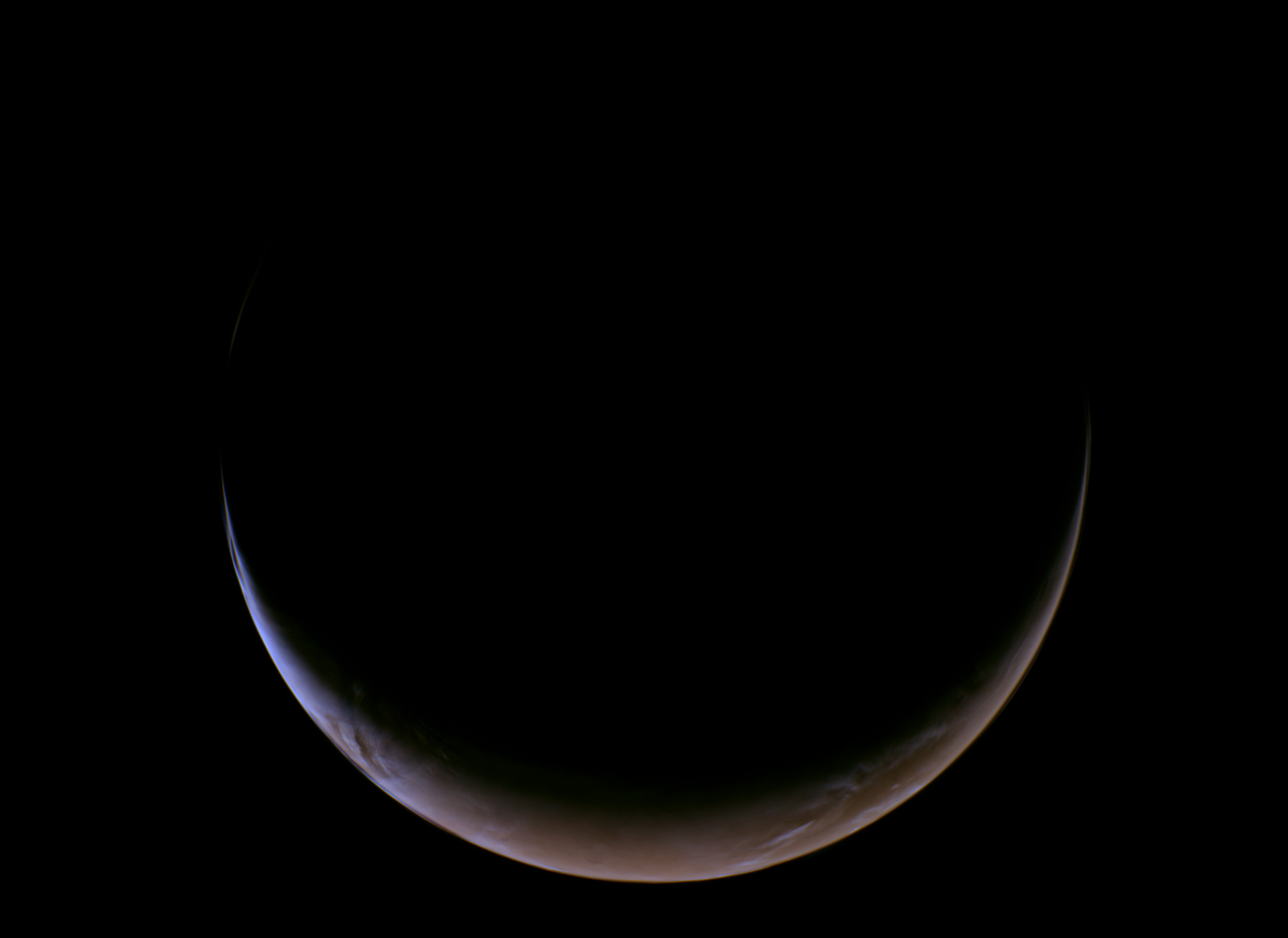
As Psyche approached Mars, the planet appeared as a narrow crescent because of the angle between the spacecraft, Mars, and the Sun. Images taken by the spacecraft's multispectral camera showed the crescent stretching farther around the planet than expected. Scientists say sunlight scattering through Mars' dusty atmosphere likely caused the effect. Near closest approach, the spacecraft rapidly photographed the Martian surface as it crossed from the night side of the planet into daylight.
Jim Bell, the Psyche imager instrument lead at Arizona State University, said, "We've captured thousands of images of the approach to Mars and of the planet's surface and atmosphere at close approach. This dataset provides unique and important opportunities for us to calibrate and characterize the performance of the cameras, as well as test the early versions of our image processing tools being developed for use at the asteroid Psyche. As the spacecraft continues its journey after the flyby, we'll continue calibration imaging of Mars for the rest of the month as it recedes into the distance."
The flyby also allowed scientists to collect valuable calibration data from Psyche's other instruments. Early readings from the spacecraft's magnetometers may have detected Mars' bow shock, the region where the solar wind interacts with the planet's magnetic environment. At the same time, the gamma-ray and neutron spectrometer team gathered measurements that can now be compared with decades of existing Mars data.
With Mars now behind it, Psyche will resume using its solar-electric propulsion system to continue toward the asteroid belt. The spacecraft is scheduled to arrive at asteroid Psyche in August 2029. Scientists believe Psyche could be the exposed partial core of an ancient planetesimal, one of the building blocks that formed planets early in the solar system's history. The asteroid measures about 173 miles across at its widest point.
Once it arrives, the spacecraft will orbit Psyche at several different altitudes while mapping the surface and collecting scientific data. If the asteroid truly represents the metallic interior of an early world, it could provide researchers with a rare opportunity to study material similar to what lies deep inside rocky planets such as Earth.
Lindy Elkins-Tanton, principal investigator for Psyche at the University of California, Berkeley, said, "We've been anticipating the Mars flyby for years, but now it's complete. We can thank the Red Planet for giving our spacecraft a critical gravitational slingshot farther into the solar system. Onward to the asteroid Psyche!"
The Psyche mission is led by Arizona State University, with NASA's Jet Propulsion Laboratory managing mission operations, engineering, testing, and system integration. The spacecraft chassis for Psyche's high-power solar-electric propulsion system was provided by Intuitive Machines in Palo Alto, California. ASU oversees operation of the spacecraft's imaging instrument in partnership with Malin Space Science Systems in San Diego, which helped design, build, and test the cameras.
Psyche is the 14th mission selected for NASA's Discovery Program, managed by the agency's Marshall Space Flight Center in Huntsville, Alabama. NASA's Launch Services Program at Kennedy Space Center in Florida managed launch services for the mission.
How significant is this development?
Participate in our community survey on the trajectory and real-world impact of this news.