NASA's New Horizons spacecraft wakes from its longest hibernation in good health
After awakening from its longest hibernation to date, New Horizons is resuming active operations to study the outer heliosphere and identify new Kuiper Belt objects.
- Headline Dispatch: NASA's New Horizons spacecraft wakes from its longest hibernation in good health
- Core Takeaway: After awakening from its longest hibernation to date, New Horizons is resuming active operations to study the outer heliosphere and identify new Kuiper Belt objects.
- Source Synthesis: Continuous live monitoring aggregated across major news wires and independent bureaus.
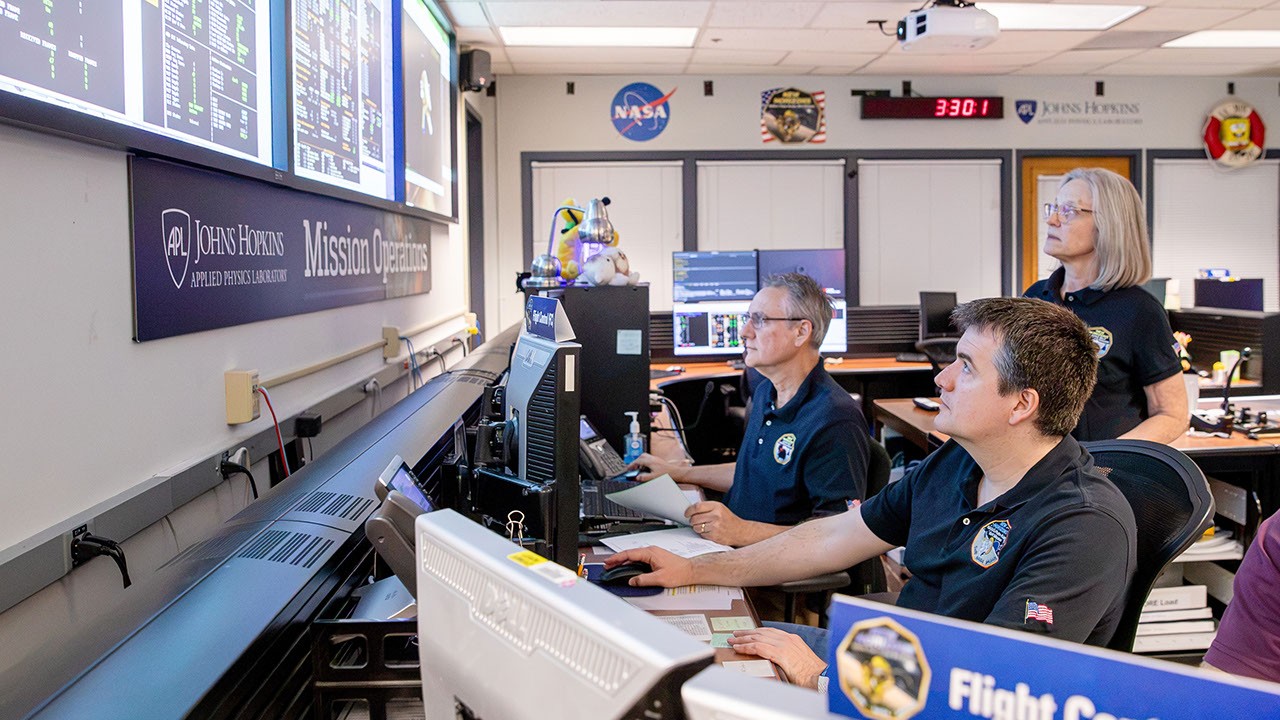
NASA's New Horizons spacecraft has successfully awakened from its longest hibernation period to date, spanning 321 days. Flight controllers at the Johns Hopkins Applied Physics Laboratory (APL) in Laurel, Maryland, confirmed the spacecraft's health on June 23, following the execution of commands that had been uplinked to the main computer the previous July.
The hibernation period began on Aug. 7. Because New Horizons is currently approximately 5.9 billion miles (9.5 billion kilometers) from Earth, the radio signal confirming its awakening took about 8 hours and 52 minutes to travel from the spacecraft to the APL Mission Operations Center via a NASA Deep Space Network station located near Madrid, Spain.
To conserve resources during long cruise periods, the mission team frequently places the spacecraft into this hibernation mode. During these intervals, operators do not retrieve data or send new commands. However, New Horizons continues to gather and store information around the clock using the Venetia Burney Student Dust Counter and heliospheric plasma sensors, specifically the Pluto Energetic Particle Spectrometer Science Investigation and Solar Wind at Pluto.
Alice Bowman, the New Horizons mission operations manager at APL, stated that the spacecraft maintained communication through a weekly status beacon.
"Every status report through this hibernation period was ‘green,’ meaning all was well aboard New Horizons each and every week,"
Alice Bowman, mission operations manager at APL, via science.nasa.gov
The spacecraft is now resuming active operations. According to Bowman, the team will first downlink health and safety data before retrieving information from the three scientific instruments. In approximately three weeks, the Alice ultraviolet spectrograph will be used to examine the distribution of hydrogen gas in the outer heliosphere. Meanwhile, the ground team will perform a series of instrument and spacecraft checkouts.
The mission is now utilizing updated autonomy logic. This system is designed for operations far from the Sun, accounting for naturally increasing radio-signal travel times and an expected reduction in power.
On the ground, the team is upgrading software for the mission control system to simplify operations. These tests began previously and are expected to continue through the year.
New Horizons has been exploring the solar system since January 2006, when it departed Earth in the fastest launch on record. Its journey has included:
- A February 2007 flyby of Jupiter and its moons.
- The first exploration of the Pluto system in July 2015.
- The first exploration of a Kuiper Belt object, Arrokoth, in January 2019.
- Studies of dozens of other Kuiper Belt objects and the Sun's outer heliosphere.
Future objectives include a detailed campaign to study the termination shock, the region where solar wind slows to subsonic speeds upon meeting the interstellar medium of the Milky Way galaxy. New Horizons will provide the first new data on gas, radiation, dust, and charged particles for this region since the Voyager missions. The team also intends to use the Vera Rubin Observatory, a National Science Foundation facility coming online this year, to identify new Kuiper Belt objects for potential study or flybys.
The mission has also seen a change in leadership. Helene Winters has stepped down as project manager after nearly nine years. She is succeeded by Caitlin Shearer of APL, who previously worked on the DART asteroid impactor mission.
How significant is this development?
Participate in our community survey on the trajectory and real-world impact of this news.