UIUC researchers develop first omnidirectional 3D thermal cloak
A team from the University of Illinois Urbana-Champaign has developed a hybrid material capable of guiding heat around objects from any direction.
- Headline Dispatch: UIUC researchers develop first omnidirectional 3D thermal cloak
- Core Takeaway: A team from the University of Illinois Urbana-Champaign has developed a hybrid material capable of guiding heat around objects from any direction.
- Source Synthesis: Continuous live monitoring aggregated across major news wires and independent bureaus.
UIUC researchers develop first omnidirectional 3D thermal cloak
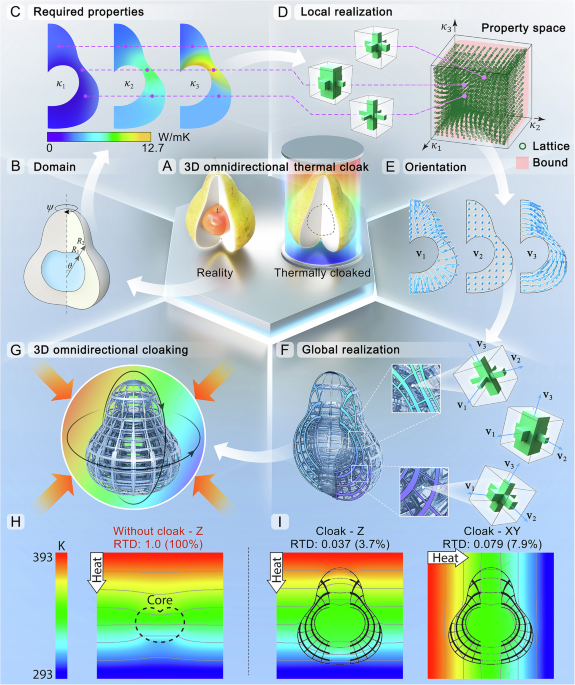
Researchers have designed and built the first 3D device capable of making objects invisible to heat. This development, published in Nature Communications, creates a shield that hides objects of nearly any shape from infrared cameras while simultaneously protecting those objects from extreme temperatures.
Previous thermal cloaking attempts were limited to two dimensions or functioned only when heat flowed from a single direction. This new device operates from essentially any direction. Rather than blocking heat, the cloak guides it around an object, making it appear to an infrared camera as if the object is not there.
The project was a collaboration between University of Illinois Urbana-Champaign professor Shelly Zhang, graduate student Yibo Wang, and postdoctoral researcher Weichen Li, working alongside professor Ole Sigmund at the Technical University of Denmark.
"A real thermal cloak should work no matter where the heat comes from,"
Shelly Zhang, professor, via news.illinois.edu
To move beyond 2D limitations, the team utilized the original theory of transformation thermotics to determine what material structure could provide the necessary thermal properties for a perfect cloak. Their solution was a lattice-based material adjustable in three directions. By tuning these dimensions, the researchers could precisely control the thermal conductivity of different regions, matching the theoretical requirements for ideal cloaking more closely than previous methods.
The resulting device is a physical hybrid material. The team used 3D-printed metal to construct a precise aluminum lattice for high conductivity, then used mold casting to fill that structure with a rubber-like material that possesses low thermal conductivity. This approach uses a 3D de-homogenization method to deliver the graded and anisotropic 3D thermal conductivities required.
During laboratory testing, the team placed the device within a temperature gradient between hot and cold regions. Infrared cameras showed that the external temperature field looked as if no object were present, while the temperature inside the cloaked region remained uniform and protected from external extremes. The researchers tested the device on highly complex 3D geometries, including detailed head-like shapes and a specific experiment involving cloaking an apple inside a pear.
The research team states that no previous experimental thermal cloak has reached this level of performance or geometric complexity. They believe the technology could transform several fields:
- Precise heat management for microchips and sensitive electronic components.
- Defense and security applications to hide equipment or personnel from thermal detection.
- Protection of assets operating in harsh environments.
"Any field that needs precise control of heat or needs to protect something from being detected thermally could benefit from this work,"
Shelly Zhang, professor, via news.illinois.edu
Zhang noted that the work is fundamentally about hiding and protecting information carried by heat. The study was supported by the Air Force Office of Scientific Research, the Villum Foundation, and the National Science Foundation.
The team now intends to explore multifunctional and "smart" cloaks. A primary future goal is to determine how to mask an object that generates its own internal heat, which would require a device capable of spreading, concentrating, or guiding heat on demand within the protected zone.
"We've shown that a true 3D omnidirectional thermal cloak is possible,"
Shelly Zhang, professor, via news.illinois.edu
How significant is this development?
Participate in our community survey on the trajectory and real-world impact of this news.