Russia’s missile and drone attack on Ukraine kills at least 18
A wave of Russian strikes targeting residential buildings and critical infrastructure has killed at least 18 people and wounded over 100. President Zelenskyy is calling for urgent air defense reinforcements as casualties mount.
- Headline Dispatch: Russia’s missile and drone attack on Ukraine kills at least 18
- Core Takeaway: A wave of Russian strikes targeting residential buildings and critical infrastructure has killed at least 18 people and wounded over 100. President Zelenskyy is calling for urgent air defense reinforcements as casualties mount.
- Source Synthesis: Continuous live monitoring aggregated across major news wires and independent bureaus.
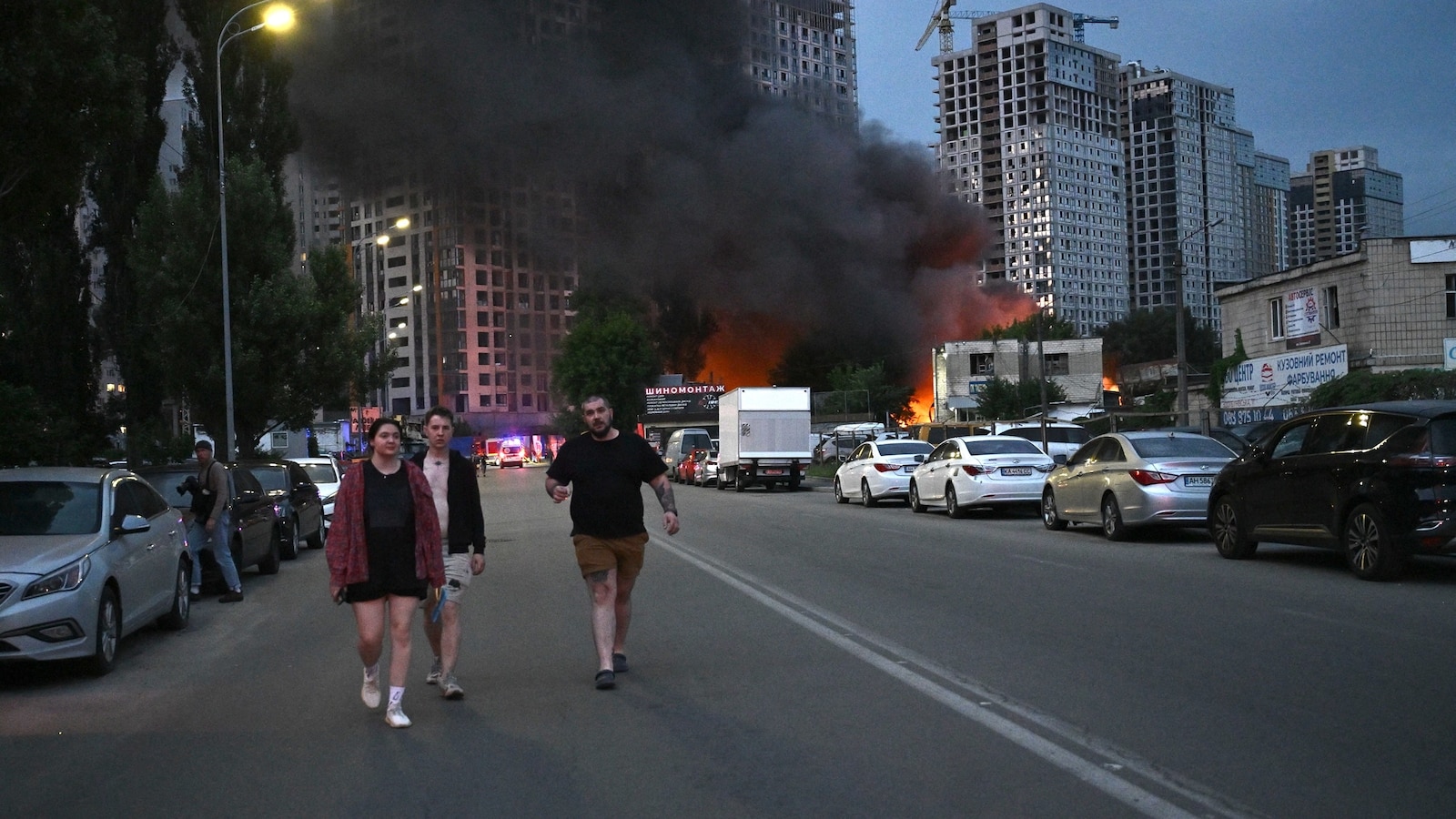
Russia’s missile and drone attack on Ukraine kills at least 18
Russia launched a massive wave of drones and missiles across Ukraine, killing at least 18 people and wounding over 100 in an onslaught that officials described as one of the deadliest raids on the capital in months. The strikes, which targeted residential buildings and critical infrastructure, have intensified calls from Ukrainian leadership for urgent air defense reinforcements from Western allies.
The capital, Kyiv, bore the brunt of the bombardment. In one instance, a missile struck a nine-storey residential building in Kyiv's Solomianskyi district, wiping out a whole section of it, which was flattened into a pile of debris. Other strikes hit the Darnytskyi district, where a five-storey residential building was struck, and the Podilskyi district, where a building partially collapsed. Rescue teams have spent days combing through rubble to locate survivors.
Casualty reports from the region vary across official accounts. Some local officials stated 12 people died in Kyiv and six in the wider region. Other reports indicated 16 deaths in the capital, including a 62-year-old U.S. Citizen killed by shrapnel. Victims included children, with one reported as young as two. In Dnipro, officials reported between five and 12 deaths, while other sources cited deaths in the southern port city of Odesa.
The Ukrainian air force reported a staggering volume of ordnance. While different counts were provided, one report stated Russia launched 656 drones and 73 missiles, including 33 hard-to-shoot-down ballistic missiles and eight Zircon hypersonic missiles. The Zircon travels at nine times the speed of sound and has a range of 625 miles. Another report listed 68 missiles and 351 drones. While hundreds of drones were intercepted, Ukrainian officials emphasized that advanced ballistic weapons frequently evade defenses.
President Volodymyr Zelenskyy attributed the casualties to a critical shortage of Patriot interceptor missiles. He noted that many of these U.S.-made missiles have been diverted to the Middle East since the U.S. And Israel began attacking Iran in February.
"As long as the missiles for the Patriots remain in the warehouses of allies, this only encourages Russia to continue destroying residential buildings,"
Volodymyr Zelenskyy, President of Ukraine, via social media
The strikes also targeted diplomatic and cultural sites in Kyiv. The offices of the EU delegation were severely damaged by the shock wave
of a blast, according to EU ambassador Katarina Mathernova. The British Council office also suffered severe damage, including shattered front windows. In the city, the attack temporarily cut power to 140,000 residents, while cities in the south, including Mykolaiv and Kherson, were left without electricity.
Russia's Defense Ministry described the operation as a massive strike
using land, air, and sea-based systems. Moscow claimed to have targeted military-industrial facilities, including sites producing sea drones and armored vehicles, as well as energy infrastructure. The Kremlin stated it remains interested in diplomacy but will continue its strikes, claiming the war has entered a new paradigm
following what it called inhumane acts of terror
by Ukrainian forces.
Ukraine retaliated with its own drone strikes deep inside Russian territory. In the Krasnodar region, a Ukrainian drone hit the Ilsky oil refinery, causing a fire. Russian officials reported that two people, including a 14-year-old girl, were killed in Tuapse, while another 11-year-old boy was injured in the Belgorod region. Moscow's Mayor Sergey Sobyanin reported that at least 15 Ukrainian drones were shot down near the Russian capital.
The escalation comes as peace efforts stall. U.S.-brokered talks have slowed as President Donald Trump shifted focus toward the Middle East. While Ukraine has proposed a stable ceasefire as a first step toward negotiations, Moscow insists on a peace deal before any ceasefire. Tensions were further heightened after Trump met Vladimir Putin in Alaska in August, an attempt to end the war that ultimately failed.
International support continues to fluctuate. Canada recently announced $2 billion in military aid and a $2.3-billion loan for infrastructure. Meanwhile, Ukraine is seeking the release of a €90bn EU loan, following the removal of Viktor Orbán from power in Hungary. President Zelenskyy is expected to press for further air defense decisions at a NATO summit in Ankara this week.
How significant is this development?
Participate in our community survey on the trajectory and real-world impact of this news.