Spain declares national emergency over wildfires near Madrid and in Avila
The Spanish government has shifted operational command to the Military Emergency Unit as critical blazes devastate regions near Madrid and Avila.
- Headline Dispatch: Spain declares national emergency over wildfires near Madrid and in Avila
- Core Takeaway: The Spanish government has shifted operational command to the Military Emergency Unit as critical blazes devastate regions near Madrid and Avila.
- Source Synthesis: Continuous live monitoring aggregated across major news wires and independent bureaus.
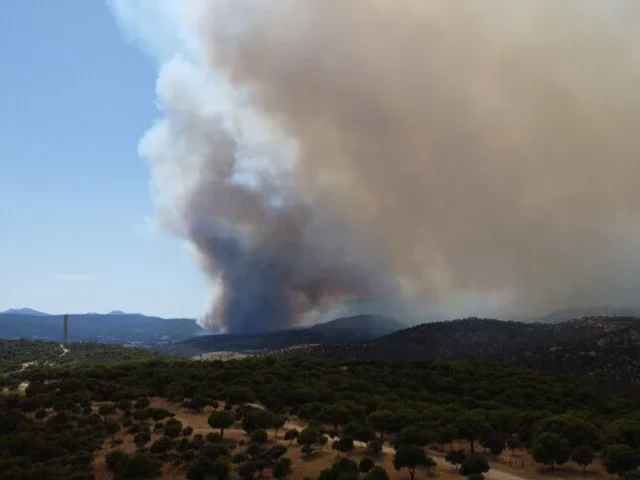
Spain declares national emergency over wildfires near Madrid and in Avila
Spain’s government declared a national emergency on Friday, July 24, 2026, as multiple wildfires raged through the Community of Madrid and the province of Avila. The decision, announced by Interior Minister Fernando Grande-Marlaska, comes as the country struggles against a heatwave and dry conditions that have pushed regional resources to their limits.
The emergency declaration allows the Interior Ministry, which manages security and police forces, to take direct charge of firefighting efforts. This shift in command was prompted by the simultaneous spread of fires, adverse weather, and the need to coordinate extensive resources across different public administrations. The Military Emergency Unit (UME) has been assigned operational command of the emergency response.
In the Madrid region, the fires have impacted the municipalities of Villa del Prado and San Martín de Valdeiglesias. Regional authorities describe the situation as critical
, with three major fires remaining active and out of control. More than 10,000 people have been evacuated from Villa del Prado, San Martin de Valdeiglesias, Pelayos de la Presa, and Aldea del Fresno. Local officials warned that current conditions mean the blazes have the potential to continue advancing without the capacity for extinction
.
The crisis extends into the Castilla and Leon region, specifically in the province of Avila. Fires have advanced near Burgohondo and Cebreros, where residents have been forced to spend nights in sports centers. In Burgohondo, Mayor Francisco Martínez told national broadcaster TVE that in 60 years he had never seen fire of such dimensions in his village of 1,500 residents.
The broader national picture is equally grim. According to Minister for the Ecological Transition Sara Aagesen, Spain has already seen 1,140 square kilometers burned this year. This figure is more than five times the burned terrain recorded through the first half of 2025. Recent disasters include the second-largest fire in Spanish history, which consumed 320 square kilometers in Guadalajara, and a blaze in southern Spain earlier this month that killed 13 people.
Interior Minister Grande-Marlaska noted that beyond the crises in Madrid and Avila, there are nine other serious fires active across Spain. Firefighters are battling the flames with bulldozers and firetrucks, though their efforts are hampered by hilly terrain and strong winds. Temperatures in parts of the country were expected to exceed 39 degrees Celsius on Friday, reaching as high as 44 degrees Celsius in Almeria.
Spain is not alone in the struggle. A wider wave of wildfires has hit southern Europe. In France, more than 60,000 people fled their homes to escape two major blazes. Interior Minister Laurent Nunez reported 40,000 evacuations in the Gironde department and 23,000 in the Landes. In the tourist-heavy Cap Ferret peninsula, where a fire has raged since Wednesday, July 23, 2026, some residents were evacuated by boat.
The scale of the crisis has led both Spain and France to request aid from the European Union. France is expecting reinforcements including two Portuguese Air Tractor aircraft, two Croatian Canadair aircraft, and two heavy-lift Black Hawk helicopters from Slovakia and the Czech Republic. Italy and Greece are each sending two Canadair water-dumping airplanes to assist Spain.
Similar devastation is occurring in Italy. In Sicily, the province of Agrigento has been particularly hard hit, with the national fire department reporting over 1,400 operations since the previous weekend. High temperatures exceeding 40 degrees Celsius and low humidity have contributed to the blazes, which recently killed a firefighter in Caltanissetta.
Prime Minister Pedro Sánchez described the situation as dramatic
and called on Wednesday, July 23, 2026, for a political pact to fight climate change, stating it is the key to adapting to a more fire-prone climate. The European Union’s Copernicus Climate Change Service noted that Europe is the fastest-warming continent, with temperatures increasing twice as quickly as the global average since the 1980s.
How significant is this development?
Participate in our community survey on the trajectory and real-world impact of this news.