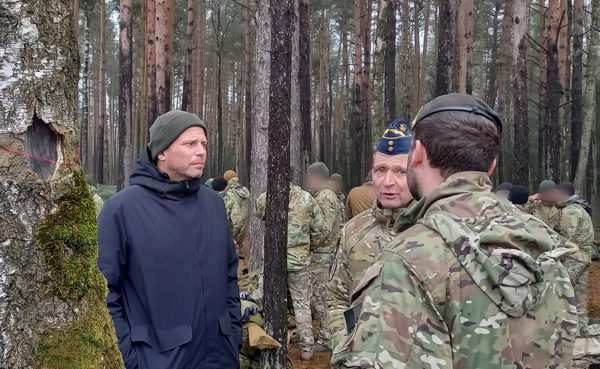
NATO’s eastern flank reinforced as Belgian troops train in Lithuania
Belgian Defence Minister Theo Francken and Chief of Defence Frederik Vansina visited the Belgian contingent stationed at the Rukla military camp in Lithuania on Tuesday, 2025. The delegation inspected the battalion that Belgium deployed in the summer of 2024 as part of NATO’s Enhanced Forward Presence (eFP) on the alliance’s eastern frontier. With more than 200 Belgian soldiers integrated into a multinational battlegroup of roughly 1,400 troops, the unit trains alongside forces from Germany, Norway, the Netherlands, Luxembourg and the host nation, operating under German command.
Francken described the Baltic region as “a threatened region” and highlighted that “I was able to see with my own eyes how intensively they train.” His assessment echoes NATO’s own appraisal that the eFP’s purpose is to deter aggression by demonstrating a credible, forward‑deployed force capable of rapid response. The Belgian contingent’s presence, according to NATO’s Baltic‑eFP statement, is designed to reassure allies and signal that any attempt to destabilise the area would be met with a unified multinational response.
During the visit, a Belgian soldier who has been in Lithuania since 2021 remarked, “The Lithuanians are really preparing for war.” His commanding officer added that the sentiment among both civilians and troops is no longer “if” but “when” an invasion could occur. The comment reflects a broader anxiety in the Baltic states, where recent intelligence assessments by NATO’s International Security Department have underscored a “high probability” of Russian hybrid pressure, ranging from cyber‑attacks to the possible deployment of conventional forces near the border.
Belgium’s stance on the EU‑Ukraine funding debate
While the troops rehearse defensive drills, Brussels is locked in a separate, high‑stakes discussion over how to fund Ukraine’s war effort. The European Union is negotiating a €210‑billion “reparations loan” that would use interest generated by frozen Russian sovereign assets—most of which are held at Belgium’s Euroclear clearing house—to back a multi‑year financing package for Kyiv. Belgian Prime Minister Bart De Wever has repeatedly warned that the plan places “unlimited financial and legal risk” on Belgium, arguing that if Moscow successfully challenges the seizure of assets, the liability could fall on the Belgian state.
According to Politico, EU officials have warned that a continued Belgian veto could result in Belgium being “treated like Hungary,” meaning its concerns would be sidelined in future negotiations and its influence on the EU budget diminished. Belgium’s foreign minister Maxime Prévot echoed this view in a December 3 statement, describing the reparations‑loan proposal as “the worst of all options” because it “has never been done before” and carries “consequential economic, financial and legal risks.”
The dispute over the frozen‑asset loan is not merely a fiscal issue; it directly ties into NATO’s security calculations. Euroclear’s role as the custodian of roughly €194 billion of Russian assets means that any legal challenge could affect the credibility of the alliance’s financial infrastructure. As NATO’s Secretary‑General Jens Stoltenberg has warned, the stability of the euro and the functioning of European clearinghouses are essential for maintaining allied cohesion, especially as the bloc seeks to finance the same defense measures being practiced on the ground in Lithuania.
Regional implications and global relevance
The convergence of on‑the‑ground military readiness and high‑level diplomatic wrangling underscores the intertwined nature of European security. The Helsinki summit on Tuesday, attended by leaders from Finland, Sweden, Latvia, Lithuania, Estonia, Poland, Romania and Bulgaria, issued a joint declaration calling for “immediate priority” to strengthen land forces, drone defenses, air and missile shielding, and border protection across the EU’s eastern flank. This political signal aligns with the NATO eFP’s operational goals and reinforces the perception that the Baltic region is a flashpoint in the broader Russia‑West confrontation.
Globally, the outcome of Belgium’s opposition will influence how the EU marshals resources to sustain Ukraine’s defense, which in turn affects the overall balance of power in Eastern Europe. Should the EU proceed without Belgian acquiescence, it risks a split that could weaken collective resolve, echoing earlier frictions over sanctions enforcement. Conversely, a compromise that provides “extra cash buffers and financial guarantees,” as requested by Brussels, could set a precedent for leveraging frozen assets while safeguarding member‑state legal exposure.
Next diplomatic steps and outlook
The EU leaders’ summit scheduled for December 18 in Brussels will be the decisive forum for the reparations‑loan proposal. Diplomatic sources indicate that EU ambassadors will review Belgium’s amendment list line‑by‑line, seeking a compromise that includes additional guarantees for Euroclear and a clear liability framework should Russia win a legal challenge. Simultaneously, NATO plans to rotate additional multinational exercises at Rukla in the coming months, with a focus on combined arms manoeuvres and anti‑drone tactics, to maintain readiness on the alliance’s most vulnerable flank.
For Belgium, the situation presents a dual challenge: maintaining its credibility as a reliable NATO partner while protecting national financial interests tied to Euroclear. The outcome will be watched closely by allies in Washington, where the Trump administration’s renewed skepticism toward NATO and its own aid commitments to Ukraine have already strained transatlantic coordination (see Reuters coverage of the U.S. aid freeze). A coherent EU response could help re‑anchor European security architecture at a moment when global geopolitical fault lines are sharpening.
In sum, the visit by Francken and Vansina spotlights the tangible dimension of NATO’s deterrence strategy, while the parallel diplomatic debate in Brussels underscores how financial tools and legal considerations are now central to the alliance’s capacity to support Ukraine and safeguard the eastern European frontier.
For further analysis of Belgium’s financial stance, see our in‑depth report on the EU‑Ukraine frozen‑asset loan.
