
Donald Trump will present the World Cup trophy alongside FIFA president Gianni Infantino at the July 19 final in New Jersey — but the ceremony risks overshadowing the game itself.
FIFA president Gianni Infantino confirmed Wednesday that U.S. President Donald Trump will join him on stage at MetLife Stadium to hand the trophy to the tournament winner, marking the first time a sitting U.S. president has participated in a World Cup final. The announcement comes as France’s Didier Deschamps abruptly departs the tournament after his mother’s death, leaving his team’s final group match in limbo. Meanwhile, FIFA’s controversial hydration breaks — introduced this year amid fan backlash — may become a permanent fixture in future tournaments, Infantino suggested.
Trump’s Return to MetLife Stadium: A Trophy Presentation with Controversial History
Trump’s presence at the final isn’t his first appearance at MetLife Stadium. Last year, he presented the trophy to Chelsea after their Club World Cup victory, an event marred by boos from the crowd and awkward moments on stage. Trump remained on the podium as Chelsea captain Reece James and goalkeeper Robert Sánchez lifted the trophy, a scene that played out again in the Oval Office when a replica was displayed. The president’s attendance at this year’s final, however, carries far greater weight — and potential for distraction.
Infantino’s confirmation on Fox & Friends that Trump will “be together with the president, enjoying the final, and handing the trophy to the winner” underscores the political symbolism of the moment. The two have a long-standing relationship, with Infantino calling Trump a “close friend” and presenting him with FIFA’s Peace Prize in 2025. That award, however, drew criticism from human rights groups and the Norwegian Football Association, who questioned its legitimacy. The ethics committee never investigated the relationship, but the controversy lingers.
“We will be together with the president, enjoying the final and handing the trophy to the winner — of course, together.”
Gianni Infantino, FIFA president, via Fox & Friends
Trump’s role in the ceremony raises questions about whether the moment will eclipse the football itself. At last year’s Club World Cup, his prolonged presence on stage drew confusion from players and murmurs from the crowd. This time, with the World Cup final on the line, the risk is greater: broadcasters may cut to commercials during the trophy presentation, further disrupting the flow of the game. Infantino dismissed concerns about lost revenue for FIFA, noting that contracts were signed before the hydration breaks were introduced — but the optics of a political figure hijacking the final’s climax could still alienate fans.
MetLife Stadium, the venue for the final, has a history of hosting high-profile political events, including Trump’s 2020 State of the Union address and the 2016 Republican National Convention. The stadium’s capacity of 82,500 makes it the largest in the U.S., and its proximity to New York City ensures a global audience. However, the stadium’s association with Trump — particularly after his 2024 indictments — has led to protests and boycotts from some fans and sponsors. The World Cup final presents a unique challenge: balancing the event’s global appeal with local political sensitivities.
Infantino’s decision to include Trump in the ceremony also reflects FIFA’s broader strategy of leveraging high-profile figures to enhance the tournament’s visibility. Past World Cups have featured appearances by celebrities like Beyoncé and Shakira, but a sitting U.S. president represents a new level of political engagement. The move has drawn mixed reactions from football purists, who view the ceremony as a distraction, and commercial stakeholders, who see it as a marketing opportunity.
For Trump, the appearance offers a chance to rehabilitate his image ahead of the 2024 U.S. election, where his handling of international affairs — including his relationship with Infantino — could be a campaign talking point. The president’s attendance at the final aligns with his administration’s push to position the U.S. as a global leader in sports and entertainment, a narrative that has gained traction since the 2026 World Cup bid win.
Deschamps’ Absence Leaves France in Uncertain Hands
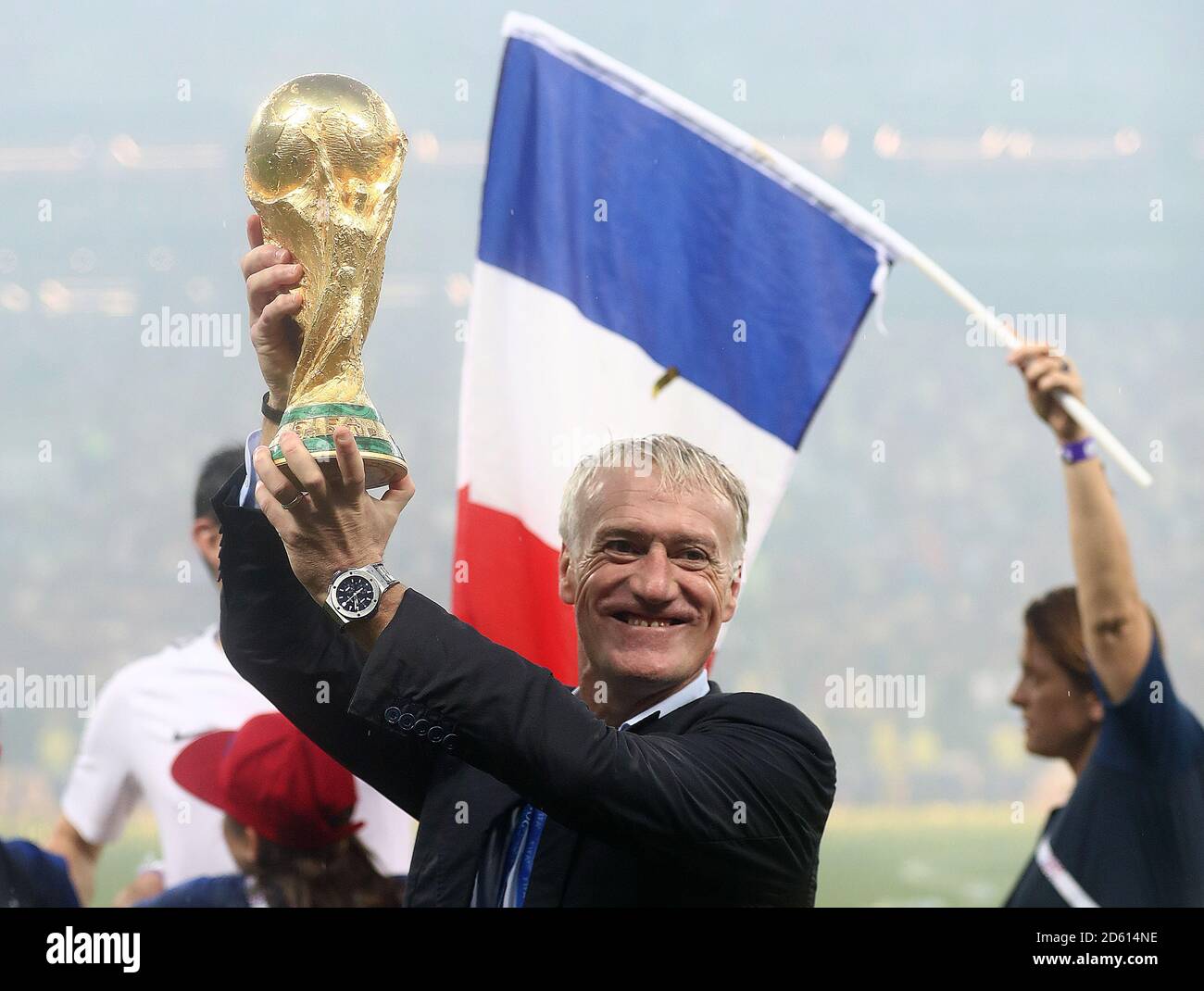
While the trophy presentation dominates headlines, France’s tournament is in flux after manager Didier Deschamps learned of his mother’s death Wednesday morning. The French Football Federation announced he would miss the team’s final group match against Norway, entrusting assistant coach Guy Stéphan with leadership. Deschamps, a three-time World Cup winner as both player and manager, will return to France to attend the funeral, leaving his squad without its most experienced voice.
For more on this story, see USMNT Defeats Paraguay 4-1 in Historic 2026 World Cup Opener at SoFi Stadium.
“Didier Deschamps will not be able to oversee training sessions ahead of the Norway vs France match. He will also be absent from the bench for Friday’s final Group I game.”
French Football Federation statement, via ABC News
France, already assured of a knockout spot after wins over Senegal and Iraq, now faces a critical test against Norway — a team that has matched their intensity. A Norway victory would knock France into second place, complicating their path to the final. Stéphan’s temporary leadership could test the squad’s cohesion, though Deschamps’ absence might also provide an unexpected benefit: a brief respite for players after a grueling group stage.
Deschamps’ departure comes at a pivotal moment in France’s campaign. The team’s 2-1 victory over Senegal in their opening match set the tone for a dominant start, but their 2-0 win over Iraq was marred by controversy after a late penalty was awarded to France. The match ended in celebrations, but the decision — which saw Iraq’s goalkeeper handball the ball — has sparked debate among neutrals and pundits alike. Deschamps’ tactical acumen and ability to manage player egos have been key to France’s success, and his absence could leave a void.
Norway, meanwhile, has emerged as a dark horse in the tournament. Their 2-1 victory over Spain in their opening match — a team they had never beaten in 11 previous encounters — sent shockwaves through football circles. Norway’s aggressive pressing and physicality have made them a formidable opponent, and their ability to exploit defensive weaknesses has been a recurring theme. If they defeat France, they will advance to the knockout stage as one of the few European teams to do so without a single loss.
Stéphan, a former France midfielder, has managed the team in Deschamps’ absence before, including during the 2022 World Cup. However, his role as assistant coach has been largely behind the scenes, and his ability to inspire the team in a high-pressure match remains untested. The French players, many of whom have won multiple World Cups, may also be more focused on their own performances than on tactical adjustments, which could work in their favor against a Norway side that has struggled with consistency.
Deschamps’ return is expected within 48 hours, but the damage to the team’s momentum could be lasting. The French Football Federation has not ruled out Deschamps managing the team in the knockout rounds, but his emotional state and the need for continuity could complicate his return. The team’s next match, against Norway, will be a litmus test for Stéphan’s leadership and the squad’s ability to perform without their manager.
Hydration Breaks: A Permanent Distraction?
Infantino’s defense of hydration breaks — the three-minute stoppages introduced this year — reveals another layer of controversy. While fans and players have criticized the disruptions, Infantino framed them as a potential long-term feature, citing “the intensity of the games” as justification. “We’ve never seen 90 minutes in a tournament like this played in such an intensity,” he told SNTV, implying the breaks help players recover.
This follows our earlier report, Trump to Attend Knicks-Spurs Game 3 Amid Security, Political Tensions.
“Maybe the coach can reassess certain situations, correct certain mistakes. The players get a little rest and come back in full speed. Well, is that bad necessarily? Maybe it’s good.”
Gianni Infantino, via SNTV
Yet the financial implications remain murky. Infantino insisted FIFA makes “zero additional revenues” from the breaks, as broadcasters’ contracts predated the decision. The real winners, he hinted, are networks cutting to ads during the stoppages — a boon for television partners but a frustration for fans who see the breaks as an erosion of the game’s flow. Whether the experiment becomes permanent hinges on whether the disruptions prove tolerable or become a permanent stain on the tournament’s rhythm.
The hydration breaks were introduced after FIFA conducted a study in collaboration with medical experts, who argued that the high temperatures and physical demands of the tournament required additional rest periods. However, the decision was made unilaterally by FIFA’s executive committee, bypassing the traditional consultation process with player unions and broadcasters. This has led to accusations that the breaks were implemented to benefit television networks rather than player welfare.

Player reactions to the breaks have been mixed. Some, like Argentina’s Lionel Messi, have publicly criticized the disruptions, arguing that they break the flow of the game and reduce the intensity of the final moments. Others, including England’s Jude Bellingham, have acknowledged the physical toll of the tournament and supported the breaks as a necessary adjustment. The International Players’ Association (FIFPro) has also expressed concerns, stating that the breaks could lead to a loss of momentum and increase the risk of injuries during transitions.
For broadcasters, the hydration breaks present a unique opportunity to monetize the additional airtime. Networks like ESPN and Fox have already begun testing extended commercial breaks during the stoppages, with some reports suggesting that ad revenue has increased by as much as 15% during these periods. However, the long-term impact on fan engagement remains uncertain, as many viewers have expressed frustration with the disruptions on social media.
FIFA’s decision to introduce the breaks without prior consultation has also raised questions about the organization’s transparency and accountability. The World Cup has long been a showcase for football’s global appeal, but the hydration breaks have become a symbol of FIFA’s willingness to prioritize commercial interests over the integrity of the game. Whether the breaks become a permanent feature will depend on the feedback from players, broadcasters, and fans in the coming months.
What Happens Next: Three Scenarios for the Final
- Political Overshadowing: If Trump’s presence dominates coverage, broadcasters may prioritize his role over the football, risking fan frustration. The 2024 Club World Cup incident suggests the stage could become a distraction — but this time, the stakes are higher. With the final taking place in the U.S., the political implications are magnified, and any disruption could lead to widespread backlash from football purists and media outlets. The ceremony’s duration and Trump’s potential speech could also draw criticism from those who view it as a misuse of the World Cup’s neutral platform.
- France’s Uncertainty: Deschamps’ absence leaves Stéphan in charge, raising questions about tactical cohesion. Norway’s strong form means France could finish second in Group I, complicating their knockout path. If France loses to Norway, they will enter the knockout stage as the group’s second seed, facing a potential quarterfinal against a team like Brazil or Argentina. Stéphan’s ability to adapt France’s tactics without Deschamps’ input could be the deciding factor in their campaign.
- Hydration Breaks as Policy: If Infantino’s hints hold, future World Cups may adopt the breaks permanently — a decision that could reshape the tournament’s pace and fan experience. The breaks could also lead to a shift in how matches are structured, with more emphasis on halftime strategies and player rotations. However, the long-term impact on the game’s intensity and spectator experience remains uncertain, and any permanent change would require widespread consensus from stakeholders.
The final itself remains the focal point, but the surrounding controversies — from Trump’s political presence to Deschamps’ abrupt departure and the hydration breaks’ future — threaten to overshadow the game. For Infantino, balancing these elements is the ultimate test: can FIFA deliver a spectacle that satisfies both the sport’s purists and its commercial imperatives?
Read also: Trump Eyes Keeping South Lawn UFC Arena as Permanent White House Landmark.
One thing is certain: the July 19 final at MetLife Stadium will be remembered not just for the winner, but for the chaos — and potential brilliance — of the ceremony that follows.
As the tournament progresses, the stakes for the final are higher than ever. The winner will not only claim the World Cup trophy but also the bragging rights of being the best team in the world. For France, the absence of Deschamps adds an emotional layer to their campaign, while Norway’s unexpected rise has captured the imagination of football fans worldwide. Meanwhile, the hydration breaks serve as a reminder of the ongoing tension between tradition and innovation in modern football.
The final will be a clash of titans, not just on the pitch but also in the narrative surrounding the tournament. Whether it’s Trump’s political influence, Deschamps’ emotional absence, or the hydration breaks’ legacy, the World Cup final promises to be a moment that transcends the game itself.
Find more reporting in our Sports section.
