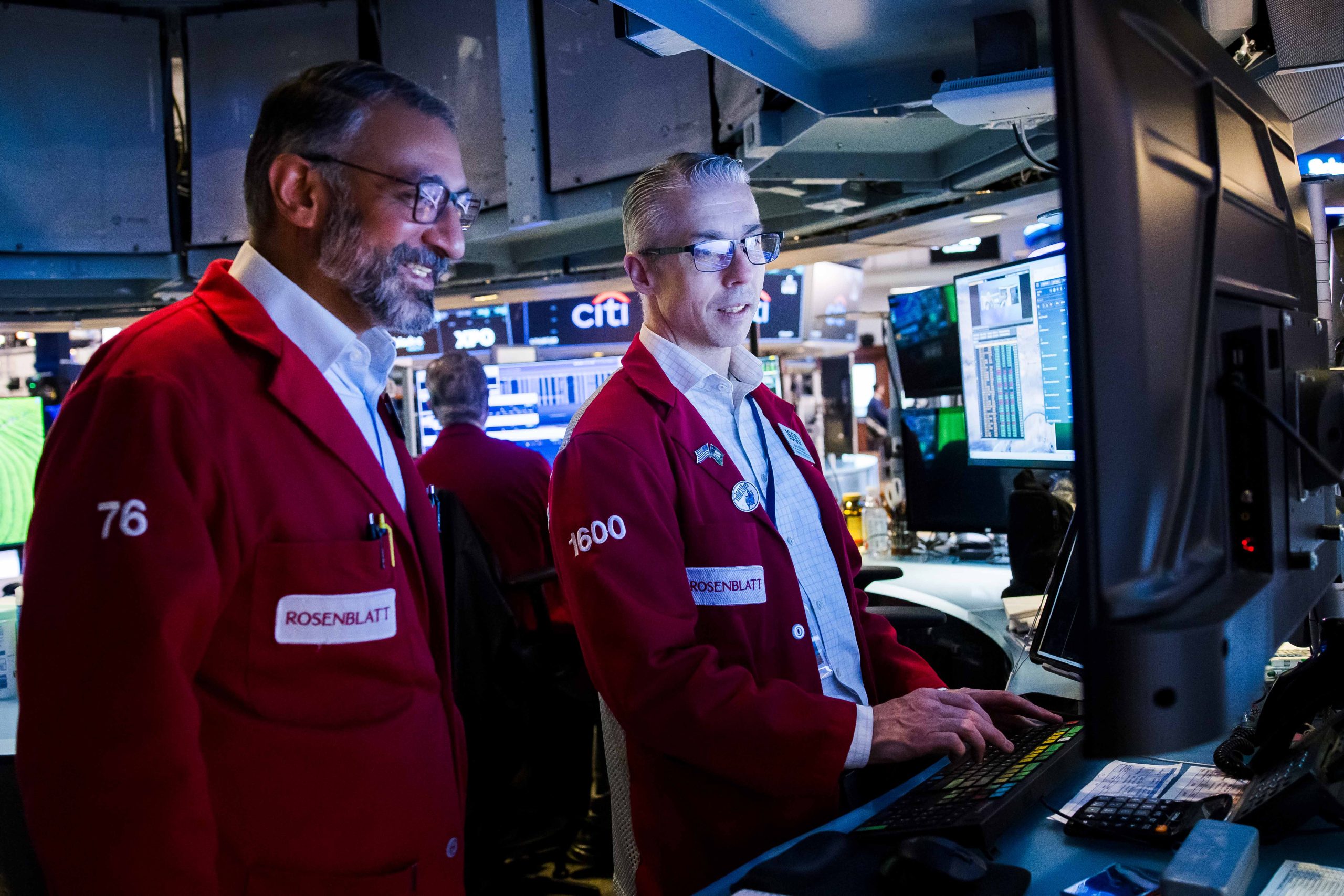
The Dow Jones Industrial Average reached an all-time intraday high of 50,600.73 on Friday, May 22, 2026, as U.S. stocks climbed alongside easing Treasury yields. Investors tracked potential progress in conflict-resolution talks between the U.S. and Iran, while resilient earnings and the ongoing expansion of artificial intelligence infrastructure supported a broad weekly market rally.
Market Records and the Impact of Easing Yields
Dow Jones Industrial Average
Wall Street signaled a strong finish to the week on Friday, with major benchmarks moving higher as bond market volatility subsided. The Dow Jones Industrial Average climbed 315.07 points, or 0.63%, to hit a record high of 50,600.73—the last of the three major U.S. indexes to reach a new milestone since the onset of the conflict in late February. The S&P 500 rose 0.65% to 7,494.23, while the Nasdaq Composite added 0.67% to reach 26,468.72.
The rally follows a week defined by significant fluctuations in the bond market. The 10-year Treasury note yield, which had touched its highest level in over a year earlier in the week, eased to 4.54% on Friday. This relief in borrowing costs provided a tailwind for equities, particularly as investors weighed the inflationary pressures of energy prices against the optimism surrounding technology sector earnings. According to reporting from the Associated Press, the easing of yields is critical for smaller companies, which rely on borrowing to scale operations; the Russell 2000 index responded with a 0.9% gain.
Geopolitical Tensions and Energy Market Volatility
cluster (priority): AP News
The market has remained sensitive to the ongoing conflict between the U.S. and Iran, which has caused significant disruption in global oil markets. Earlier this week, Brent crude oil prices briefly surged past $109 per barrel, raising concerns about supply chain bottlenecks in the Strait of Hormuz. However, prices settled at $102.58 following a midday reversal on Thursday, helping to stabilize equity sentiment.
Progress remains incremental. Media reports indicate that Iran’s foreign minister has met with the interior minister of Pakistan to discuss proposals for ending the conflict. Despite the diplomatic activity, analysts remain cautious about the economic fallout. Adam Crisafulli, founder of Vital Knowledge, noted the persistent risk of stagflation:
“Our view on Iran is the same as before: a deal is much more likely than not, but this is already priced in, and the conflict will have stagflationary effects for at least the next few quarters,” Adam Crisafulli, founder of Vital Knowledge
Adding to this perspective, Peter Cardillo, chief market economist at Spartan Capital Securities, emphasized that while geopolitical hurdles persist, the market has found support elsewhere:
“While key differences between the U.S. and Iran still need to be resolved to end the war, the continuation of peace talks remains a supportive factor for investors,” Peter Cardillo, Spartan Capital Securities
AI Infrastructure and Corporate Performance
Stocks: Dow hits record high, crosses 49K for first time
Despite geopolitical headwinds, the “AI trade” continues to serve as a primary engine for market growth. Nvidia, despite a 1.8% dip in recent sessions, remains a central figure in the market’s narrative regarding data center expansion. CEO Jensen Huang underscored the scale of this shift:
“The buildout of AI factories — the largest infrastructure expansion in human history — is accelerating at extraordinary speed,” Jensen Huang, CEO of Nvidia
The broader market has benefited from this momentum. UBS Global Wealth Management recently raised its year-end target for the S&P 500 to 7,900, up from 7,500, citing the resilient demand for data center infrastructure and consistent consumer spending. Meanwhile, individual corporate results have provided further catalysts. Ralph Lauren shares jumped 13.9% after beating quarterly revenue and profit expectations, and Estée Lauder surged 12% following news of a partnership with Spanish perfumery Puig.
Outlook for the Memorial Day Holiday
cluster (priority): news.google.com
As the trading week concludes, volatility appears to be waning ahead of the Memorial Day holiday, when U.S. markets will remain closed. The CBOE Volatility Index, often referred to as Wall Street’s “fear gauge,” hovered near a two-week low of 16.64. The focus will shift next week to Washington, as Kevin Warsh is set to be sworn in as the new Federal Reserve leader, a transition that marks a pivotal moment for U.S. monetary policy.