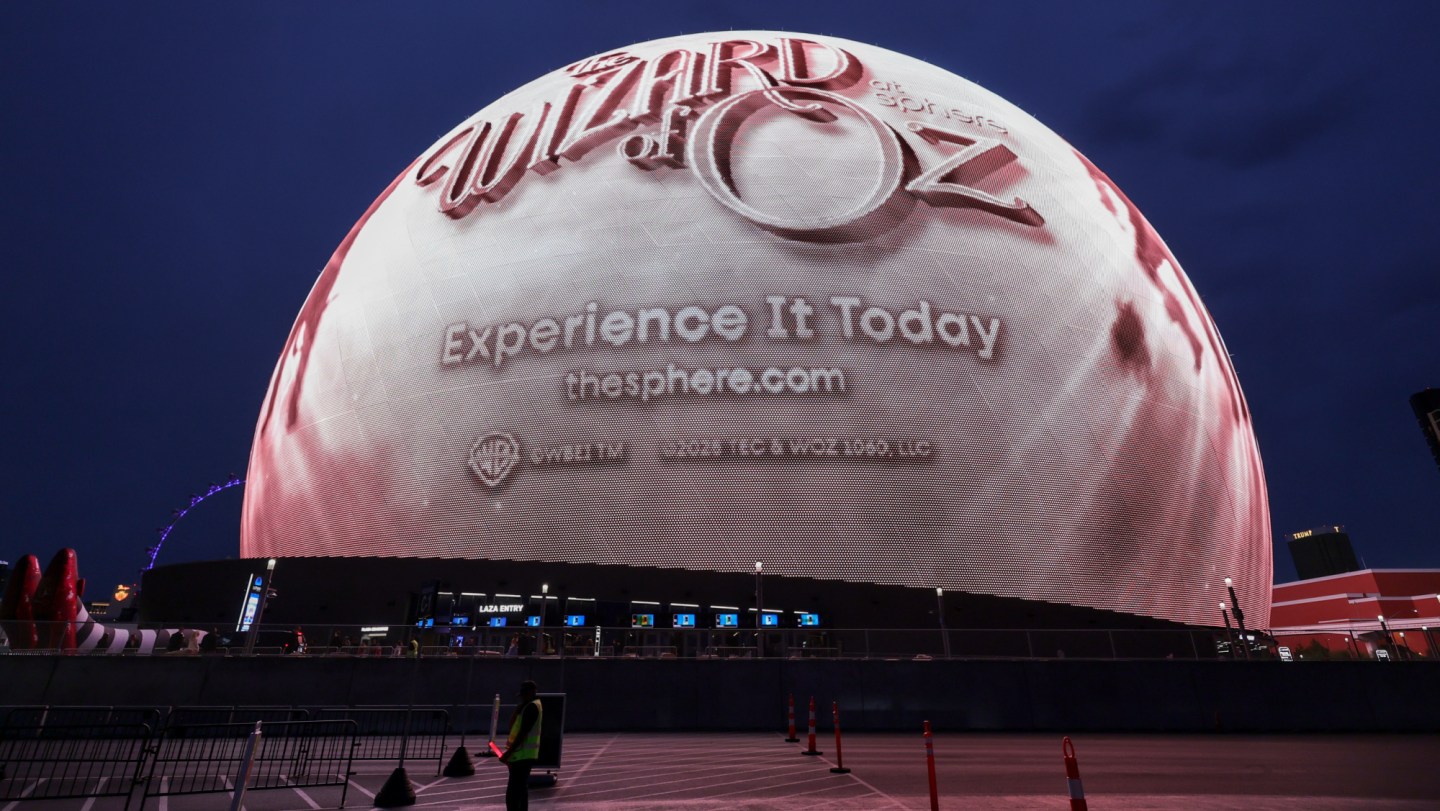
Sphere Entertainment announced Tuesday that an experiential production of The Rocky Horror Picture Show will premiere at the Las Vegas Sphere in 2027. The project follows the massive financial success of the venue’s Wizard of Oz at Sphere experience, which has generated over $400 million in revenue and sold 3 million tickets since August 2025.
The Shift from Oz to Rocky Horror
The 1975 cult classic The Rocky Horror Picture Show is set to replace the venue’s current feature, Wizard of Oz at Sphere, according to reports by the Las Vegas Review-Journal. While no specific date has been set for the transition, the venue currently has no scheduled screenings for the Oz production past December. The new project is being developed in a collaboration between Sphere Studios, Primary Wave Music, and 20th Century Studios.

The transition marks a distinct change in tone for the venue’s programming. The Wizard of Oz served as a technical test case for adapting classic film IP, utilizing a $100 million development budget to recreate elements like tornadoes within the dome. In contrast, The Rocky Horror Picture Show is expected to lean into its legacy of audience participation, a hallmark of its decades-long history in midnight screenings. As Deadline reported, while the Oz production drew praise for its technical fidelity, it also faced criticism from film purists regarding the removal of roughly 25 minutes of original runtime and several musical numbers.

The selection of The Rocky Horror Picture Show suggests a strategic pivot toward properties that possess strong, pre-existing fan communities. Unlike The Wizard of Oz, which functions as a broad, family-oriented spectacle, Rocky Horror remains one of the longest-running theatrical releases in history, famously bolstered by decades of interactive “shadow cast” performances. By bringing this title to the Sphere, the production team faces the unique challenge of scaling a traditionally intimate, basement-theater experience to a dome that stands 366 feet tall and 516 feet wide, featuring a 16K-resolution wraparound LED screen.
Financial Viability of Bespoke Immersive Experiences
The decision to greenlight Rocky Horror appears driven by the financial performance of the venue’s existing film slate. The Hollywood Reporter notes that the Wizard of Oz experience has generated $400 million in sales since its premiere on August 28, 2025. This figure represents a significant increase in recent weeks, with an additional $30 million recorded since the company’s May 5 earnings disclosure.
When comparing these results to traditional theatrical releases, the economics of the Sphere are distinct. Based on the $400 million revenue figure and 3 million tickets sold, the cost per ticket averages approximately $133. This is significantly higher than the $12–$15 price point typically associated with standard movie theater tickets. Sphere Entertainment Chairman and CEO Jim Dolan has expressed confidence in the venue’s ability to handle high-demand content, noting that the facility can accommodate multiple shows—including concerts and feature experiences—within a single day.
For more on this story, see Rocky Horror’ to Screen at Sphere Las Vegas.
“I think the biggest learning is that we can do multiple shows, even different shows, concert and features like Wizard of Oz all in the same day that the building can handle it, that the market can handle it.”
Jim Dolan, Sphere Entertainment CEO, via The Hollywood Reporter
The high revenue-per-ticket model is essential to the Sphere’s business logic. Because the venue requires bespoke content—films must be shot or re-mastered specifically for the venue’s proprietary Big Sky camera system and ultra-wide aspect ratio—the overhead for content creation is substantially higher than distributing a standard DCP (Digital Cinema Package) to a traditional multiplex. By opting for iconic, long-standing IP that commands premium pricing, Sphere Entertainment is attempting to solidify a model where the venue itself acts as the primary draw, rather than the film’s traditional theatrical window.
Technological Ambitions and Future Expansion
The development of The Rocky Horror Picture Show at Sphere is part of a broader strategy to populate the venue with original, purpose-built content. Sphere Studios intends to use its proprietary immersive technology to enhance the 1975 feature, which originally starred Tim Curry, Susan Sarandon, and Barry Bostwick. Variety reports that the project will aim to elevate the film’s established spirit of audience participation to a new level of immersion.

The technological requirements for such a project involve more than just visual projection. The Sphere is equipped with an advanced haptic seat system and a “beamforming” audio array that allows for localized sound distribution. For a musical like Rocky Horror, these tools are expected to be used to create an environment where the audience feels as though they are part of the film’s chaotic, immersive world, rather than merely observers. The challenge, as noted by industry analysts, lies in balancing the “purist” expectations of a cult classic with the technological gimmickry that the Sphere brand is built upon.
Dolan’s ambitions extend beyond the Las Vegas location. The company is currently exploring plans to build additional venues in other major metropolitan areas, including a project already in development for the Washington, D.C., metro area. As The Verge noted, the company maintains a tight control over its content library, as the specific immersive technology utilized at the Sphere is not easily replicated by other exhibition venues. For now, the creative team behind the specific visual and interactive elements for the Rocky Horror production remains unannounced, leaving open questions about how the venue will manage the iconic prop-heavy participation traditionally seen in repertory theaters.
The expansion into D.C. and potentially other global hubs relies heavily on the “Sphere Experience” format tested in Las Vegas. By cycling through high-profile, recognizable intellectual property, the company is attempting to create a rotation of “must-see” events that encourage repeat visits from tourists and locals alike. The Rocky Horror announcement underscores the company’s commitment to this cycle, signaling that the venue’s future will be defined by its ability to re-imagine legacy media through the lens of modern, large-scale immersive engineering.
Find more reporting in our Entertainment section.
