AI could help manage satellite degradation to prevent failures
As megaconstellations grow, AI-driven predictive maintenance and federated learning are being developed to prevent satellites from becoming orbital debris.
- Headline Dispatch: AI could help manage satellite degradation to prevent failures
- Core Takeaway: As megaconstellations grow, AI-driven predictive maintenance and federated learning are being developed to prevent satellites from becoming orbital debris.
- Source Synthesis: Continuous live monitoring aggregated across major news wires and independent bureaus.
AI could help manage satellite degradation to prevent failures
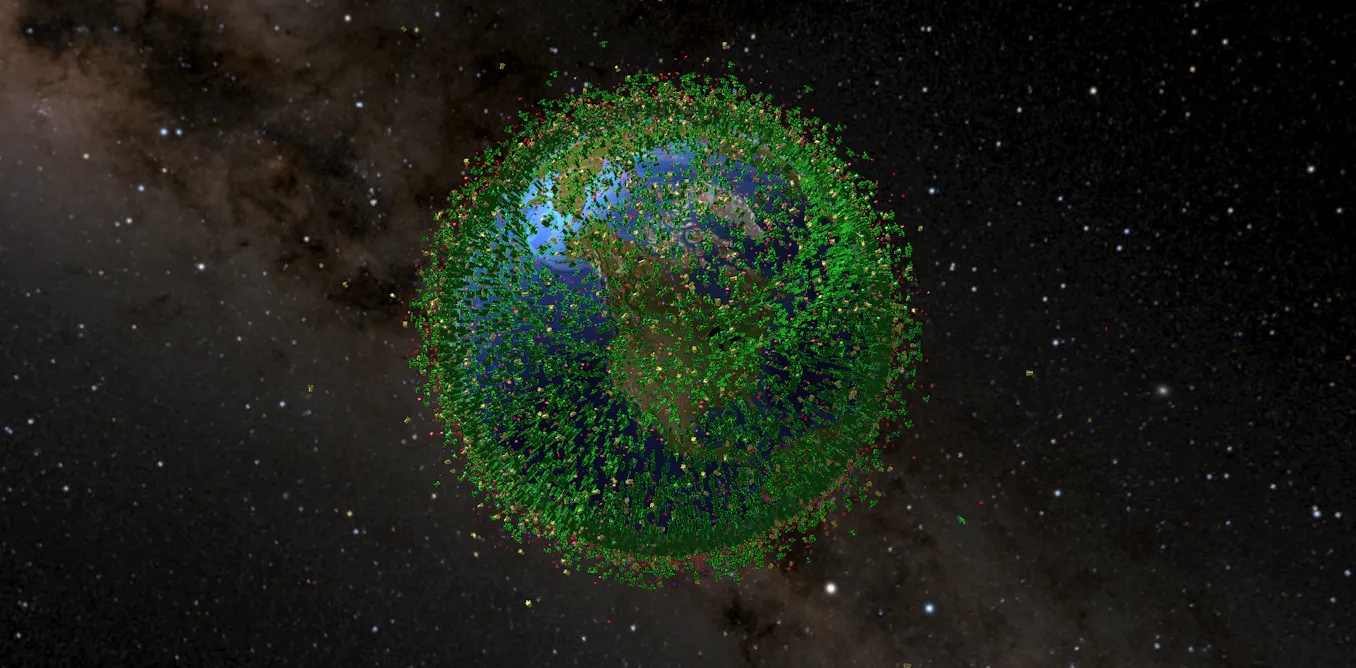
As the number of satellites circling Earth climbs toward a potential 100,000 within this decade, researchers are developing artificial intelligence to prevent spacecraft from becoming hazardous orbital debris. With current estimates placing the population at approximately 16,000 satellites, the rapid growth of megaconstellations is straining the ability of human operators to maintain satellite health from the ground.
The urgency of autonomous monitoring was highlighted in March this year when a large NASA satellite underwent an uncontrolled re-entry into the atmosphere over the eastern Pacific Ocean. While NASA expected most of the craft to burn up, the event served as a reminder that satellites face constant degradation from intense radiation, mechanical stress, and extreme temperature changes.
The Challenge of Orbital Maintenance
Unlike terrestrial vehicles, satellites cannot be brought to a workshop for repairs. Servicing missions exist but are described as relatively uncommon and expensive. Currently, engineers rely on telemetry data—tracking battery performance, power consumption, and temperatures—to identify warning signs of failure. However, as constellations grow from dozens to thousands of spacecraft, human operators may be unable to monitor the sheer volume of information.
Predictive AI offers a way to identify early signs of degradation before they lead to mission-threatening failures. Research published in the Journal of Intelligent Manufacturing by Adel, Das, and Jan used publicly available NASA satellite battery data to explore how machine learning can recognize patterns of battery ageing. This approach mirrors predictive maintenance used in wind farms and modern aircraft, searching for subtle changes rather than waiting for a total system collapse.
If AI detects battery degradation early, operators can extend a satellite's operational life by sending new instructions to:
- Reduce power-hungry activities.
- Change the timing of data processing or transmission.
- Place non-essential systems into standby.
Federated Learning and Self-Monitoring
Transmitting the massive amounts of raw data required for AI analysis back to Earth consumes significant energy, bandwidth, and time. To solve this, researchers are proposing federated learning
. In this distributed AI model, individual satellites learn from their own operational experiences and share insights with other satellites or ground systems.
This allows satellites to effectively help each other recognize potential faults, supporting a system of continuous self-monitoring across vast networks without the need to transmit all raw data to Earth.
The Risk of Orbital Criticality
The need for smarter maintenance is compounded by increasing orbital congestion. A study published in Acta Astronautica introduced the concepts of capacity, occupation, and criticality to describe the state of near-Earth space. Researchers found that the risk of collision does not scale linearly; doubling the number of satellites can multiply the risk many times over.
The study identified two orbital hot zones
already heavily congested:
| Congested Orbital Band | Distance from Earth |
|---|---|
| Zone 1 | 400 to 600 kilometers |
| Zone 2 | 700 to 800 kilometers |
The pressures of this environment are already visible. In 2019, only 0.2% of satellites performed more than 10 collision-avoidance maneuvers per month. By early 2025, that figure rose to 1.4%. Maya Harris, a research assistant at the Massachusetts Institute of Technology and co-author of the study, stated that operators are reaching a practical limit, as they do not want to spend all their propellant and time on avoidance maneuvers.
The Kessler Syndrome Threat
Failure to manage degrading satellites increases the risk of Kessler syndrome, a runaway chain reaction where collisions create clouds of debris that render orbits unusable. There are already 50,000 pieces of debris in orbit measuring 4 inches or larger. According to recent data, a major collision could be expected every 3.8 days if all collision-avoidance maneuvers were stopped.
The scale of future launches may exacerbate these risks. On January 30, 2026, SpaceX filed an application with the US Federal Communications Commission for a megaconstellation of up to one million satellites to power space-based data centers, operating between 300 and 1,200 miles in low Earth orbit.
While AI can assist in monitoring health, it cannot eliminate space debris on its own. Predictive models must still undergo extensive testing against simulated faults and laboratory experiments before they are trusted in orbit. For now, the future of orbital safety depends on combining these AI advancements with stricter de-orbiting rules and improved tracking technology.
How significant is this development?
Participate in our community survey on the trajectory and real-world impact of this news.