NASA races to save Swift telescope from falling back to Earth with daring rescue mission
NASA and startup Katalyst Space Technologies are launching a robotic mission to boost the aging Swift Observatory into a higher orbit to prevent it from burning up in Earth's atmosphere.
- Headline Dispatch: NASA races to save Swift telescope from falling back to Earth with daring rescue mission
- Core Takeaway: NASA and startup Katalyst Space Technologies are launching a robotic mission to boost the aging Swift Observatory into a higher orbit to prevent it from burning up in Earth's atmosphere.
- Source Synthesis: Continuous live monitoring aggregated across major news wires and independent bureaus.
NASA races to save Swift telescope from falling back to Earth with daring rescue mission
NASA is attempting a high-stakes salvage operation to prevent the Swift Observatory from plummeting into the atmosphere and burning up. The $30 million mission relies on a robotic spacecraft to boost the aging telescope into a higher, more stable orbit.
Launched in 2004, the 1.6-ton (1.4-metric ton) gamma ray observatory has been sinking toward Earth at an accelerated pace. This descent is the result of intense solar activity and solar storms since fall 2024. To delay the telescope's fall, NASA turned off all scientific instruments in February, halting observations to slow its descent.
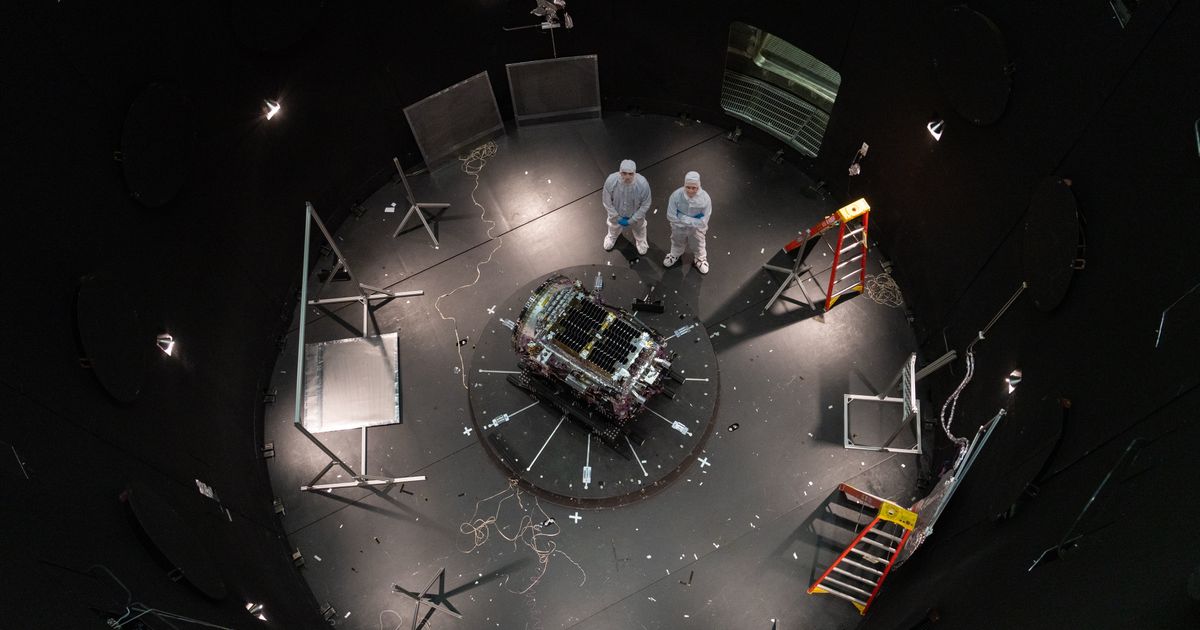
The rescue depends on the LINK spacecraft, an autonomous robot developed by Arizona-based startup Katalyst Space Technologies. Roughly the size of a small kitchen refrigerator with a 40-foot (12-meter) solar wingspan, LINK weighs 880 pounds and stands 5 feet tall. It features three arms with a reach of just over 3 feet (1 meter), each equipped with two finger-like pinching grippers. Because Swift lacks docking ports or grappling fixtures, LINK will use a custom robotic capture mechanism to attach to a feature on the satellite's main structure.
The mission is a race against time. Current estimates suggest Swift will reach a point of no return in October; it must remain above 185 miles (300 kilometers) for the rescue to be viable. Without intervention, Katalyst reports a 50% chance of an uncontrolled reentry by mid-2026, increasing to 90% by the end of that year.
The launch process involves an air-launch strategy. On June 18, a Northrop Grumman Stargazer L-1011 aircraft took off from NASA's Wallops Flight Facility in Virginia, carrying a Pegasus XL rocket attached to its belly. The rocket, which encapsulates LINK, is scheduled to launch from the Kwajalein Atoll in the Marshall Islands. NASA is targeting a liftoff on Tuesday, June 30, with a window opening at 6:23 a.m. ET. The Stargazer will climb to approximately 40,000 feet before releasing the Pegasus XL, which will ignite its three-stage motors to deliver LINK into orbit in about 10 minutes.
Once in orbit, Katalyst will spend a few weeks testing propulsion and sensor systems before attempting to rendezvous with Swift. This phase is expected to take about a month. Following the capture, it will take another couple of months to raise the observatory's orbit from 224 miles (360 kilometers) to the target of 373 miles (600 kilometers).
Swift was not designed for repairs or retrieval, making the operation uniquely challenging. Katalyst CEO Ghonhee Lee noted that only China has attempted a similar mission, having boosted a satellite into a graveyard orbit four years ago.
"This is the first American space robot to go up and do anything like this. NASA has all these big senior observatories … all of them can benefit from a service like this. So what we're proving with this mission is this is a new play in the playbook that's available."
Ghonhee Lee, Katalyst Space CEO, via The Associated Press
The telescope is considered a vital asset due to its ability to pivot quickly to capture gamma ray bursts and exploding stars. According to NASA's astrophysics director, Shawn Domagal-Goldman, Swift would serve as the agency's first responder, complementing discoveries from the Webb Space Telescope and the upcoming Roman Space Telescope.
NASA's science mission chief Nicky Fox emphasized the necessity of the effort, stating that the agency does not currently have the budget to build a replacement and would lose significant capability if the telescope were lost.
"I have to be honest. No one thought it was going to be possible. No one thought we would get as far as we’ve already gotten today,"
Shawn Domagal-Goldman, NASA astrophysics director, via The Associated Press
The Swift mission serves as a proof-of-concept for a broader space repair business. Katalyst plans to fly a next-generation robot next year capable of tackling satellites at altitudes up to 22,300 miles (35,800 kilometers). Lee envisions a future fleet of hundreds of robots that can refuel satellites and build data centers or solar farms in orbit.
This technology may soon be applied to the 36-year-old Hubble Space Telescope. Like Swift, Hubble is losing altitude due to solar flares. A life-extending boost from a Katalyst robot could follow as early as 2028.
If the current mission succeeds, Lee believes Swift could be operational again by September.
How significant is this development?
Participate in our community survey on the trajectory and real-world impact of this news.