NASA's James Webb Telescope Observes Millions Of Stars Within 'Cigar Galaxy
New NIRCam data from the James Webb Space Telescope pierces through cosmic dust to reveal the distorted structure and intense stellar birth of Messier 82.
- Headline Dispatch: NASA's James Webb Telescope Observes Millions Of Stars Within 'Cigar Galaxy
- Core Takeaway: New NIRCam data from the James Webb Space Telescope pierces through cosmic dust to reveal the distorted structure and intense stellar birth of Messier 82.
- Source Synthesis: Continuous live monitoring aggregated across major news wires and independent bureaus.
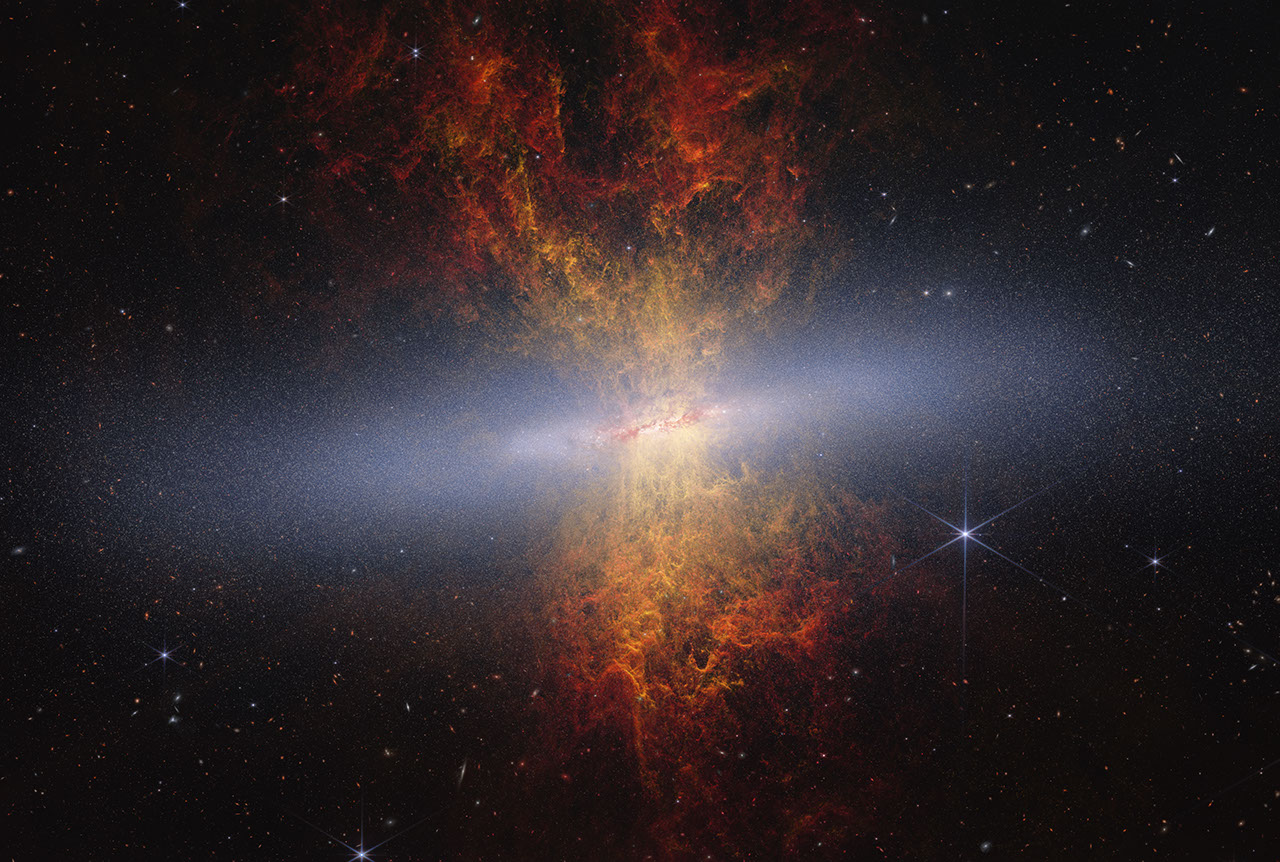
NASA's James Webb Telescope Observes Millions Of Stars Within 'Cigar Galaxy'
NASA’s James Webb Space Telescope has captured a detailed portrait of Messier 82, an edge-on spiral galaxy located 12 million light-years from Earth. Known to many as the Cigar galaxy due to its long, slim shape, the target is a starburst galaxy characterized by an extreme pace of stellar birth. According to researchers, M82 forms stars 10 times faster than the Milky Way galaxy.
The new data is the result of an imaging survey that utilized the telescope's Near-Infrared Camera, or NIRCam, for a total of 65 hours of observation. This duration, paired with the telescope's infrared sensitivity, allowed it to pierce through thick volumes of dust that had previously obscured high-resolution details from other observatories, including the retired Spitzer space telescope and the Hubble Space Telescope.
The resulting 223-megapixel mosaic reveals approximately 16.5 million individual stars, appearing as luminous blue granules. While this number is staggering, astronomers believe it represents only a small portion of the total stellar population in M82, as the majority of stars remain too faint to be seen.
"The sheer number of stars that we were able to resolve with Webb is incredible,"
Benjamin Williams, University of Washington, via science.nasa.gov
The survey provided a first look at the galaxy's distended disk structure. Astronomers noted an asymmetrical shape and differing radii between the two sides of the disk, which suggests the galaxy is distorted. This structural anomaly is a common occurrence during intense galaxy mergers, which scientists believe triggered the current surge in star formation.
This starburst phase is considered a short-lived event in astronomical terms, estimated to last a few hundred million years in its entirety. The intensity of the stellar frenzy is driving bipolar plumes of material away from the galactic center in an hourglass-shaped outflow. These outflows exhibit a layered structure: yellow tendrils closest to the disk represent ionized gas, while orange material further away consists of polycyclic aromatic hydrocarbons, which are small dust grains used to trace the interstellar medium.
Principal investigator Adam Smercina, a NASA Hubble Fellow at the Space Telescope Science Institute and incoming Assistant Professor at Tufts University, described M82 as a beautiful mess
.
"M82 is an ideal galaxy evolution laboratory because it has properties that allow us to probe important physical processes, such as how stars form in such environments and how that activity drives outflows,"
Adam Smercina, NASA Hubble Fellow, via science.nasa.gov
To create the most complete picture, researchers combined Webb's near-infrared data with Hubble's visible-light observations. While Hubble detailed the gas and dust structure, Webb resolved the stellar population beneath those clouds. Kristen McQuinn of the Space Telescope Science Institute said that combining these datasets allows researchers to pose more complex questions than any single mission could answer alone.
The observations provide a fossil record that scientists will use to analyze how the galaxy grew and reshaped itself over hundreds of millions of years. Team member Eric Bell of the University of Michigan stated that the data will help address mysteries regarding how star formation has shifted within M82 over the last few billion years.
The James Webb Space Telescope is an international program led by NASA in partnership with the European Space Agency (ESA) and the Canadian Space Agency (CSA). This latest dataset is one of several that scientists will analyze to fully reconstruct the formation history of the starburst galaxy.
How significant is this development?
Participate in our community survey on the trajectory and real-world impact of this news.