
The Soviet Venera 14 lander touched down on Venus on March 5, 1982, and in an unexpected twist, its mechanical arm later measured the compressibility of a discarded camera lens cap instead of the planet’s surface, according to a 1945.com article. This anomaly, coupled with a 2026 study in Universe Today, offers a dual perspective on humanity’s exploration of Venus and the planet’s enigmatic history.
The Venera 14 Anomaly: A Soviet Spacecraft’s Unintended Experiment
The Venera 14 mission, part of the Soviet Union’s ambitious effort to study Venus, faced extreme conditions upon landing. With surface temperatures exceeding 870°F and atmospheric pressure 90 times that of Earth, the lander was designed to survive just long enough to transmit data before succumbing to the hostile environment. According to 1945.com, the spacecraft’s camera lens cap was ejected during descent, and the lander’s soil-testing arm later pressed directly onto the discarded cap, capturing a unique measurement of Soviet plastic’s compressibility rather than Venusian rock.


This incident highlights the engineering challenges of landing on Venus, a planet often called Earth’s “twin” but vastly different in its hostile conditions. The dense atmosphere, composed of 96% carbon dioxide, traps heat in a runaway greenhouse effect, creating a surface temperature that remains stable day and night. The Venera landers, built as titanium-reinforced pressure vessels, were essentially “miniature submarines” designed to withstand the planet’s crushing pressure and heat, as detailed in the 1945.com article.
Despite the lens cap mishap, the mission provided critical data. Venera 13 and 14 were the first to return color panoramas of Venus’s surface, revealing orange-brown volcanic rocks and a hazy yellow sky. The spacecraft’s microphones also captured sounds of wind and drilling, offering a rare auditory glimpse of another world.
Impact Theory: How a Cosmic Collision Shaped Venus’s Rotation
While the Venera missions focused on direct exploration, a 2026 study published in Universe Today explores Venus’s broader planetary history. Led by Cedric Gillmann of ETH Zurich, the research suggests that Venus’s peculiar retrograde rotation—its clockwise spin compared to Earth’s counterclockwise—is likely the result of a high-velocity, moon-sized impactor that struck the planet within its first 50 million years. This theory aligns with simulations showing that such an impact could have reversed Venus’s rotation and melted 99% of its mantle, as reported by Universe Today.
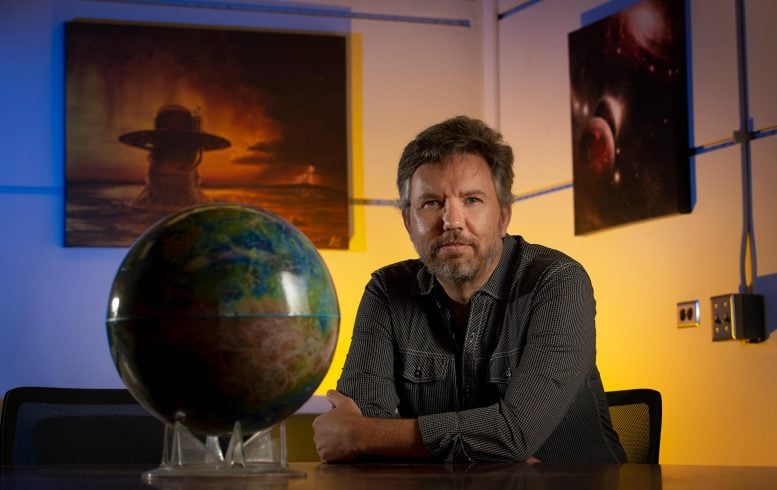
Gillmann’s team used computer models to simulate how a massive impact could alter a planet’s rotation. Their findings indicate that an impactor roughly a tenth of Venus’s mass, hitting at a high angle, could have slowed the planet’s initial rapid rotation and even reversed its direction. This scenario explains Venus’s current 248-day rotation period, which is both slow and retrograde. The study also notes that such impacts would have created vast magma oceans, which later cooled to form the planet’s solid crust.
The research challenges previous assumptions about Venus’s geological evolution. While the planet lacks plate tectonics, the study suggests that its lack of a carbon recycling mechanism may have contributed to its runaway greenhouse effect. Stephen Kane, a planetary astrophysicist at the University of California, Riverside, emphasizes that a planet’s rotation influences its energy distribution, making Venus’s unique spin a critical factor in its climate history.
Connecting the Dots: From Engineering Feats to Cosmic Origins
The Venera 14 mission and the 2026 impact study represent two facets of Venus exploration: the immediate challenges of landing on the planet and the long-term processes that shaped its evolution. The lens cap incident underscores the ingenuity required to operate in such an extreme environment, while the impact theory provides a framework for understanding Venus’s mysterious rotation and internal structure.

Both narratives highlight the importance of planetary science in unraveling the solar system’s history. As Gillmann notes, the impact hypothesis “evolves into a slow rotating planet,” a process that could mirror Venus’s current state. Meanwhile, the Venera missions laid the groundwork for future exploration, demonstrating the resilience of human engineering in the face of cosmic adversity.
Looking ahead, these findings could inform upcoming missions to Venus, such as NASA’s DAVINCI+ and VERITAS, which aim to study the planet’s atmosphere and geology in greater detail. Understanding Venus’s past may also shed light on the conditions necessary for habitability, offering insights into Earth’s own climate challenges.
As the 1945.com article and Universe Today study illustrate, Venus remains a planet of extremes—both in its environment and in the scientific questions it continues to pose. From the unintended experiments of Soviet landers to the cosmic collisions that shaped its rotation, each discovery brings us closer to unraveling the secrets of our closest planetary neighbor.
<a href="https://www.19fortyfive.com/2026/06/on-5-march-1982-the-soviet-venera-14-lander-reached-the-surface-of-venus-ejected-the-protective-cap-from
Find more reporting in our Technology section.
