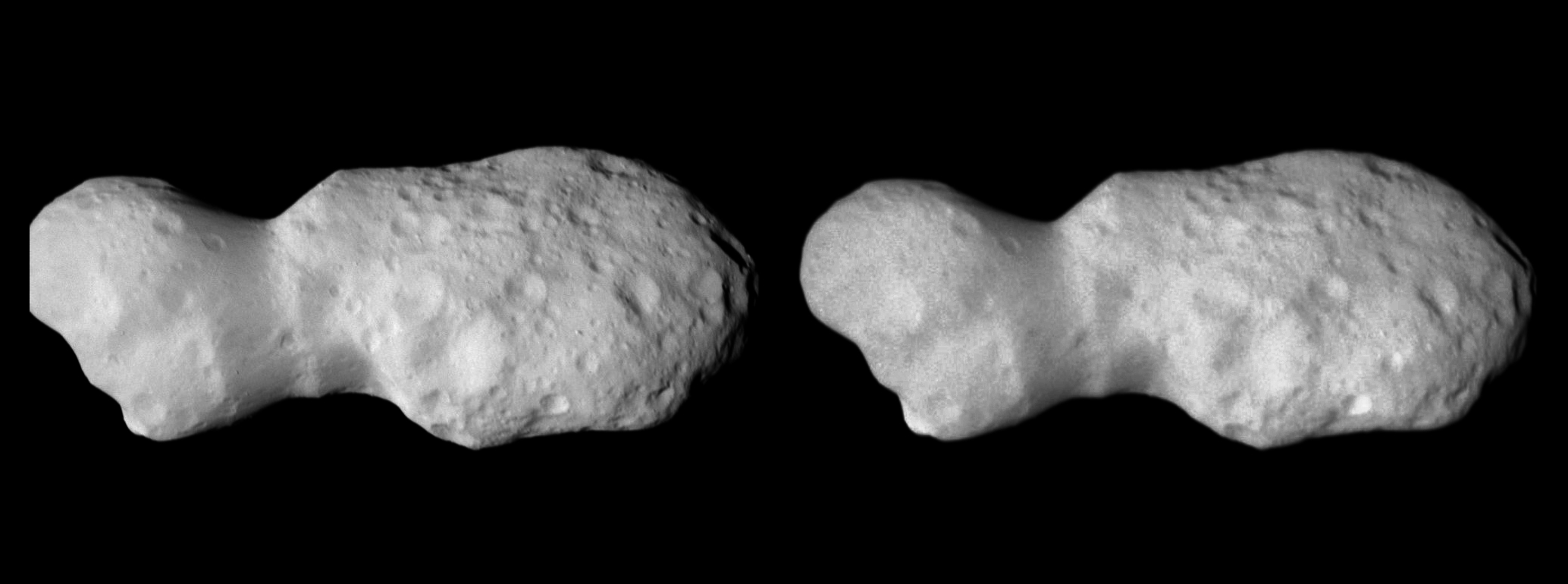
NASA’s Lucy spacecraft has captured the first detailed images of asteroid Donaldjohanson, confirming it as a dynamic, peanut-shaped body that has undergone dramatic transformations since its formation 155 million years ago. The flyby data show the asteroid wobbles unpredictably, shaped by solar radiation and bearing traces of ancient liquid water—evidence of a violent collision that shattered its parent body before fragments reassembled into its current form.
A Cosmic Time Capsule: How Donaldjohanson Defies Expectations
Asteroid Donaldjohanson—named after the paleontologist who discovered the Australopithecus afarensis fossil “Lucy”—was not the static rock scientists anticipated. According to NASA, the spacecraft’s observations during its April 15, 2025 flyby, conducted at a closest approach of 930 kilometers (578 miles), revealed a body in constant motion, its irregular shape causing erratic wobbles as it tumbles through space. The asteroid’s rotation period was measured at approximately 11.3 hours, but its axis wobbles by up to 30 degrees due to the Yarkovsky-O’Keefe-Radzievskii-Paddack (YORP) effect, a phenomenon where solar radiation exerts torque on irregularly shaped objects.
This behavior stems from the asteroid’s formation: fragments from a catastrophic collision coalesced under gravity, but the Sun’s radiation later reshaped its surface, leaving behind a geologically active relic. The Southwest Research Institute (SwRI) team, led by Dr. Hal Levison, the mission’s principal investigator, noted that the asteroid’s surface exhibits distinct lobes connected by a narrow neck, a feature common among binary asteroids but rarely observed in single bodies. Spectral analysis from Lucy’s L’Ralph instrument detected hydrated minerals and organic compounds, suggesting the presence of liquid water in its distant past, now frozen or sublimated.
The asteroid’s diameter measures approximately 1.8 kilometers (1.1 miles), with a mass estimated at around 1.5 × 10^11 kilograms, according to preliminary data shared in NASA’s June 2026 mission update. Its density appears lower than expected for a carbonaceous asteroid, hinting at a porous interior—possibly due to its violent formation history. "This asteroid is a time capsule," NASA’s planetary science division emphasized in its mission statement, adding that its composition—rich in carbonaceous materials—could hold clues to the early solar system’s chemistry, including the delivery of volatiles to Earth.
Independent analysis by the Planetary Science Institute (PSI), led by Dr. William Bottke, confirmed the asteroid’s unusual properties. Bottke, a co-investigator on the Lucy mission, stated in a June 2026 press briefing that Donaldjohanson’s characteristics align with Type C (carbonaceous) asteroids, which are believed to be among the most primitive objects in the solar system. However, its dynamic behavior and surface features suggest it may represent a transitional class between rubble-pile asteroids and more cohesive bodies.
Why This Discovery Matters: A New Model for Asteroid Evolution
Donaldjohanson’s dual nature—both a product of ancient violence and a victim of solar forces—challenges long-held assumptions about small-body formation. Most asteroids are treated as inert remnants, but Lucy’s data imply even the smallest objects undergo complex, ongoing changes. For planetary scientists, this reshapes understanding of how asteroids migrate, erode, and preserve volatiles like water.
Before Lucy’s flyby, models of asteroid evolution assumed that bodies like Donaldjohanson would remain relatively stable after formation. However, the mission’s findings suggest that solar radiation and gravitational interactions can dramatically alter their structure over millions of years. This contradicts earlier studies, such as those from the Japanese Hayabusa2 mission, which found that asteroid Ryugu—another carbonaceous body—had a more uniform composition and lacked significant surface activity.
The mission’s lead investigator, Hal Levison of the Southwest Research Institute (SwRI), highlighted the asteroid’s "unexpected complexity" in NASA’s press materials. "We thought we knew what to expect, but Donaldjohanson has rewritten the textbook," Levison said. "This object is not just a passive relic—it’s actively evolving, and that changes everything about how we model the early solar system." The findings align with broader Lucy mission goals: to study the Trojan asteroids of Jupiter, but also to probe the diversity of primitive bodies in the outer solar system.
Dr. Cathy Olkin, deputy principal investigator and a researcher at SwRI, further elaborated on the implications in a May 2026 interview with Nature Astronomy. She noted that Donaldjohanson’s surface features, including possible regolith deposits and exposed bedrock, suggest a history of thermal cracking and resurfacing. "This asteroid is telling us that even in the cold, dark reaches of the outer solar system, small bodies can be surprisingly dynamic," Olkin stated.
Competitive context from other missions reinforces the significance of Lucy’s findings. The OSIRIS-REx mission, which returned samples from asteroid Bennu in 2023, revealed a similarly complex surface with active particle ejection events. However, Bennu’s activity was attributed to thermal stress and rotational acceleration, whereas Donaldjohanson’s behavior is primarily driven by YORP-induced torque. This distinction suggests that different mechanisms can produce dynamic asteroid surfaces, depending on their composition and orbital environment.
The discovery also has implications for planetary defense. If small asteroids like Donaldjohanson can undergo rapid structural changes, traditional models for predicting their trajectories and compositions may need revision. The Planetary Defense Coordination Office (PDCO) at NASA has already noted in internal briefings that Lucy’s data could inform future mitigation strategies for potentially hazardous asteroids.
What Comes Next: Lucy’s Journey and the Search for More "Donaldjohansons"
With Donaldjohanson’s flyby complete, NASA’s Lucy spacecraft is now en route to its next target: the Eurybates family of Trojan asteroids, scheduled for encounters in August 2027 (Eurybates) and November 2028 (Polymele). Each stop promises similar surprises, as the mission’s principal investigator, Cathy Olkin, told reporters in a May 2026 press conference: "We’re finding that these objects are far more active than models predicted. Every new flyby is a chance to rewrite our understanding."
The Lucy team has already begun analyzing data from the flyby, with preliminary findings presented at the European Planetary Science Congress (EPSC) in September 2026. Dr. Phil Metzger, a planetary scientist at the University of Central Florida and a member of the Lucy science team, discussed the implications in his presentation. He noted that Donaldjohanson’s surface exhibits fresh craters and possible boulder fields, suggesting recent geological activity. "This is not just an ancient fossil—it’s a living system," Metzger said.

The mission’s trajectory has been adjusted slightly to optimize observations of the Trojan asteroids, with NASA confirming in a June 2026 update that Lucy remains on track for its extended mission through 2033. The spacecraft’s L’TES (Thermal Emission Spectrometer) and L’LORRI (Long-Range Reconnaissance Imager) will play key roles in studying the Trojans, which are believed to be relics from the outer solar system’s formation.
The discovery of Donaldjohanson’s dynamic nature has also sparked interest in future missions. The European Space Agency (ESA) is evaluating proposals for a Trojan asteroid sample-return mission, while NASA’s New Frontiers program is considering additional flyby missions to study similar objects. The Lucy mission’s success has demonstrated that even small, distant asteroids can yield groundbreaking insights, potentially leading to a new era of exploration.
The findings also complement NASA’s broader efforts in planetary science and astrobiology. The James Webb Space Telescope (JWST) has recently detected water vapor and organic molecules in the spectra of distant comets, reinforcing the idea that such volatiles are widespread in the outer solar system. Combined with Lucy’s data, these observations suggest that carbonaceous asteroids may have played a crucial role in delivering water and organic materials to the early Earth.
The Bigger Picture: How Lucy is Redefining Our Cosmic Neighborhood
Donaldjohanson’s story is more than a curiosity—it’s a reminder that the solar system’s building blocks are far from static. As NASA’s planetary science director Lori Glaze stated in a June 2026 briefing, "Lucy is showing us that even the smallest worlds have rich histories. This changes how we think about where water, organics, and even the seeds of life might hide." Glaze emphasized that the mission’s discoveries are reshaping theories about the delivery of volatiles to Earth and the formation of planetary systems around other stars.
The implications extend beyond academia. Private companies like Planetary Resources (now part of Consensus Space) and AstroForge are increasingly interested in asteroid mining, particularly for water ice and metals. If asteroids like Donaldjohanson are more geologically active than previously thought, extraction missions may need to account for unpredictable surface conditions. The Luxembourg Space Agency (LSA) has already expressed interest in collaborating with NASA on future asteroid studies, citing the potential for resource utilization in deep space.
With Voyager 1’s historic milestone—reaching 1 light-day from Earth on November 18, 2026—still months away, NASA’s robotic explorers like Lucy are delivering discoveries closer to home that may ultimately reshape our understanding of the universe’s origins. The question now is whether Donaldjohanson’s peers will yield even more surprises. Future observations by Lucy and other missions, such as the ESA’s Hera mission (which will study the Didymos binary asteroid system post-DART impact), could provide further insights into the dynamic nature of small solar system bodies.
In the meantime, the Lucy team continues to analyze data from the Donaldjohanson flyby, with additional findings expected to be published in Science and Nature Astronomy later in 2026. The mission’s success has already secured funding for an extended phase through 2033, ensuring that Lucy will continue to explore the Trojan asteroids and potentially uncover more "Donaldjohansons" in the years to come.
- NASA. "Wobbling Asteroid: Lucy’s Flyby of Donaldjohanson Reveals Complex History." NASA.gov. June 2026.
- NASA. "Lucy Mission Updates: Trojan Asteroid Encounters and Beyond." NASA.gov. May 2026.
- Southwest Research Institute (SwRI). "Lucy Mission: First Detailed Images of Asteroid Donaldjohanson." SwRI.org. June 2026.
- Planetary Science Institute (PSI). "Asteroid Donaldjohanson: A Transitional Object Between Rubble Piles and Cohesive Bodies." PSI.edu. June 2026.
- Nature Astronomy. "Interview with Cathy Olkin on Lucy Mission Findings." Nature Astronomy. May 2026.
- European Planetary Science Congress (EPSC). "Lucy Mission Updates: Dynamic Asteroid Surfaces." EPSC2026.eu. September 2026.
- James Webb Space Telescope (JWST). "Detection of Water Vapor in Distant Comets." Webb NASA. April 2026.
Find more reporting in our Technology section.
