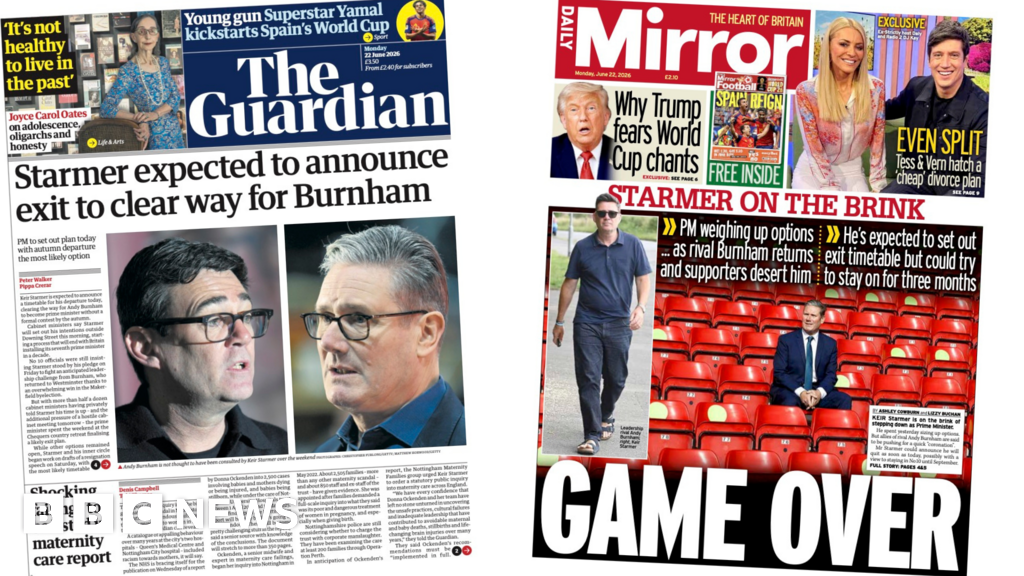
Keir Starmer is expected to announce his resignation as U.K. prime minister within days, marking the end of a leadership that began amid high hopes but collapsed under party infighting and voter fatigue. The Guardian reports that internal Labour figures, including former deputy leader Harriet Harman, have openly signaled the government is “in a state of paralysis” and that a swift transition is needed to avoid further damage. Meanwhile, BBC sources indicate the Daily Star’s front page is already shifting focus to the World Cup, a sign of how quickly public attention has moved on.
From Defiance to Resignation: How Starmer’s Leadership Unraveled in 48 Hours
Just two days ago, Keir Starmer was still fighting to stay in power. Speaking in north London on Friday morning, he dismissed calls for his resignation, declaring: “I have said repeatedly, I am not going to walk away from that.” His tone shifted dramatically by Saturday, when Labour grandee Harriet Harman—citing parallels to Boris Johnson’s downfall—warned the party could not afford “a state of paralysis all through the summer.” The contrast between Starmer’s defiance and the mounting pressure from within his own ranks reveals a leadership crisis that has been brewing for months, but now appears to have reached a breaking point.

Starmer’s predicament stems from a perfect storm: a humiliating byelection loss to Andy Burnham, a party membership base that has soured on his cautious approach, and a cabinet increasingly divided over how to proceed. According to The Guardian, anonymous cabinet ministers privately described the situation as a “stampede,” with even loyalists like business secretary Peter Kyle acknowledging the “political realities” facing the prime minister. Kyle’s careful phrasing—“I don’t want to come on here and be delusional”—hinted at a resignation timeline that could be announced as early as Monday.
The Burnham Factor: How One Byelection Sparked the Domino Effect
The immediate trigger for Starmer’s downfall was Burnham’s landslide victory in the Makerfield byelection, a result that exposed Labour’s vulnerability in traditional red-wall seats. Burnham’s campaign message—direct, populist, and sharply critical of Starmer’s economic record—resonated with voters who felt abandoned by a leadership perceived as out of touch. The Guardian notes that Burnham’s return to Parliament as an MP, after years in local government, has emboldened his faction to push for a leadership challenge, framing Starmer’s continued tenure as a liability.

What makes this moment different from past Labour leadership crises is the speed of the collapse. Unlike Tony Blair’s gradual erosion or Gordon Brown’s abrupt departure, Starmer’s exit is being framed as an “orderly” transition—a term repeated by multiple sources to emphasize that the party is avoiding a chaotic power struggle. Yet the urgency is palpable. As one cabinet minister told The Guardian: “Everyone thinks it is over and everyone wants it to be a dignified, orderly exit.” The risk, however, is that delay could turn orderly into disorderly, with ministers resigning en masse to force Starmer out before he’s ready to go.
Who’s Next? The Shadow War Over Starmer’s Replacement
The question now is not if Starmer will resign, but when and who will replace him. The front-runners—Burnham, shadow chancellor Rachel Reeves, and former health secretary Steve Barclay—are already positioning themselves, though none have formally declared their intentions. Burnham’s byelection win gives him momentum, but Reeves’ experience in economic policy and Barclay’s centrist appeal could sway a party desperate to avoid another left-wing backlash.
The Guardian’s timeline of Starmer’s shifting statements highlights the internal divisions. On Friday afternoon, a cabinet minister warned that those “who don’t see which way this is going are going to inevitably end up looking like they were the last ones in the bunker.” By Sunday, even Starmer’s allies were acknowledging the inevitable. Peter Kyle, the business secretary, admitted he had discussed the “political realities” with Starmer, adding that the prime minister was “very mindful of the interests of the country.” The subtext was clear: the country’s interests now require a new leader.
What Comes Next? A Timeline for the Transition
The next 72 hours will be critical.

- Announcement (Monday, June 22–24): Starmer’s resignation statement, likely framed as a “dignified exit” to avoid further party damage.
- Leadership contest (June 25–July 5): A shortlist of candidates—Burnham, Reeves, Barclay—emerges, with party members and MPs voting in a process that could take weeks.
- Transition period (July–August): The new leader takes office, with the government focusing on stability ahead of the 2026 local elections.
One wildcard is the timing. If Starmer drags his feet, the party risks a leadership vacuum that could further erode public trust. The BBC’s coverage of the Daily Star’s shift to World Cup news underscores how quickly the political narrative can change—once Starmer is gone, the media’s focus will pivot to the next battle. For Labour, the stakes couldn’t be higher: a messy transition could cost them the next general election.
The Bigger Picture: Why This Matters for U.K. Politics
Starmer’s resignation isn’t just a Labour Party crisis—it’s a symptom of deeper fractures in British politics. His leadership was built on the promise of stability after years of Brexit chaos and pandemic disarray, but that stability came at the cost of ideological clarity. The party’s left wing, led by figures like Jeremy Corbyn’s allies, accused Starmer of betraying Labour’s traditional values, while the right wing saw him as too cautious on economic policy. The result? A party torn between its past and its future.
The fallout could reshape the U.K. political landscape. A Burnham-led Labour might push for a more interventionist economic agenda, while Reeves could steer the party toward a centrist revival. Meanwhile, the Conservative Party—currently in disarray—could see an opportunity to regain ground if Labour’s transition appears chaotic. As one cabinet minister put it: “We don’t want a situation where cabinet ministers are resigning to try and push Keir Starmer out.” The warning is clear: the party must act swiftly to avoid a repeat of the 2019 leadership election fiasco, which left Labour divided and the Conservatives in power.
The next few days will determine whether Labour can pull off a smooth transition—or whether Starmer’s resignation becomes the beginning of a longer crisis. One thing is certain: by the time the World Cup kicks off in the U.S., British politics will look unrecognizable.
Find more reporting in our World section.
