
Far-right lawyer and businessman Abelardo de la Espriella won Colombia’s presidential runoff election on June 21, 2026, securing 49.65% of the vote. Defeating left-wing senator Iván Cepeda by a margin of 248,310 votes, the self-styled “outsider” will succeed President Gustavo Petro on August 7, marking a significant rightward shift for the nation.
The Election Results and Voter Margin
With 99.65% of the ballots counted in the preliminary tally, The Guardian reported that Abelardo de la Espriella received 12.91 million votes against 12.67 million for Iván Cepeda. The final gap of 49.65% to 48.7% represents a tighter contest than the first round of voting three weeks earlier, where the margin between the two candidates was 673,000 votes. An additional 1.6% of the electorate cast blank ballots.

The result brings an end to the four-year term of Colombia’s first left-wing president, Gustavo Petro. Because the Colombian constitution bars incumbents from seeking consecutive re-election, Petro had backed Cepeda as his chosen successor to maintain the trajectory of his administration’s social and environmental policies.
Disputes Over the Preliminary Count
Despite the declared lead, the transition remains contentious. President Petro has publicly challenged the preliminary results released by the National Civil Registry, the independent body overseeing the vote. In social media statements, the president alleged that the registry was “uploading forms … without the signatures of election jurors” and asserted that “those polling stations must be immediately challenged.”

Petro maintained that the preliminary numbers are not definitive, stating: “No president can be declared yet. It is the scrutiny process that determines who the president is,” Petro said, via The Guardian.
In Colombia, the electoral system utilizes a two-tier process: the preliminary count (preconteo) conducted by the National Civil Registry, which is used for information purposes on election night, and the official scrutiny (escrutinio) carried out by the National Electoral Council (CNE). The CNE is composed of magistrates elected by Congress, and it is this body that holds the legal authority to declare a winner. Election experts cited by The Guardian noted that the discrepancy between preliminary counts and the final official scrutiny in Colombian elections is historically less than 1%. The official process is expected to conclude within two days.
De la Espriella’s Political Platform and External Support
Abelardo de la Espriella, who is also a US citizen, campaigned on a platform of “iron fist” security, positioning himself as an anti-establishment figure. Known by the nickname “El Tigre,” the president-elect has never held public office. His campaign received the endorsement of former US President Donald Trump following the first round of the election, a move that highlighted the intersection of Colombian internal politics with broader Western hemispheric ideological divides.
His rhetoric regarding criminal groups has been notably aggressive. The president-elect has pledged to construct 10 maximum-security “mega-prisons” and has described his intent to treat criminals “like rats and cockroaches.” He also previously promised to “disembowel” the left, a statement he later characterized as a figure of speech. Such rhetoric has drawn both fierce support from his base, who desire a return to more punitive security measures, and sharp condemnation from human rights advocates who fear a degradation of civil liberties.
Regional Trends and the Future of Colombian Security
De la Espriella’s victory is being viewed by analysts as part of a broader shift toward far-right leadership in Latin America, following similar electoral outcomes in Honduras and Chile. Upon taking office on August 7, the new administration is expected to dismantle Petro’s “total peace” plan, which focused on negotiating with various armed criminal factions. The “total peace” policy was a cornerstone of Petro’s presidency, aimed at ending the internal conflict that has persisted for decades by offering legal frameworks for the submission of armed groups.
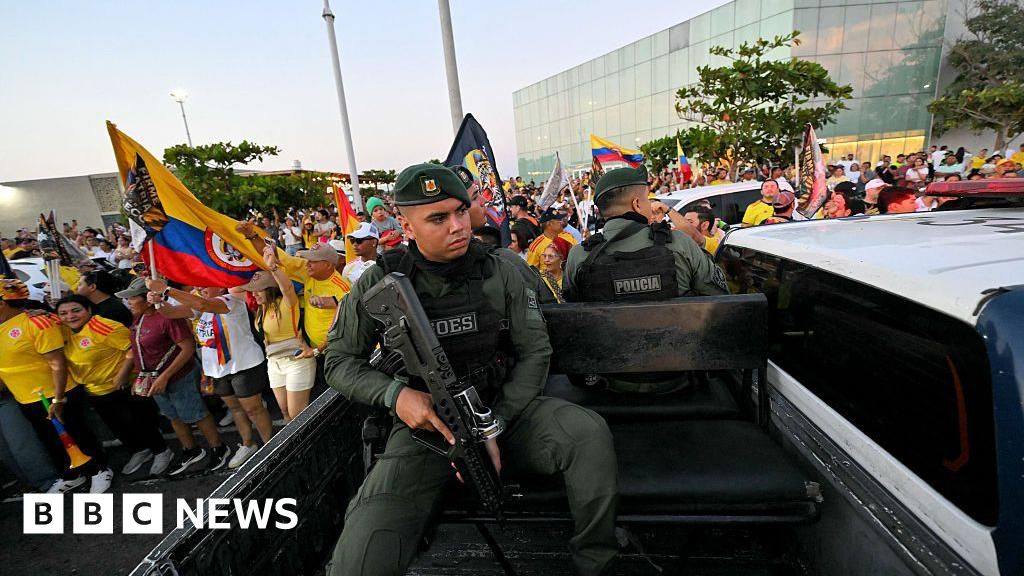
The security environment remains a critical point of concern. While current violence levels are lower than those seen in the decades prior to the 2016 peace agreement, the past year has been the most violent period since that accord was signed. The government only managed to successfully disarm its first criminal group—a small faction of 99 members—on the Thursday preceding the election, highlighting the complexities the incoming administration will face as it moves away from the previous government’s negotiation-heavy approach. The transition period will now focus on the transfer of power between the Ministry of Defense and the incoming security cabinet, as the nation watches to see how the new administration addresses the ongoing influence of illegal armed groups in rural territories.
Find more reporting in our World section.
