A UK court on Friday sentenced four Palestinian Action activists to prison terms ranging from four years and eight months to eight years, labeling their 2024 raid on an Israeli arms factory as a “terrorist act” despite the group’s claims of targeting weapons used in Gaza. The ruling, which included £1.2m in damage to Elbit Systems’ Bristol site, has sparked international debate over the legal and ethical boundaries of protest.
Four Activists Jailed for ‘Terrorist Act’
Samuel Corner, 23, received seven years and eight months for striking a police officer with a sledgehammer, while Charlotte Head, Leona Kamio, and Fatema Rajwani faced sentences of five, five, and four years and eight months, respectively. Justice Jeremy Johnson, presiding at Woolwich Crown Court, ruled the August 2024 break-in involved a “terrorism connection,” citing the activists’ intent to intimidate the UK government and disrupt Elbit Systems, Israel’s largest weapons manufacturer.

The raid, which included crashing a van through factory gates and destroying over 40 military assets, caused £1.2m in damage, according to a prosecution report. The group, which had previously been cleared of terrorism charges by a jury, argued their actions aimed to “dismantle drones and weaponry” linked to Palestinian casualties in Gaza. “By taking direct action, they saved lives. That is not terrorism, it is a duty,” said a statement from the Filton 25 Defence Committee NGO, which supported the activists.
Corner’s sentence included an additional year on licence, and all four will face 15 years of “terrorist notification requirements” under the 2000 Terrorism Act. The judge emphasized the “carefully planned and highly sophisticated attack,” noting the activists’ intent to “influence the UK government and intimidate a section of the public.”
Judge’s Rationale and Legal Precedent
Johnson’s decision to classify the raid as terrorism hinged on the activists’ alleged “political or ideological” motives, despite their non-violent methods. “The fact that you were trying to shut down a company that you thought was acting unlawfully does not reduce the seriousness of the offence,” he stated, citing section 69 of the Sentencing Act.

The ruling has drawn sharp criticism from human rights groups. Amnesty International called it a “dangerous precedent,” arguing that “treating criminal damage as terrorism sets a new low in the crackdown against protest.” Kerry Moscogiuri, the organization’s UK chief, added, “It is completely disproportionate to do so because the offense occurred at a protest.”
Legal experts highlighted the case’s implications for free speech. Tom Wainwright KC, representing Corner, compared the activists to historical movements like the suffragettes and Greenham Common women, asking, “Is it wrong for someone to be sentenced for a more serious offence of which they have not been convicted?” The defense argued the prosecution’s use of section 69 risked “chilling, creeping authoritarianism.”
Public Reaction and Broader Implications
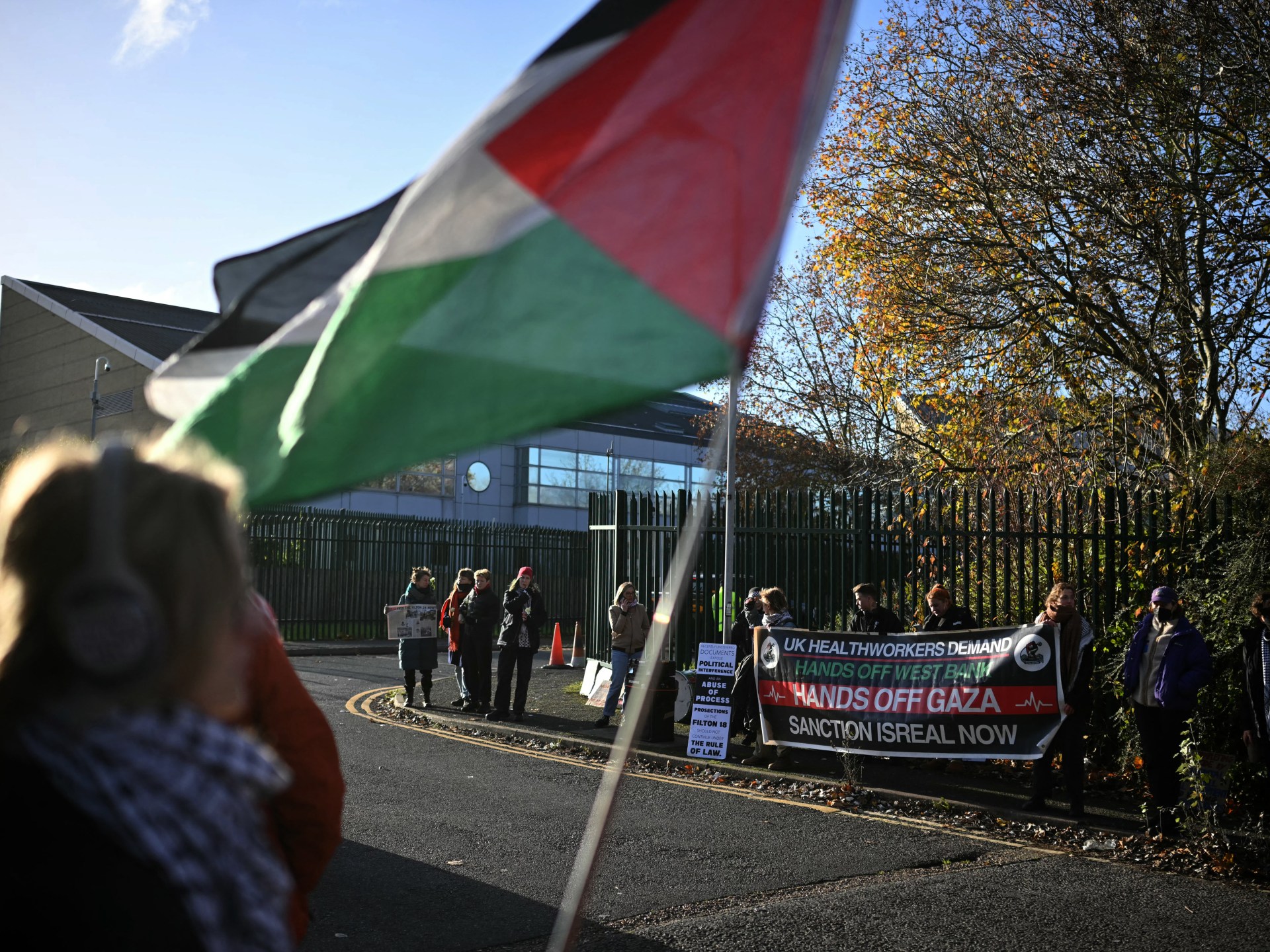
The sentencing drew over 500 protesters outside the court, leading to 72 arrests. Demonstrators carried signs reading “Free Palestine Action” and “No to Terror Laws,” while the Home Office reported 1,600 arrests at pro-Palestine rallies between July and September 2025. The government’s 2024 ban on Palestine Action as a terrorist group, later deemed unlawful by the High Court, remains in effect pending an appeals court ruling.
The case also reignites debates over the UK’s approach to activism. The Guardian noted that the prosecution’s focus on “terrorism” charges could deter future protests targeting companies linked to conflict zones. “This ruling sends a clear message: even non-violent acts of defiance may be criminalized if they challenge state or corporate interests,” said a legal analyst quoted in the article.
For the activists, the verdict is a setback but not the end. Their defense team plans to appeal, citing the “serious miscarriage of justice” and the lack of direct violence. “Today’s ruling will be appealed to correct this,” the Filton 25 statement declared. Meanwhile, the High Court’s upcoming decision on the ban’s legality could reshape the legal landscape for similar protests.
What Happens Next?
The activists’ appeals and the High Court’s ruling on the Home Office’s ban will be critical in determining the case’s long-term impact. Legal scholars warn that the court’s handling of this case could set a precedent for how UK authorities classify protest-related offenses. “If non-violent actions are increasingly labeled as terrorism, it risks eroding civil liberties under the guise of national security,” said a professor of law at the University of London, citing the case as a “test case for the boundaries of dissent.”

Meanwhile, the activists’ supporters argue the ruling reflects broader geopolitical tensions. “This isn’t just about four people—it’s about who gets to decide what activism looks like in a world where corporate interests often override human rights,” said a protester outside the court. As the legal battle unfolds, the case remains a flashpoint in the global debate over the role of protest in challenging systems of power.
For now, the four activists will serve their sentences, their fate a stark reminder of the risks faced by those who challenge entrenched interests through direct action. The question remains: will this ruling deter future protests, or will it galvanize a new wave of dissent?
Find more reporting in our World section.
