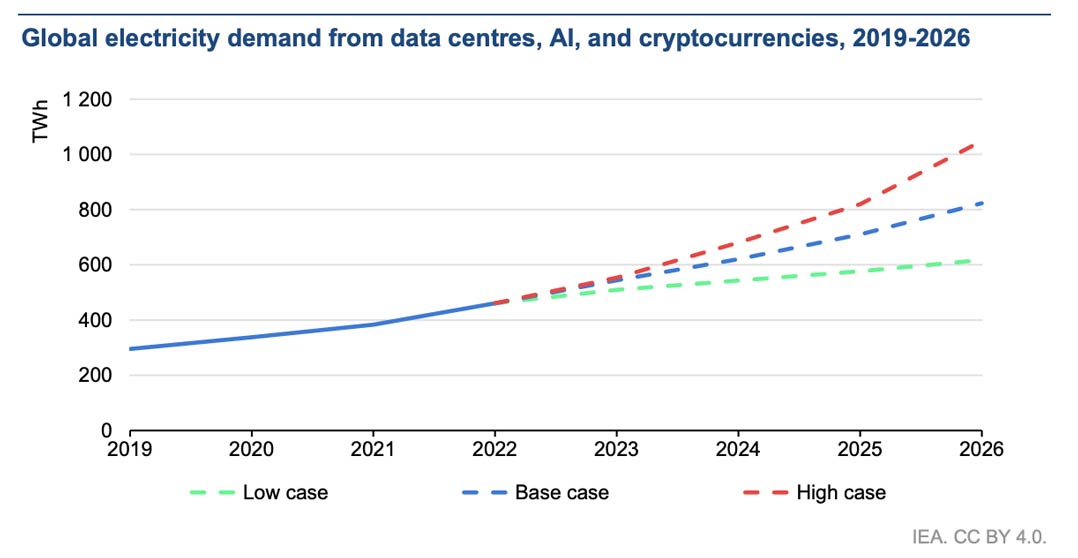
The world’s largest AI companies burned through 1.5 terawatt-hours of electricity in the first quarter of 2026—enough to power 1.3 million U.S. homes for a year—according to a new analysis by the International Energy Agency (IEA). The surge, driven by hyperscale data centers training generative AI models, now accounts for 3.5% of global data center energy use, up from 1.8% in 2024, as cloud providers race to meet demand for tools like Google’s Gemini Ultra and Microsoft’s Copilot Pro.
AI’s Explosive Energy Consumption in Early 2026 and the Factors Driving It
The IEA report, released June 14, attributes the spike to three factors: model size inflation, training frequency, and inefficient cooling. Meta’s Llama 3.5, launched in March, required 42% more compute power than its predecessor, while Nvidia’s H100 GPUs—now the backbone of most AI workloads—consume 1,000 watts each under full load. "The arms race for larger models is directly tied to energy consumption," said Dr. Elena Vasquez, a senior researcher at the Massachusetts Institute of Technology’s Climate and Computation Lab. "We’re seeing a feedback loop where performance gains require more power, which then demands more cooling, which in turn needs more power."
A separate study by the University of Cambridge, published June 10, found that training a single large language model emits between 100 and 500 metric tons of CO₂, equivalent to the lifetime emissions of 5–25 cars. The university’s data center energy model projects that by 2030, AI training could consume 10% of global electricity if current trends persist.
- Model scaling: Google’s Gemini Ultra uses 1.8 trillion parameters, up from 700 billion in its 2024 predecessor.
- Real-time inference: Services like Microsoft’s Copilot Pro now run 24/7, requiring persistent GPU clusters.
- Cooling demands: Data centers in Texas and Northern Virginia now use evaporative cooling towers to handle heat loads exceeding 100°C, a practice critics call "energy-intensive overkill."
How AI’s Energy Demand Is Locking Regions Into Fossil Fuel Dependence
The IEA warns that AI’s energy demand is outpacing renewable capacity additions. In Arizona, where Google and Amazon operate major data centers, peak electricity demand surged 18% year-over-year in May, forcing the state to rely on natural gas peaker plants—which emit 50% more CO₂ per kilowatt-hour than coal. "We’re seeing a paradox where AI is marketed as a green technology, but its infrastructure is locking in fossil fuel dependence," said Mark Reynolds, director of the Data Center Energy Coalition.
A June 15 report from the Union of Concerned Scientists found that 90% of AI data centers still rely on non-renewable power, despite public claims of sustainability. The group analyzed 12 major cloud providers and found that only Microsoft and Google had met their 2025 carbon-neutral pledges—partially through renewable energy certificates (RECs), which critics call "greenwashing." "RECs are like buying indulgences—they don’t actually reduce emissions," said Dr. Raj Patel, a climate policy expert at the University of California, Berkeley.
For more on this story, see Thames microplastic pollution hits 15,000 particles/kg in new study.
Industry Efforts to Reduce AI’s Energy Footprint and Their Limitations
- Nvidia’s NVLink 5.0, which reduces inter-GPU communication overhead by 30%.
- Google’s "Carbon-Aware Computing", which shifts workloads to times when renewable energy is abundant.
- Amazon’s "Trainium2" chips, designed to cut training energy use by 40% compared to CPUs.
Yet these gains are outpaced by demand. A June 12 earnings call transcript from Nvidia revealed that AI-related revenue grew 28% quarter-over-quarter, but energy costs for data center operators rose 15%. "The efficiency improvements are real, but they’re not enough to offset the sheer scale of what’s being built," said Sarah Chen, an analyst at Counterpoint Research.
- The European Union’s AI Act, set to take full effect in 2027, will require energy impact assessments for high-risk AI models.
- California’s SB-1047, signed into law in May, mandates that data centers disclose real-time energy consumption to grid operators.
- Texas’s Public Utility Commission is investigating whether data center operators should pay higher peak-hour rates to reflect grid strain.
The Future of AI and the Path to Carbon Neutrality—or Further Climate Harm
- Hardware innovation: Quantum-resistant encryption and neuromorphic chips (which mimic the brain’s efficiency) could cut power needs by 90%.
- Policy intervention: The U.S. and EU are debating carbon taxes on AI training, with proposals ranging from $50–$200 per ton of CO₂ emitted.
- Consumer pressure: A June 2026 survey by YouGov found that 62% of U.S. consumers would avoid AI services if they knew the environmental cost.
Google and Microsoft are investing in nuclear-powered data centers, while Amazon has partnered with Climeworks to capture CO₂ emissions directly from server exhaust. But experts warn that no single solution will suffice. "This isn’t just about switching to renewables—it’s about rethinking how we build AI itself," said Dr. Vasquez. "We need models that are smaller, smarter, and designed for efficiency from day one."
What’s next?
- Regulators will force transparency on AI energy use within 18 months.
- Hardware makers will push for "green AI" chips, but adoption will lag.
- Consumers may boycott high-emission services, pressuring companies to act.
One thing is certain: the cloud’s silence is over. The sound of AI’s energy hunger is here—and it’s getting louder.
Find more reporting in our Technology section.
