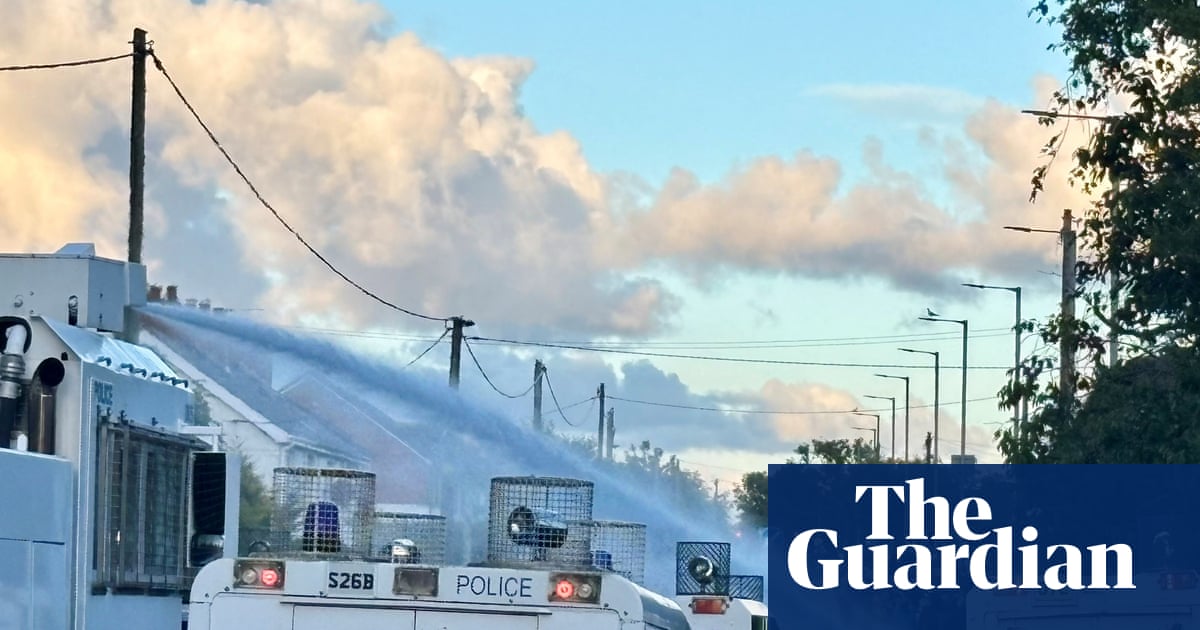
Police in Northern Ireland deployed water cannons against anti-immigration rioters on June 10, 2026, after two nights of violence sparked by a knife attack that left a man critically injured. The unrest, centered in Belfast, saw protesters burn vehicles, clash with police, and target properties believed to house migrants, according to The Guardian. The disturbances followed a pattern of escalating tensions in Northern Ireland, where immigration has become a politically charged issue amid broader debates over the UK’s post-Brexit borders and the Good Friday Agreement’s provisions on cross-community relations.
Violence Erupts After Knife Attack
The violence began following a stabbing on June 9, 2026, when Hadi Alodid, a 30-year-old Sudanese man who had claimed asylum in the UK, attacked Stephen Ogilvie, leaving him with severe injuries. Alodid was later charged with attempted murder and threatening to kill a second person, according to Newsday. Police confirmed in a statement that Alodid had no prior criminal record in the UK and had been granted temporary protection under the UK’s asylum system following his arrival in 2023. The family of Ogilvie condemned the riots, stating, “We have witnessed a lot of false information circulating on social media which is now forcing us to clarify that our loved one is in fact in a stable condition, and we are solely focused on his recovery at this time,” as reported by The Guardian.
Alodid, who appeared in court on June 10, 2026, refused legal representation and did not enter a plea, according to Newsday. Police have not disclosed a motive for the attack, though they ruled out terrorism in a statement from Assistant Chief Constable Jon Murphy, who emphasized that “this was not an act of terrorism but a serious criminal offense that will be dealt with through the criminal justice system.” The incident has fueled anti-immigrant rhetoric, with protesters in Belfast targeting properties linked to migrants, as detailed in The Guardian. The UK Home Office reported that Northern Ireland has seen a 40% increase in asylum seeker arrivals in the first half of 2026 compared to the same period in 2025, a figure cited by the Democratic Unionist Party (DUP) in a press release calling for stricter immigration controls.
In a separate development, the Northern Ireland Human Rights Commission issued a statement condemning the violence and urging authorities to address the root causes of rising tensions. The commission’s chief executive, Les Allamby, said in a press release, “The rule of law must be upheld, and we must reject any form of violence or discrimination. The current situation risks undermining the fragile peace process in Northern Ireland.” The statement also highlighted concerns about the spread of disinformation on social media platforms, which have been linked to previous outbreaks of violence in the region.
Protesters Target Migrants, Police Respond
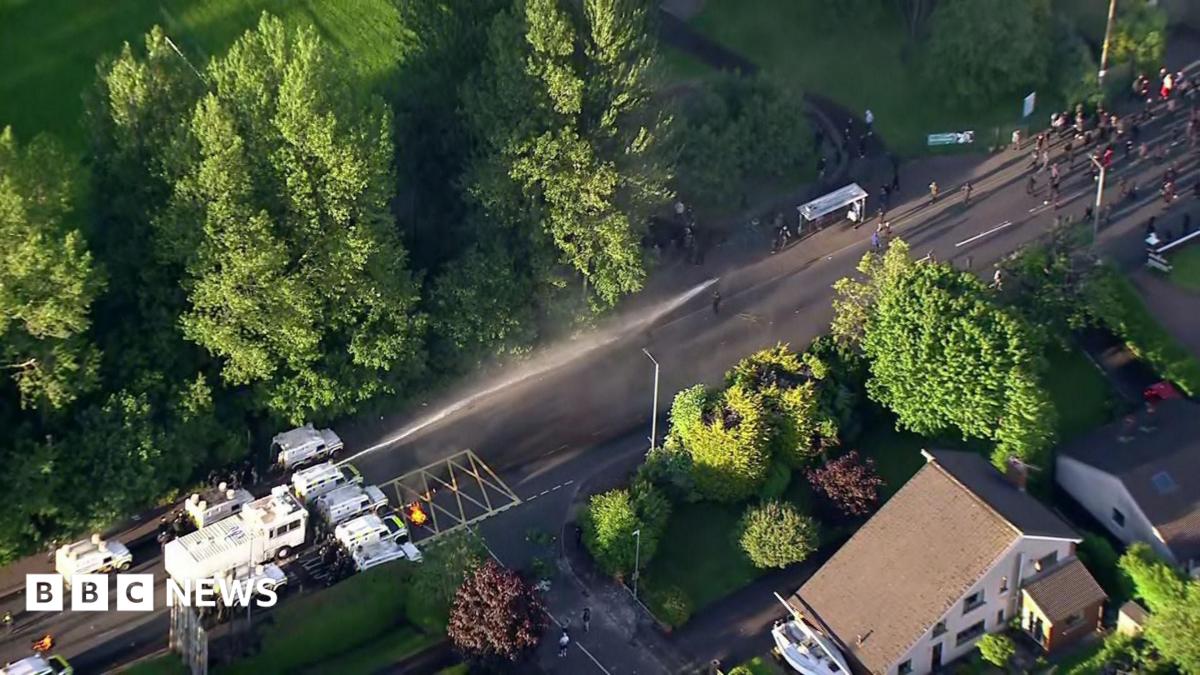
On June 10, 2026, rioters in Belfast’s Newtownabbey area burned a truck, threw bricks, and set fires using tires and furniture, according to The Guardian. A white van was driven into flames by a man who then fled, while police struggled to extinguish the fires. One onlooker and a police officer were injured, with the latter treated for a head wound. Police confirmed in a statement that the officer was part of the Public Order Unit and was responding to reports of arson at a property believed to house asylum seekers. “Attention, attention, disperse immediately or water cannon will be used, no further warnings will be given,” police announced, as reported by The Guardian.
Protesters, many wearing dark clothing and face coverings, aimed to target a hotel believed to house migrants. They tore up a garden fence to use as a barricade and erected a fire using debris. An older woman, undeterred by the water cannon, remained seated at a bus stop, stating, “She said she’s lived through the Troubles, she’s not going to move,” as recounted by The Guardian. A rioter shouted at onlookers to “Put your fucking phones away or you’re fucking next,” according to the same source. The BBC reported that the police response included the deployment of additional officers from the Police Service of Northern Ireland (PSNI) reserve units, bringing the total number of officers on duty to over 1,200 for the night.
The violence spread to Derry and Coleraine, though disturbances were less severe than on June 9, 2026, when mobs targeted ethnic minorities following the stabbing. Protests at Belfast City Hall and Stormont were largely peaceful, with the latter drawing several dozen attendees, as noted in The Guardian. The Sinn Féin party, which has been vocal in its support for asylum seekers, organized a counter-protest at Stormont, where party leader Michelle O’Neill addressed the crowd, emphasizing the need for unity and condemning the violence. Meanwhile, the DUP held a separate rally in Belfast, where party leader Jeffrey Donaldson reiterated calls for stricter immigration controls and a review of the UK’s asylum system.
For more on this story, see Belfast Stabbing: Asylum Seeker Charged as Protests Erupt Across the City.
In a statement, the PSNI confirmed that 15 people had been arrested in connection with the riots, including three on charges of public order offenses and twelve for arson. The force also reported that it had received multiple reports of hate crimes targeting migrants and ethnic minorities, with a total of 27 such incidents logged between June 9 and June 10. The PSNI’s chief constable, Simon Byrne, issued a warning in a press conference, stating, “We will not tolerate violence or discrimination. Those responsible for these actions will be brought to justice.”
Political Condemnation and Community Impact
Northern Ireland’s power-sharing government condemned the violence, with First Minister Michelle O’Neill calling it “thuggery” and urging calm. A joint statement from Stormont ministers emphasized that “no community benefits from these actions,” while acknowledging the public’s “strength of feeling” about the stabbing. The incident is now under legal proceedings, with justice to be served, according to The Guardian.
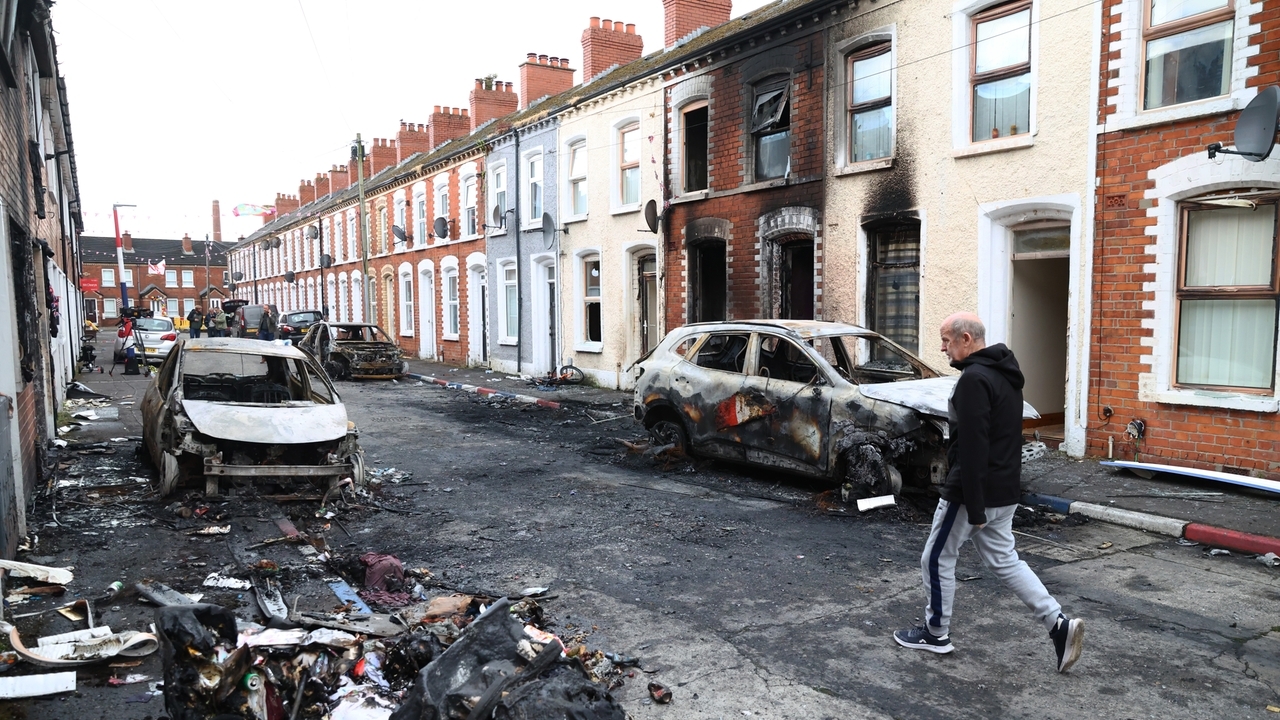
Residents expressed fear and confusion. Anselme Shima, a Belfast resident originally from Congo, described the violence as “horrific,” stating, “I’ve lived on my street for almost 10 years, I have a good relationship with my neighbors, but last night was a horrific one.” He added, “We don’t know what to do. I’m scared. Seeing this, I’m wondering if I’m next,” as reported by Newsday. Over 20 people were left homeless, and firefighters rescued several from burning homes, per Newsday. The Northern Ireland Fire and Rescue Service confirmed that it had responded to 47 separate incidents related to the riots, including 12 fires at residential properties.
Political figures, including UK Secretary of State for Northern Ireland Hilary Benn, called for calm, while Prime Minister Rishi Sunak denounced the violence as “unjustified.” In a statement, Sunak said, “The UK government is committed to upholding the law and protecting all communities. We will take all necessary steps to ensure that those responsible for these appalling acts are held accountable.” The BBC noted that the stabbing has echoes of previous riots, including those in 2024 after a teen killed three girls in Liverpool, which also featured Black or Asian suspects and white victims. In that case, the UK government established a public inquiry led by Lord Woolf to investigate the root causes of the violence and recommend measures to prevent future outbreaks.
In response to the current unrest, the UK Home Office announced an emergency meeting of the Cross-Government Asylum and Migration Taskforce, which includes representatives from the Home Office, the Northern Ireland Executive, and the PSNI. The taskforce is expected to review the UK’s asylum system and consider measures to address the rise in tensions. Meanwhile, the European Commission issued a statement expressing concern over the situation in Northern Ireland and calling for a “return to dialogue and respect for human rights.” The commission’s spokesperson, Peter Stano, said, “We urge all parties to exercise restraint and avoid actions that could further destabilize the peace process.”
The violence has also drawn international attention, with the United Nations High Commissioner for Refugees (UNHCR) issuing a statement condemning the attacks on migrants and asylum seekers. The UNHCR’s representative in the UK, Caroline Gluck, said, “We are deeply concerned by the violence and hate speech targeting refugees and migrants in Northern Ireland. Everyone has the right to live in safety and dignity, regardless of their background.” The statement also called for an independent investigation into the riots and the underlying causes of anti-migrant sentiment.
As the situation unfolds, local community leaders and faith groups have stepped in to provide support for affected families. The Belfast Intercommunity Peace Project, a long-standing organization that works to promote reconciliation in Northern Ireland, issued a statement urging residents to reject violence and stand together. The project’s director, Gerry McKiernan, said, “We have seen too much division in recent years. Now is the time for unity and solidarity. We must not allow fear to drive us apart.” Meanwhile, local churches have opened their doors to displaced families, offering temporary shelter and food supplies.
Find more reporting in our World section.
