
China’s robotics industry is racing ahead with humanoid machines capable of backflips, coffee-making, and even security patrols, yet the hard truth remains: demand for these $26,600 to $99,000 units is struggling to match production capacity. With over 140 manufacturers and 330 models flooding the market in 2025, experts warn of a bubble as companies like Matrix Robotics and EngineAI scale up—only to find buyers hesitant to adopt robots that still struggle in real-world chaos. The stakes? A $5 trillion global market dominated by China’s manufacturing muscle and the U.S.’s AI edge, but with adoption lagging behind the hype.
China’s manufacturing edge: why the U.S. can’t compete (yet)
China’s advantage isn’t just in numbers. While the U.S. leads in AI-driven “robot brains,” China dominates the hardware supply chain—built on decades of EV manufacturing expertise—and can churn out units at speeds Western rivals can’t match. Unitree Robotics, for instance, shipped 36 times more humanoids last year than U.S. competitors Figure and Tesla combined, according to TechCrunch. The result? Chinese robots aren’t just cheaper—they’re faster to iterate, thanks to a manufacturing ecosystem that treats humanoids like another assembly-line product.
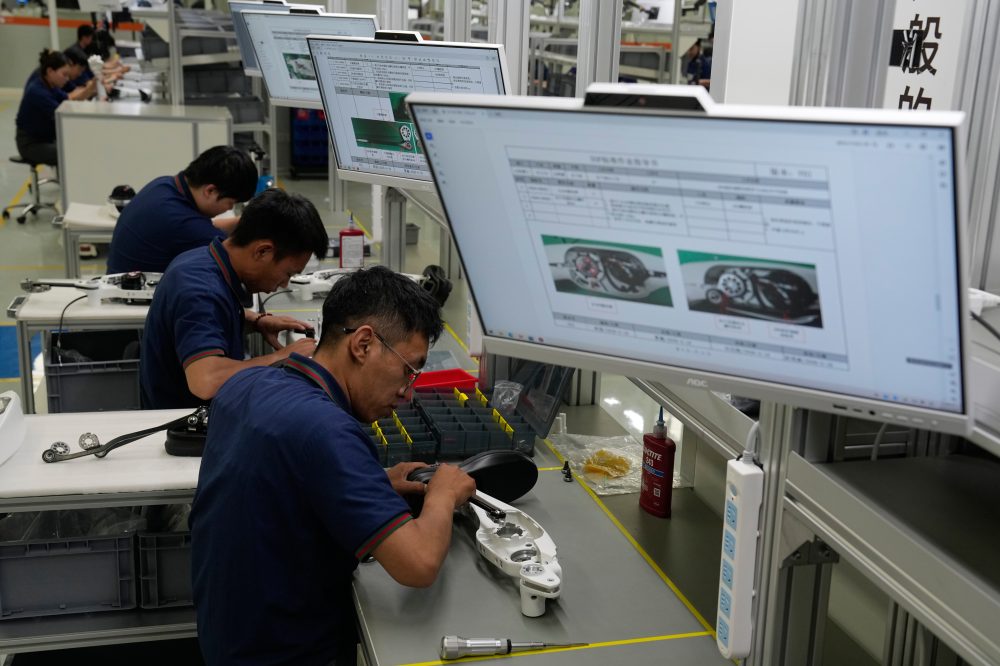
Yet the gap isn’t just technological. Policy plays a role: Beijing’s “Made in China 2025” plan, originally focused on factory automation, now extends to humanoids as a solution to labor shortages and an aging population. “The most durable adoption comes when you can show reliable and repeatable value in production or service operations,” says Yuli Zhao, chief strategy officer at Galbot, whose robots performed at this year’s Spring Festival Gala. The message is clear: showcases matter, but real-world reliability matters more.
The $99,000 question: who’s buying these robots?
Matrix Robotics’ $99,000 MATRIX-3 humanoid—towering at 5.6 feet with hands precise enough to make coffee—has secured 1,000 orders from coffee chains and hotels, its CEO Allan Zhang revealed at a Macao expo. But here’s the catch: the company has only produced a few hundred units so far, with plans to hit 5,000 this year. EngineAI’s $26,600 basic model, meanwhile, targets security guards and museum guides—yet even its founder, Issac Li, admits the next phase is moving “into more real-life scenarios.”

“The next step will be to move into more real-life scenarios.”
The problem? Most humanoids today are performative, not functional. Samm Sacks of the New America think tank puts it bluntly: “The use cases of these robots are still so limited.” Chibo Tang of Gobi Partners agrees, calling the industry’s scale a mismatch with demand. “Without the demand and without that scale from the market, these companies are not able to really go into mass production,” he warns. The Chinese government’s own 2025 data backs this up: over 140 manufacturers and 330 models—yet the market remains a demo-driven spectacle rather than a productivity revolution.
The bubble warning: China’s robotics boom may be ahead of itself
Last year, China’s Ministry of Industry and Information Technology issued a rare public warning: the humanoid robot industry risks a bubble. The reason? Commercialization lags behind capacity. While startups like Matrix and EngineAI tout orders, the reality is that most deployments are pilots or research projects—not scalable operations. Corporate labs and universities are the primary buyers, but that’s not a sustainable market.
Consider the numbers: global humanoid shipments totaled just 13,317 units in 2025, per a Forbes report. That’s a tiny fraction of the 2.6 million units projected by 2035—a growth rate that assumes demand catches up. The question is whether China’s robot makers can pivot from showcasing to solving before overproduction becomes a liability. “The hardest part isn’t building them,” says Selina Xu of Eric Schmidt’s AI policy team. “It’s proving they’re worth the cost.”
Who stands to win—and who’s left behind?
If China’s humanoid push succeeds, the winners are clear: manufacturers gaining efficiency, service industries cutting labor costs, and tech investors betting on the $5 trillion market. But the losers? Companies that overproduce without demand, workers displaced by robots before they’re truly reliable, and Western rivals struggling to compete on both AI and hardware. The U.S. holds the AI edge, but China’s manufacturing dominance means it can iterate faster—and at lower cost.
For now, the industry remains in a limbo between hype and reality. Matrix’s 5,000-unit target this year is ambitious, but without clearer use cases, even that could be a gamble. As Chibo Tang notes, “scale without demand is a recipe for excess capacity.” The real test? Whether China’s robots can move from backflips and coffee-making to stable, repeatable operations—or if the bubble bursts before they do.
What’s next: three scenarios for China’s robot future
- Scenario 1: The productivity breakthrough — Humanoids prove their worth in logistics, healthcare, or manufacturing, triggering a demand surge. China’s supply chain adapts, and the market scales.
- Scenario 2: The bubble pops — Overproduction outpaces demand, leading to write-offs and industry consolidation. Survivors focus on niche applications where robots are truly indispensable.
- Scenario 3: The U.S. catches up — American AI advances close the gap, forcing China to either innovate faster or accept a secondary role in the global market.
The next 12 months will tell which path China’s humanoid industry takes. One thing is certain: without a clear path to real-world reliability, even the most advanced robots risk becoming little more than expensive novelty acts.
For now, the message from experts is unambiguous: China can build humanoids at scale. The hard part is finding enough buyers who actually need them.
