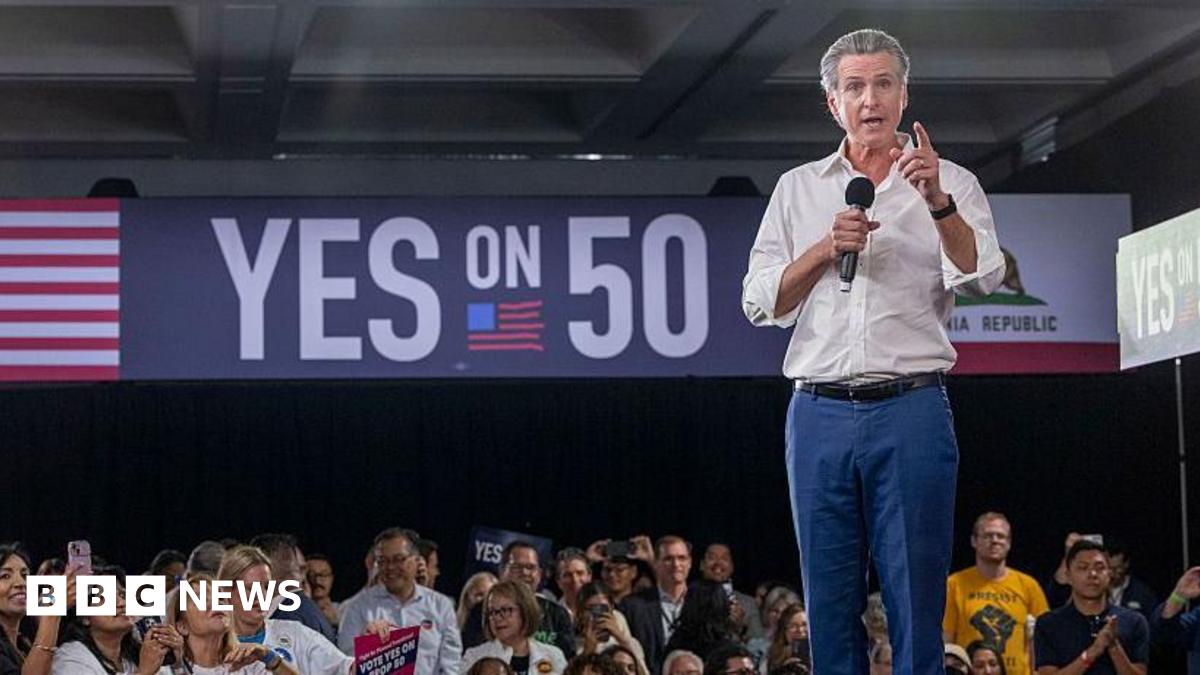
WASHINGTON — The U.S. Department of Justice on Nov. 13 filed a federal lawsuit asking a judge to block California’s newly approved congressional map, arguing the state’s temporary redistricting plan enacted by Proposition 50 was drawn with race as the dominant factor and therefore violates the Equal Protection Clause of the 14th Amendment. The suit — filed in the U.S. District Court for the Central District of California and seeking to intervene in Tangipa et al. v. Newsom et al. — names Governor Gavin Newsom and Secretary of State Shirley Weber as defendants and asks the court to bar the map’s use in the 2026 elections and beyond. ([justice.gov](https://www.justice.gov/opa/pr/justice-department-sues-governor-gavin-newsom-californias-race-based-redistricting-plan?utm_source=openai))
What the Justice Department says
The Justice Department’s public statement says its complaint rests on “substantial evidence” in the legislative record and public statements showing Latino demographics and racial considerations predominated when the legislature adopted the new map after voters approved Proposition 50. The department’s Civil Rights Division argues that when race is the predominant motive and traditional, race‑neutral districting principles are subordinated, the resulting districts are subject to strict constitutional scrutiny and cannot stand. Principal Deputy Assistant Attorney General Jesus A. Osete, who the department named to represent it in the case after Assistant Attorney General Harmeet K. Dhillon recused, said in the DOJ release that “race cannot be used as a proxy to advance political interests.” ([justice.gov](https://www.justice.gov/opa/pr/justice-department-sues-governor-gavin-newsom-californias-race-based-redistricting-plan?utm_source=openai))
Background on Proposition 50 and the map
Proposition 50, approved by California voters in a special election on Nov. 4, 2025, temporarily transfers authority to adopt congressional district lines from the state’s independent Citizens Redistricting Commission to the state legislature for the 2026, 2028 and 2030 elections, after which the commission would resume its decennial role. Backers framed the measure as a response to mid‑decade redrawing by Republican legislatures elsewhere, notably Texas, and supporters argued it would protect California’s representation. Official voter guidance published by the California Secretary of State described the measure as a temporary change that would take effect immediately if approved. News organizations reported the proposition won by roughly two‑thirds of votes. ([voterguide.sos.ca.gov](https://voterguide.sos.ca.gov/proposition/50/title-summary.htm?utm_source=openai))
The map that the legislature adopted and that voters approved was drafted with input from Democratic members of Congress and redistricting consultants; reporting by major outlets says the plan was produced with the involvement of Democratic redistricting expert Paul Mitchell and carried to the ballot by legislative action. Advocates said the new lines would make up to five Republican‑held seats competitive for Democrats in the 2026 midterms; opponents described the lines as a partisan gerrymander. Those factual disputes are at the heart of the federal challenge. ([washingtonpost.com](https://www.washingtonpost.com/politics/2025/11/04/newsom-redistricting-california-prop-50-trump/?utm_source=openai))
Legal framework and stakes
Federal law draws a distinction between partisan and racial gerrymanders. The Supreme Court has held that claims solely about partisan advantage fall largely outside the reach of federal courts, leaving many such disputes to state courts and legislatures; that principle was articulated in Rucho v. Common Cause. By contrast, the Court has long held racial gerrymanders are justiciable: if race is the predominant factor in drawing lines and traditional districting principles are subordinated, courts apply strict scrutiny. The Justice Department’s complaint advances the latter theory — that the map’s designers used race as a proxy to achieve partisan ends — which would make the map constitutionally infirm if the court agrees. ([law.cornell.edu](https://www.law.cornell.edu/constitution-conan/article-3/section-2/clause-1/overview-of-political-question-doctrine?utm_source=openai))
That legal distinction means the outcome could hinge less on whether maps benefit one party and more on whether the record shows race, rather than ordinary geographic or political considerations, was the dispositive criterion. Past Supreme Court decisions such as Shaw v. Reno and subsequent cases set the test the DOJ cites: a court must examine whether race, not neutral districting principles, predominated in the drawing of lines. ([law.cornell.edu](https://www.law.cornell.edu/constitution-conan/article-3/section-2/clause-1/overview-of-political-question-doctrine?utm_source=openai))
Reactions from the parties and political context
The Justice Department’s filing escalates a partisan national fight over redistricting that intensified after Republican legislatures began mid‑decade redraws in several states. Attorney General Pamela Bondi, representing the Trump administration in its enforcement role, called the plan “a brazen power grab that tramples on civil rights,” and in a separate post criticized Governor Newsom for what she described as an attempt “to entrench one‑party rule.” Governor Newsom and California officials have defended Proposition 50 as a lawful, temporary response to Republican mapmaking elsewhere and said the measure reflects voter approval. ([justice.gov](https://www.justice.gov/opa/pr/justice-department-sues-governor-gavin-newsom-californias-race-based-redistricting-plan?utm_source=openai))
Legal observers say the case could be fast‑moving because California will begin election preparations for 2026 and because plaintiffs seek to block the map before ballots are printed and signatures are gathered. The DOJ has moved to intervene in a suit filed by the California Republican Party and other plaintiffs; that litigation, and any appeal, could move quickly through lower courts given the electoral calendar. ([justice.gov](https://www.justice.gov/opa/pr/justice-department-sues-governor-gavin-newsom-californias-race-based-redistricting-plan?utm_source=openai))
Why this matters beyond California
Beyond the immediate impact on which party may hold House seats from California in 2026, the litigation tests the line between permissible consideration of race to comply with the Voting Rights Act and impermissible race‑first mapmaking. If a federal judge enjoins the Prop 50 map on Fourteenth Amendment grounds, it would mark a rare instance of the Justice Department asking a federal court to block a state‑approved map on a racial‑gerrymandering theory tied to a ballot measure. The case also underscores the limits of federal oversight: courts cannot police partisan intent alone, but a showing that race predominated can trigger judicial remedy. ([justice.gov](https://www.justice.gov/opa/pr/justice-department-sues-governor-gavin-newsom-californias-race-based-redistricting-plan?utm_source=openai))
This article builds on the Department of Justice’s press release and reporting by major outlets including Reuters and the BBC; readers who want a focused primer on the ballot measure can consult our explainer on Prop 50. ([justice.gov](https://www.justice.gov/opa/pr/justice-department-sues-governor-gavin-newsom-californias-race-based-redistricting-plan?utm_source=openai))
