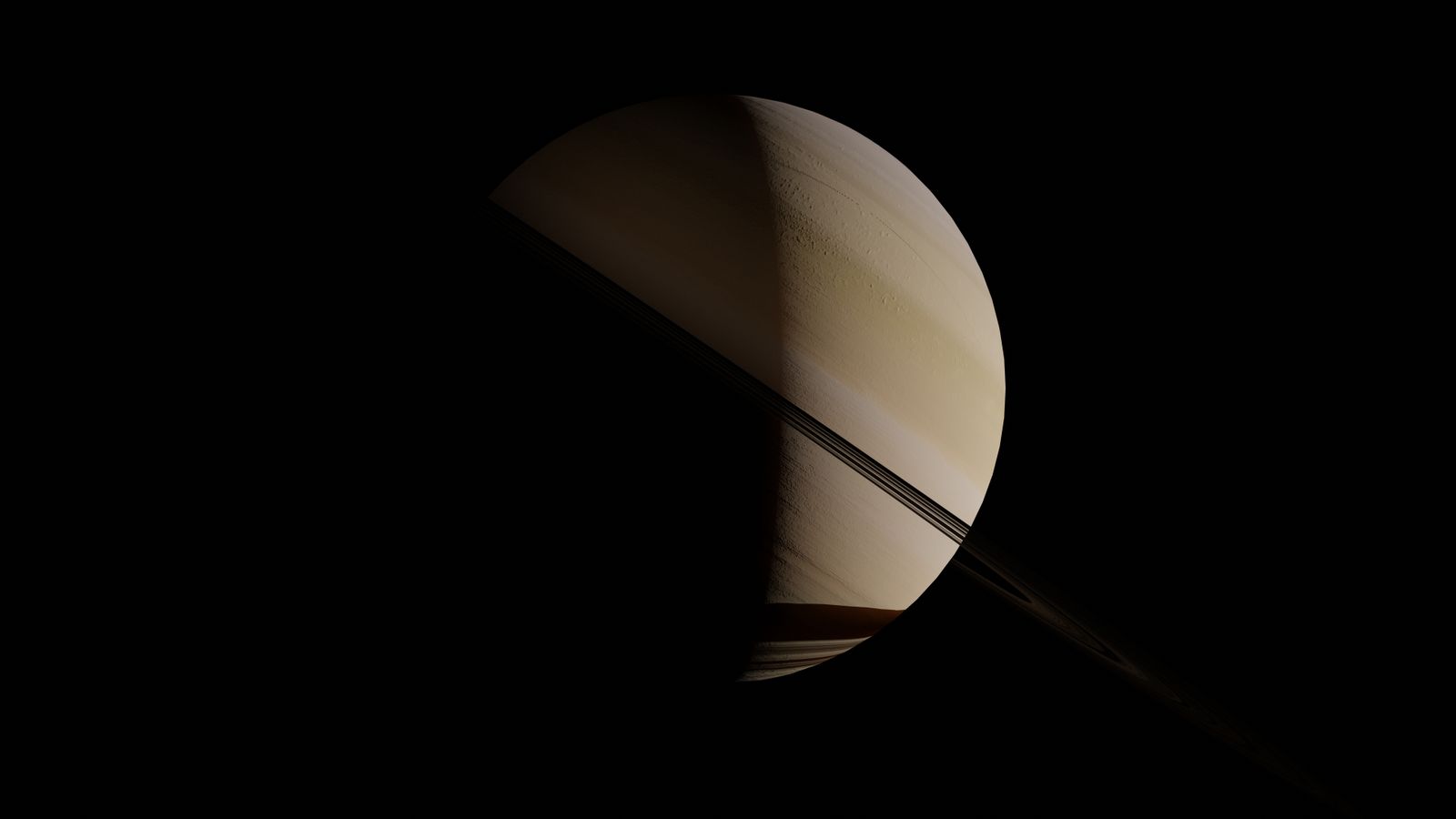
Only one human-made object has ever touched down on the outer solar system—and it did so in a place so alien it feels like another world.
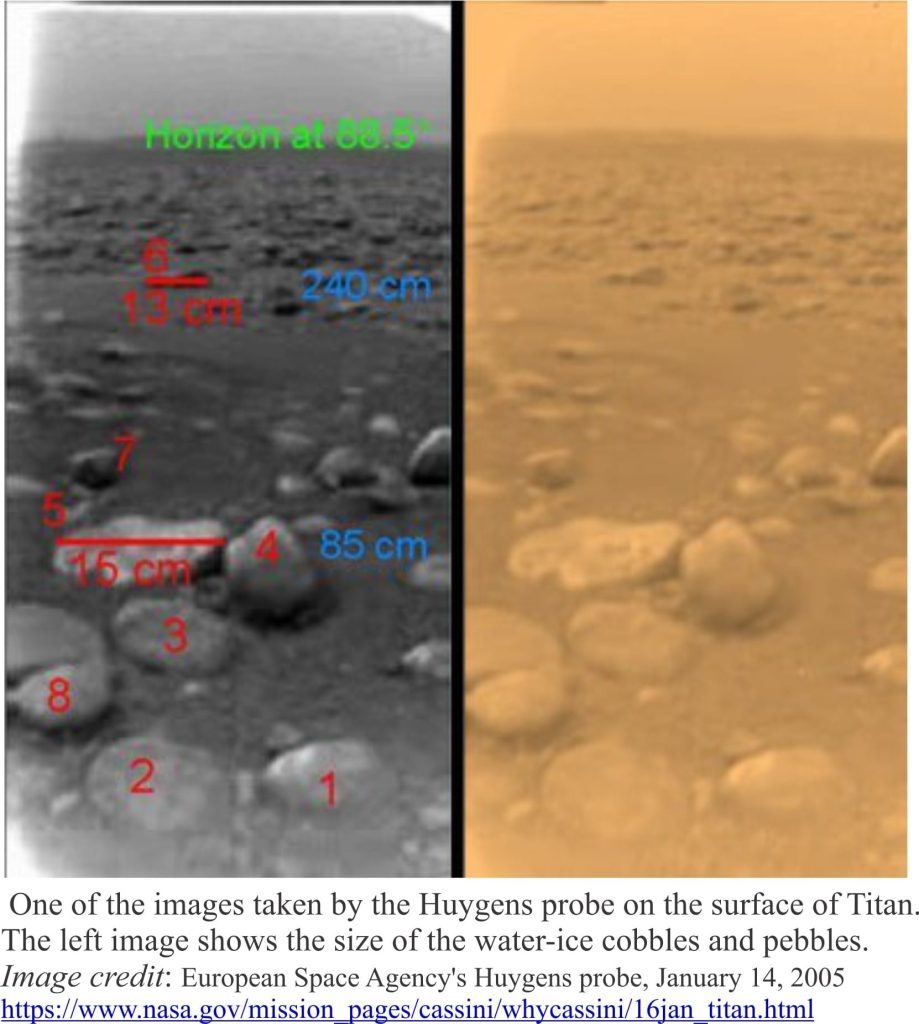
The European Space Agency’s Huygens probe landed on Saturn’s moon Titan in January 2005, more than a billion kilometers from Earth, in temperatures colder than minus 170 degrees Celsius. For two and a half hours, it descended through an orange haze of methane and nitrogen, capturing images of a landscape eerily familiar yet utterly foreign: channels carved by flowing liquid, pebbles of water ice smoothed by erosion, and a surface damp with hydrocarbons. The mission confirmed what scientists had only theorized—Titan is a dynamic world with weather, erosion, and a cycle of liquids moving between sky and ground, just like Earth, but with methane instead of water. Two decades later, Huygens remains the sole spacecraft to have landed in the outer solar system, a record that still stands.
Why Titan? The Moon That Defied Expectations
Titan was never supposed to be this interesting. Before Huygens, scientists knew it had a thick atmosphere—unusual for a moon—but little else. The haze obscured its surface, leaving them to guess whether it was a frozen wasteland or a world with active processes. The probe’s descent changed everything. As it drifted through the haze, its cameras revealed branching channels that looked like riverbeds, draining toward what appeared to be a shoreline. The images were a revelation: Titan wasn’t just a cold, dead rock. It was a world where liquid—methane—flowed, pooled, and carved the landscape, just as water does on Earth.
According to SpaceDaily, the probe’s heat shield slowed it from thousands of kilometers per hour to a manageable descent speed, allowing it to deploy parachutes and drift downward for 147 minutes. The surface it landed on was soft, slightly moist, and scattered with pebbles of water ice—hard as rock at Titan’s temperatures but shaped by what appeared to be liquid erosion. The instruments detected a whiff of methane released by the probe’s warmth, confirming that the moon’s chemistry was far more active than anticipated.
The European Space Agency (ESA) later detailed how Huygens’ instruments had detected complex organic compounds—the building blocks of amino acids—in both gas and solid phases, raising intriguing questions about the moon’s potential for prebiotic chemistry. Yet, despite these discoveries, Titan remained a mystery in many ways. The probe’s limited battery life meant it could only transmit data for about 72 minutes after landing, and once Cassini, its orbital relay, moved out of range, the connection was lost. Still, in that brief window, Huygens sent back enough to rewrite the textbooks on Titan—and to leave scientists hungry for more.
The Mission That Almost Didn’t Happen: A Seven-Year Journey to Titan
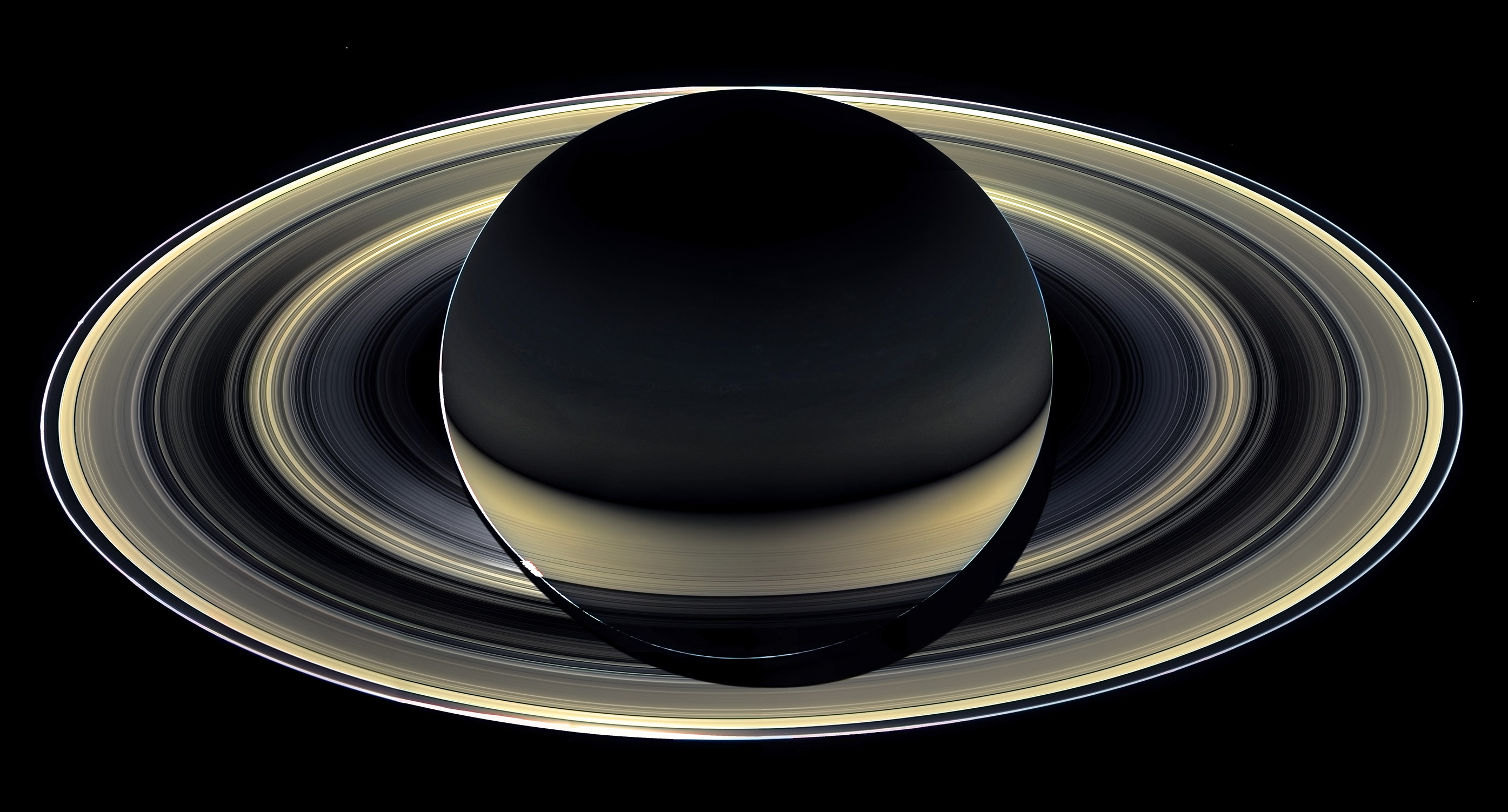
Huygens wasn’t just a standalone probe—it was the lander half of a far more ambitious mission. Launched in 1997 as part of the Cassini-Huygens collaboration between NASA, ESA, and the Italian Space Agency, the probe hitched a ride on Cassini, an orbiter designed to study Saturn and its moons. The journey itself was a marathon: seven years of travel before Cassini slipped into orbit around Saturn in 2004. On December 25, 2004, Cassini released Huygens, setting it on a three-week coast toward Titan. For most of that time, the probe was silent, drifting unpowered through space until it met Titan’s atmosphere on January 14, 2005.
The timing was critical. If Huygens had arrived too early or too late, it might have missed Titan entirely or burned up in the atmosphere. But the mission team had planned meticulously. As ESA’s mission recap notes, the probe was designed to gather data during its descent, with only a slim chance of surviving the landing. Yet survive it did—transmitting for 72 minutes after touchdown, far longer than expected, before Cassini’s orbit took it out of range.
The mission’s success hinged on a series of firsts. Huygens was the first probe to land on a body in the outer solar system, the farthest from Earth any spacecraft had ever touched down, and the only one to return data from such an extreme environment. The risks were high: the probe had to survive a descent through an unknown atmosphere, withstand temperatures near absolute zero, and function in an environment where even the air was thicker than Earth’s at sea level. That it worked at all was a triumph of engineering—and a testament to the boldness of the scientists who dared to send it.
A Cold Mirror of Earth: What Huygens Revealed About Titan’s Strange Chemistry
Titan’s surface is a paradox. It’s colder than any place humans have ever explored—temperatures hover around minus 180 degrees Celsius—but it’s also a world where chemistry is alive. Huygens’ instruments detected a surface consistency akin to wet sand, composed mostly of dirty water-ice pebbles. The probe’s accelerometer measured how quickly it stopped moving upon impact, revealing a soft, yielding terrain. Meanwhile, sensors picked up traces of carbon dioxide and other gases not found higher in the atmosphere, suggesting complex chemical interactions at the surface.
The atmosphere itself was a surprise. Scientists had expected Titan’s skies to be hazy, but Huygens found them even more opaque than models predicted, thanks to aerosols and dust particles. The winds, measured by tracking how molecules moved, revealed a global circulation pattern—like a giant conveyor belt moving gases from north to south and back again. Yet, despite the dynamic weather, the probe detected only light winds at the surface, a stark contrast to the turbulent skies above.
One of the most intriguing findings was the absence of noble gases like xenon and krypton, which had been expected based on earlier observations. Instead, Huygens detected complex organic compounds—the same molecules that, on Earth, are the precursors to life. While this doesn’t mean Titan is habitable (or even that life exists there), it does suggest that the moon’s chemistry is capable of producing the building blocks necessary for life as we know it. As ESA’s mission summary puts it, Titan is a “cold mirror of Earth,” where the same processes of erosion, weather, and chemical cycling occur—but with methane instead of water.
The Legacy of Huygens: Why Titan Still Matters in 2026
Two decades after Huygens’ landing, Titan remains one of the most compelling destinations in the solar system. The data it returned reshaped our understanding of moons, atmospheres, and even the potential for life beyond Earth. Yet, despite its success, Huygens was a one-off. No other spacecraft has landed on Titan since, though missions like NASA’s Dragonfly—a drone set to launch in 2028—aim to return in the coming years. Dragonfly will explore Titan’s surface in more detail, searching for signs of prebiotic chemistry and perhaps even life.
The question now is whether Huygens’ record will stand. With advancements in propulsion and robotics, future missions could attempt landings on other moons—Europa, Enceladus, or even Pluto. But for now, Huygens remains the sole representative of humanity’s reach into the outer solar system. Its legacy isn’t just in the data it sent back, but in the questions it left unanswered—and the promise that, one day, we may return.
As SpaceDaily noted, Huygens’ landing was a fleeting moment in a vast, cold world. Yet in that moment, it gave us a glimpse of a place where the laws of chemistry and physics play out in ways we’re only beginning to understand. Titan isn’t just a moon. It’s a laboratory for studying the origins of life—and a reminder that even in the most extreme environments, the universe has surprises in store.
What Happens Next? The Future of Titan Exploration
The story of Huygens isn’t over. Its data continues to be analyzed, and its discoveries have shaped the next generation of missions. NASA’s Dragonfly, set to arrive at Titan in the mid-2030s, will build on Huygens’ findings by exploring the moon’s surface in greater detail. Meanwhile, ESA and NASA are already planning future collaborations, including potential sample-return missions that could bring Titan’s organic materials back to Earth for study.
The bigger question is whether we’ll ever send another lander to Titan—or to other moons in the outer solar system. The technology exists, but the challenges are immense. Huygens proved it could be done, but its brief transmission window shows how much further we have to go. If future missions succeed, they’ll owe a debt to the little probe that dared to land where no other had gone before.
For now, Huygens remains a symbol of human curiosity—a single point of contact in a vast, unexplored frontier. And in a solar system where so much is still unknown, that’s a legacy worth remembering.
Find more reporting in our Technology section.
